
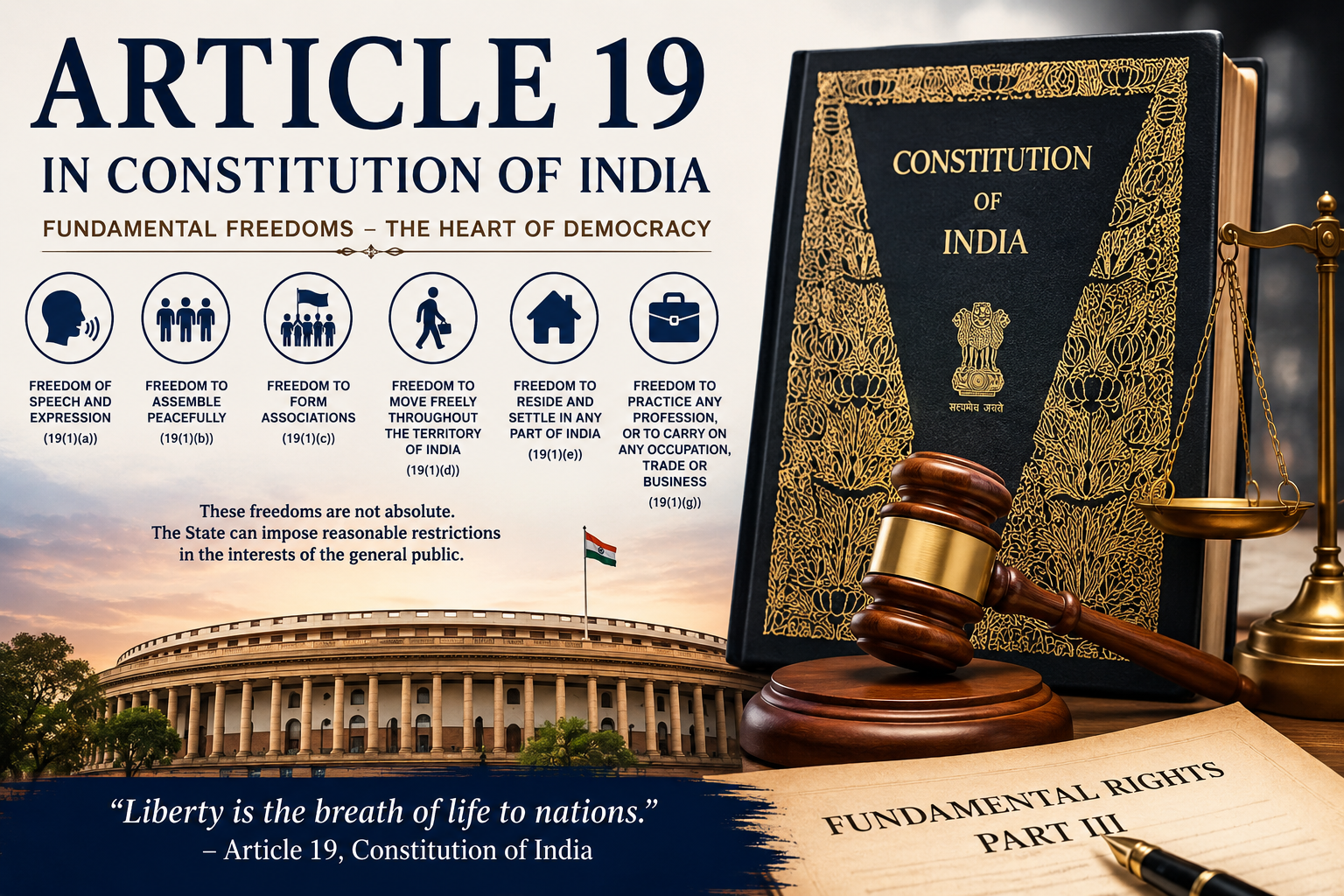
The Article 19 in Constitution of India is one of the most powerful parts of Indian democracy. It gives citizens the freedom to speak, assemble, move, associate, settle and work with dignity. These freedoms are not only legal rights written in a book; they shape daily public life. When a journalist questions the government, when a student joins a debate, when workers form a union, when a person moves to another city for work, Article 19 quietly protects that choice.
Many people think Article 19 is only about freedom of speech. That is a big part of it, but the article is much wider. It protects six major freedoms and also explains when the State can impose reasonable restrictions. This balance is important because democracy needs liberty, but society also needs public order, security, morality and protection against misuse.
This article explains the meaning, scope, restrictions and landmark cases related to Article 19 in simple language. It is written for students, citizens, legal researchers and readers of courtkutchehry who want to understand constitutional law without heavy legal jargon.
What Is Article 19 in Constitution of India?
Article 19 is part of the Fundamental Rights chapter under Part III of the Constitution of India. It is available only to citizens of India. The article protects basic civil freedoms that allow people to participate in democracy, express ideas, choose a livelihood and live with independence.
The structure of Article 19 is simple but meaningful. Article 19(1) lists the freedoms. Articles 19(2) to 19(6) list the grounds on which the State can restrict those freedoms. This means the government cannot limit a citizen's liberty according to convenience. Any restriction must be backed by law, must fit within the constitutional grounds and must be reasonable.
The Six Freedoms Under Article 19
At present, Article 19 protects six freedoms. Earlier, the right to property was also included, but it was later removed from Article 19 and is now protected separately as a constitutional legal right under Article 300A.
1. Freedom of Speech and Expression
Article 19(1)(a) gives citizens the right to freedom of speech and expression. This includes speaking, writing, publishing, artistic expression, political criticism, media reporting and digital communication. It also includes the right to receive information because a person cannot express a meaningful opinion without access to facts.
Freedom of speech is the foundation of public debate. It allows citizens to question public policy, discuss social issues and criticize authority. However, it is not absolute. Article 19(2) permits reasonable restrictions in the interests of sovereignty and integrity of India, security of the State, friendly relations with foreign States, public order, decency, morality, contempt of court, defamation and incitement to an offence.
2. Freedom to Assemble Peaceably and Without Arms
Article 19(1)(b) allows citizens to assemble peacefully and without arms. This right supports public meetings, peaceful protests, processions and campaigns. In a democracy, people must have space to gather and express collective concerns.
The State can regulate this right in the interests of public order and the sovereignty and integrity of India. For example, authorities may regulate traffic routes, timings and security arrangements. But regulation should not become a total denial of peaceful democratic participation.
3. Freedom to Form Associations, Unions or Co-operative Societies
Article 19(1)(c) protects the right to form associations, unions and co-operative societies. This freedom supports political parties, trade unions, professional bodies, student groups, resident welfare associations and civil society organisations.
This right helps citizens work together for common goals. Restrictions may be imposed on grounds such as public order, morality and sovereignty and integrity of India. An association formed for unlawful or violent purposes cannot claim protection under Article 19.
4. Freedom to Move Freely Throughout India
Article 19(1)(d) gives citizens the right to move freely throughout the territory of India. It supports travel for education, employment, healthcare, family needs, business and personal reasons. The idea is that India is one constitutional territory where citizens should not be treated as outsiders merely because they belong to another State.
Reasonable restrictions may be imposed in the interests of the general public or for the protection of Scheduled Tribes. This allows the law to protect sensitive areas and vulnerable communities while still respecting national mobility.
5. Freedom to Reside and Settle in Any Part of India
Article 19(1)(e) gives citizens the right to reside and settle in any part of India. This is important for people who move for jobs, education, business, marriage or better living conditions. It supports national integration and personal choice.
Like the freedom of movement, this right can be reasonably restricted in the interests of the general public or for protecting Scheduled Tribes. The restriction must still be fair, lawful and connected with the purpose mentioned in the Constitution.
6. Freedom to Practise Any Profession, Occupation, Trade or Business
Article 19(1)(g) protects the right to practise any profession or carry on any occupation, trade or business. This freedom is closely linked with livelihood and economic dignity. A citizen can choose a lawful career, start a business or practise a profession.
The State may impose reasonable restrictions in the interests of the general public. It can also prescribe professional or technical qualifications. For example, doctors, lawyers, architects and other professionals must meet legal qualification standards. This does not destroy the right; it regulates the right for public welfare.
Meaning of Reasonable Restrictions
The phrase reasonable restrictions is the key to understanding the Article 19 in Constitution of India. A restriction is not valid merely because the government says it is needed. It must be reasonable, proportionate and connected with the constitutional ground.
Courts look at the purpose of the law, the nature of the freedom, the extent of control and whether the restriction goes beyond what is necessary. A law that is vague, excessive or arbitrary may fail constitutional scrutiny. This is why Article 19 keeps both citizens and the State within limits.
Landmark Judgments on Article 19
Romesh Thappar v. State of Madras
This early Supreme Court case gave strong support to freedom of speech and press. The Court observed that free political discussion is essential for democracy. The case helped establish that press freedom forms part of Article 19(1)(a).
Brij Bhushan v. State of Delhi
This case dealt with pre-censorship and showed that prior restraint on publication is a serious interference with free expression. It became important in understanding how the State must be careful while controlling publication.
Bennett Coleman and Co. v. Union of India
In this case, the Supreme Court considered restrictions affecting newspapers. The Court recognised that freedom of press includes both content and circulation. A newspaper is not truly free if it can publish but cannot effectively reach readers.
State of U.P. v. Raj Narain
This judgment recognised the people's right to know about public acts of public officials. The right to information is connected with freedom of speech because citizens need information before they can form and express opinions.
Bijoe Emmanuel v. State of Kerala
The Supreme Court protected students who respectfully stood during the national anthem but did not sing it due to sincere belief. The case is important because it shows that freedom of expression also includes the freedom not to speak.
Shreya Singhal v. Union of India
This digital-era case struck down Section 66A of the Information Technology Act for being vague and overbroad. The judgment is important for online speech because unclear laws can create fear and silence genuine expression.
Article 19 in the Digital Age
Article 19 now applies strongly to digital life. Social media posts, online journalism, legal blogs, videos, comments and digital campaigns are all modern forms of expression. Citizens now use the internet to debate law, politics, business and public policy.
At the same time, online spaces create challenges such as fake news, hate speech, trolling, privacy violations and unlawful incitement. The constitutional task is to protect genuine speech while allowing lawful action against harmful content. Any digital restriction must be clear, necessary and proportionate.
Legal platforms like courtkutchehry can help readers understand judgments, rights and restrictions in a practical way. Legal awareness should not remain limited to lawyers. When citizens know their rights, they use freedom more responsibly.
Why Article 19 Matters for Citizens
Article 19 affects ordinary life more than many people realise. It protects the right to question public decisions, join peaceful protests, form groups, travel across India, settle in another State and pursue a lawful profession. These are not abstract rights. They are connected with daily dignity.
The article also protects unpopular opinions, as long as they remain within constitutional limits. A democracy does not need protection only for comfortable speech. It also needs protection for disagreement and criticism. At the same time, speech should not become defamation, protest should not become violence and business freedom should not ignore public welfare.
SEO Summary: Key Takeaways
The Article 19 in Constitution of India protects six important freedoms: speech and expression, peaceful assembly, association, movement, residence and profession. These rights are available to citizens and are subject to reasonable restrictions.
Landmark cases have expanded the meaning of Article 19 over time. Courts have linked it with press freedom, right to know, right to silence, digital speech and professional dignity. For anyone studying Indian constitutional law, Article 19 is one of the most practical and active provisions.
FAQ on Article 19 in Constitution of India
What is Article 19 in Constitution of India?
Article 19 is a fundamental rights provision that protects important freedoms of Indian citizens, including speech, assembly, association, movement, residence and profession.
Is freedom of speech absolute in India?
No. Freedom of speech under Article 19(1)(a) is subject to reasonable restrictions under Article 19(2), including public order, security, defamation, contempt of court, decency, morality and incitement to an offence.
Who can claim rights under Article 19?
Article 19 rights are available only to citizens of India.
How many freedoms are protected under Article 19?
Article 19 currently protects six freedoms: speech, peaceful assembly, association, movement, residence and profession or business.
Why is Article 19 important for digital speech?
Article 19 protects modern forms of expression, including online media and social platforms. Courts use Article 19 principles to test whether digital speech restrictions are lawful and reasonable.
Internal Linking Suggestions for CourtKutchehry
-
Link to a Fundamental Rights article using anchor text: Fundamental Rights under Indian Constitution.
-
Link to a free speech judgment using anchor text: landmark judgment on freedom of speech.
-
Link to digital law content using anchor text: online speech and Indian law.
-
Link to constitutional law category using anchor text: Indian constitutional law cases.
-
Link to a right to information article using anchor text: right to know under Article 19.
Conclusion: Article 19 Is the Voice of Indian Democracy
The Article 19 in Constitution of India is more than a legal provision. It protects the voice, movement and economic freedom of citizens. It allows people to speak, question, gather, organise, travel, settle and work. It also reminds everyone that freedom must operate with responsibility.
In the modern era, Article 19 will continue to shape debates on free speech, media freedom, online platforms, protests, business regulation and public accountability. For simple legal explainers, judgment summaries and constitutional updates, readers can explore courtkutchehry and stay connected with Indian law in a practical way.