
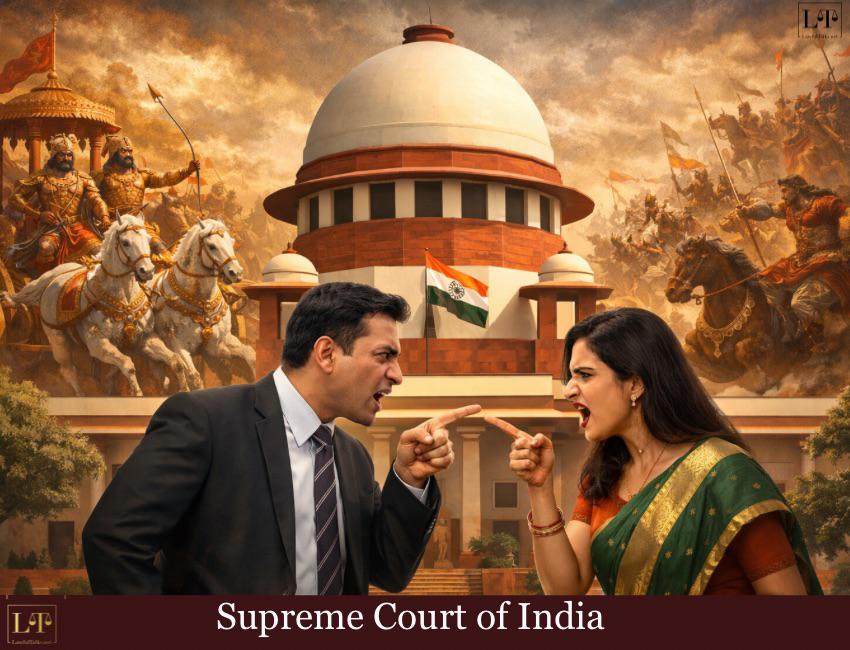
Matrimonial Mahabharata Ends: SC Quashes 80 Cases, Orders ₹5 Crore Alimony
Court invokes Article 142 to dissolve “dead marriage” and ensure complete justice
Lawyer-husband censured for weaponizing litigation against wife, family, and counsel
By Legal Reporter
New Delhi: April 09, 2026:
The Supreme Court of India has invoked its extraordinary powers under Article 142 to dissolve a decade-long estranged marriage, quash over 80 litigations filed by a lawyer-husband against his wife, her family, and even her counsel, and ordered a consolidated ₹5 crore alimony. This ruling underscore the judiciary’s intolerance for weaponized litigation and reinforces the principle of irretrievable breakdown of marriage.
For a detailed understanding of probate proceedings and will disputes, refer to this Supreme Court judgment on probate disputes and validity of wills in Sadhu Singh Vs Gurdwara Sahib Narike and Others.
This landmark ruling not only resolves a decade-long matrimonial battle but also sets a powerful precedent for how the judiciary can intervene to prevent abuse of process and ensure justice in family law.
Key Legal Principles Highlighted
1. Article 142 of the Constitution
- Grants the Supreme Court power to pass orders to ensure “complete justice”.
- Used here to dissolve a marriage deemed “dead for all practical purposes.”
2. Irretrievable Breakdown of Marriage
- Though not codified in Indian divorce law, SC has repeatedly recognized it as a ground for dissolution.
- The Court emphasized that prolonged hostility and endless litigation justified intervention.
3. Maintenance & Alimony Obligations
- Husband directed to pay ₹5 crore as permanent alimony, child support, and litigation costs.
- Reinforces that maintenance is a legal duty and cannot be evaded through procedural abuse.
4. Judicial Condemnation of Weaponized Litigation
- The Court criticized the lawyer-husband for filing over 80 cases, including against his wife’s counsel.
- Such conduct was deemed an abuse of process and contrary to the spirit of justice.
[RECOMMENDED RESEARCH RESOURCES]
📘 Legal professionals and students alike will benefit from Will Writing Simplified, which covers procedure and case law in detail.
🔹 Buy "Will Writing Simplified" online: Amazon | Flipkart
Browse succession law rulings here. Click the link here: https://www.courtkutchehry.com/pages/blog/123-supreme-court-judgments-on-wills/
Analytical Insights
- Judicial Activism vs. Legislative Gap: The ruling highlights how Article 142 bridges legislative silence on irretrievable breakdown.
- Deterrence Against Misuse of Legal Knowledge: The censure of the lawyer-husband sends a strong message against professionals exploiting the system.
- Consolidated Relief: By quashing multiple cases and ordering a lump-sum settlement, SC prioritized closure over piecemeal litigation.
- Impact on Family Law: This case may influence future debates on formally recognizing irretrievable breakdown as a statutory ground for divorce.
Detailed FAQ for Quick Understanding
Q1. What is Article 142 of the Constitution?
It empowers the Supreme Court to pass orders necessary to do complete justice in any case, even beyond statutory provisions.
Q2. Why did the SC dissolve the marriage despite no statutory ground?
The Court held the marriage had irretrievably broken down, making reconciliation impossible, and invoked Article 142 to end prolonged litigation.
Q3. What does “irretrievable breakdown of marriage” mean?
It refers to a situation where the marriage is beyond repair, with no chance of cohabitation or reconciliation.
Q4. Why was ₹5 crore ordered as alimony?
The amount was fixed to cover permanent alimony, child support, and litigation costs, ensuring financial security for the wife and children.
Q5. Can a spouse misuse legal expertise in matrimonial disputes?
No. The SC condemned the husband’s misuse of his profession to harass his wife and her counsel, calling it an abuse of process.
Q6. Does this case set a precedent?
Yes. It reinforces the SC’s willingness to use Article 142 in matrimonial disputes and strengthens the argument for recognizing irretrievable breakdown in law.