
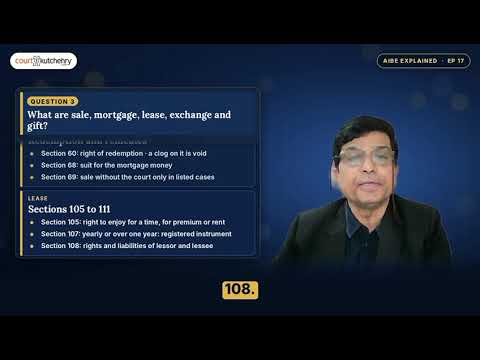
Watch the Video
In this 10-minute video, Episode 17 of the “AIBE Explained” series, the episode covers three statutes in five questions: the basic concepts and doctrines of the Transfer of Property Act, 1882; sale, mortgage, lease, exchange and gift; easements and licences under the Indian Easements Act, 1882; and land acquisition under the 2013 Act. He then solves five practice questions in the style of past AIBE papers. This article sets out the same law in writing.
Property Law in the AIBE
Property law appears in the AIBE in two places: in the 8-mark contract and property group, and as the separate 2-mark subject of Land Acquisition, Easements and Transfers. The questions are mostly on definitions, doctrines and numbers, which makes this a high-return topic.
Q1. Basic Concepts of the Transfer of Property Act (Sections 5 to 14)
Section 5 defines a transfer of property as an act by which a living person conveys property, in present or in future, to one or more other living persons, or to himself and others. A company or association of individuals is a “living person” for this purpose.
Section 6 lists what cannot be transferred, including:
- the chance of an heir apparent succeeding to an estate (spes successionis);
- a mere right of re-entry for breach of a condition subsequent;
- an easement apart from the dominant heritage;
- a right to future maintenance;
- a mere right to sue;
- a public office, and stipends and pensions of the kinds listed.
A condition absolutely restraining the transferee from alienating the property is void, except in the case of a lease where the condition is for the lessor’s benefit (Section 10). Property cannot be transferred directly to an unborn person; Section 13 allows a transfer for his benefit only through a prior interest, and the rule against perpetuity (Section 14) limits vesting to the lifetime of persons living at the date of transfer and the minority of an unborn person in existence at the end of that lifetime.
Q2. The Doctrines Tested Most
- Election (Section 35): a person who takes a benefit under an instrument must also accept its burden; he cannot take the benefit and reject the transfer of his own property made by the same instrument.
- Ostensible owner (Section 41): a transfer by a person who is the apparent owner with the consent of the real owner is not voidable, if the transferee acted in good faith after taking reasonable care.
- Feeding the grant by estoppel (Section 43): if a person fraudulently or erroneously transfers property he does not own, and later acquires it, the transfer operates on that interest at the option of the transferee.
- Priority (Section 48): between successive transfers of the same property, the earlier in time prevails.
- Lis pendens (Section 52): during a pending suit in which a right to immovable property is directly in question, the property cannot be transferred so as to affect the rights of any other party under the decree.
- Fraudulent transfer (Section 53): a transfer made with intent to defeat or delay creditors is voidable at the option of a defrauded creditor.
- Part performance (Section 53A): a transferee who, under a written contract, has taken possession and is willing to perform his part, is protected against the transferor. Since the 2001 amendment, the contract must be registered for the transferee to claim this protection. Section 53A is a shield, not a sword.
Remember this line: Section 52 freezes the property during litigation; Section 53A protects possession taken under a contract.
Q3. Sale, Mortgage, Lease, Exchange and Gift
Sale (Section 54)
Sale is a transfer of ownership for a price. A sale of tangible immovable property worth ₹100 or more can be made only by a registered instrument. A contract for sale does not, by itself, create any interest in or charge on the property.
Mortgage (Sections 58 to 60)
Section 58 defines mortgage and lists its six kinds: simple mortgage, mortgage by conditional sale, usufructuary mortgage, English mortgage, mortgage by deposit of title deeds (the equitable mortgage, available only in notified towns) and anomalous mortgage. The mortgagor’s right of redemption (Section 60) cannot be clogged: once a mortgage, always a mortgage.
Lease (Sections 105 to 111)
A lease is a transfer of a right to enjoy immovable property for a certain time, in consideration of a price or rent (Section 105). Without a contract to the contrary, a lease for agricultural or manufacturing purposes is from year to year, terminable by six months’ notice, and a lease for any other purpose is from month to month, terminable by fifteen days’ notice (Section 106). A lease from year to year, or for more than a year, or reserving a yearly rent, must be made by a registered instrument (Section 107). Section 111 lists the modes of determination, such as efflux of time, surrender, forfeiture and notice to quit.
Exchange and gift
In an exchange, two persons transfer ownership of one thing for another (Section 118). A gift is a voluntary transfer of existing property without consideration, accepted by the donee during the donor’s lifetime (Section 122). A gift of immovable property must be by a registered instrument, signed by the donor and attested by at least two witnesses (Section 123). An actionable claim is transferred by an instrument in writing (Section 130).
Q4. What Is an Easement? (Indian Easements Act, 1882)
An easement is a right which the owner or occupier of land (the dominant heritage) has, for the beneficial enjoyment of that land, to do or prevent something on land not his own (the servient heritage) (Section 4). A right of way and a right to light and air are classic examples.
- Easement of necessity (Section 13): arises when land is transferred or partitioned and the easement is absolutely necessary to enjoy it.
- Prescription (Section 15): an easement is acquired by peaceable, open enjoyment as of right, without interruption, for 20 years, or 30 years where the servient property belongs to the Government.
- Licence (Section 52): permission to do something on another’s land that would otherwise be unlawful. A licence creates no interest in the property.
- A licence is revocable (Section 60) except in two cases: where it is coupled with a transfer of property that is in force, and where the licensee, acting on the licence, has executed work of a permanent character and incurred expenses.
Q5. Land Acquisition Under the 2013 Act
The Land Acquisition Act, 1894 was replaced by the Right to Fair Compensation and Transparency in Land Acquisition, Rehabilitation and Resettlement Act, 2013, in force from 1 January 2014.
- Social impact assessment (Section 4) is required before acquisition, subject to the exceptions in the Act.
- Consent (Section 2(2)): at least 80% of affected families for acquisition for private companies, and 70% for public-private partnership projects.
- Award: the Collector holds the enquiry and makes the award (Section 23); the award must be made within 12 months of the declaration, failing which the proceedings lapse (Section 25).
- Compensation: market value is determined under Section 26, and a solatium of 100% of the compensation is added (Section 30).
- Lapse of old proceedings (Section 24): deals with acquisitions begun under the 1894 Act.
Section 24(2) produced conflicting judgments, which a Constitution Bench settled in Indore Development Authority v. Manoharlal (2020). The Court held that old proceedings lapse only if, for five years or more before the 2013 Act came into force, the authorities had neither taken possession nor paid compensation. If either step was taken, there is no lapse. Tender of compensation is treated as payment, and the Court overruled the earlier view that compensation had to be deposited in court.
Key Takeaways
- Section 6 TPA bars transfer of spes successionis, a mere right to sue and similar interests; Section 10 voids absolute restraints on alienation (except in leases).
- Know the doctrines by number: 35 election, 41 ostensible owner, 43 feeding the grant, 52 lis pendens, 53 fraudulent transfer, 53A part performance.
- Sale of immovables worth ₹100 or more and gifts of immovable property need registered instruments; Section 58 lists six mortgages.
- Easement by prescription takes 20 years (30 against the Government); a licence creates no interest and is revocable except in two cases.
- 2013 Act: in force 1 January 2014; consent of 80% (private) or 70% (PPP); 100% solatium; Section 24 lapse as settled in Indore Development Authority (2020).
Frequently Asked Questions
Can an heir transfer his expected inheritance?
No. The chance of an heir apparent succeeding to an estate (spes successionis) cannot be transferred under Section 6(a) of the Transfer of Property Act.
Does an agreement to sell transfer ownership?
No. Under Section 54, a contract for sale does not by itself create any interest in or charge on the property.
How long does it take to acquire an easement by prescription?
Twenty years of peaceable, open and uninterrupted enjoyment as of right, or thirty years where the servient property belongs to the Government.
Is a licence revocable?
Generally yes, except where it is coupled with a transfer of property in force, or where the licensee has executed permanent work and incurred expenses on the strength of it.
What is the solatium under the 2013 Act?
One hundred per cent of the compensation amount, under Section 30.
Where can I watch the full explanation?
Watch the full explanation in 10 minutes: https://youtu.be/h7ua7YYwv-c.
Conclusion
Property law in the AIBE rewards precise reading: what cannot be transferred, which doctrine sits in which section, which transfers need a registered instrument, how long prescription takes, and what the 2013 Act changed for land acquisition.
Revise the Transfer of Property Act doctrines with their section numbers, add the easement and licence rules, and learn the key percentages of the 2013 Act. The next episode covers the Law of Torts and the Motor Vehicles Act.
▶ Watch the video: Property Law for AIBE: Transfer of Property Act, Easements Act & Land Acquisition (LARR 2013) Ep 17
Research Judgments Like These on CourtKutchehry
Every judgment cited in this article, and lakhs more, can be searched and read on CourtKutchehry. Searching and reading judgments is free. A membership adds unlimited summaries, all related judgments, original court PDF downloads, bookmarks, notes and the CourtKutchehry AI assistant.
| Membership | Price | Works out to | AI credits |
|---|---|---|---|
| Monthly (1 month) | ₹599 | ₹599 / month | 1,000 / month |
| Quarterly (3 months) · Save 16% | ₹1,499 | ₹499.67 / month | 1,100 / month |
| Six-monthly (6 months) · Save 33% | ₹2,399 | ₹399.83 / month | 1,200 / month |
| Yearly (12 months) · Save 44% · Best value | ₹3,999 | ₹333.25 / month | 1,300 / month |
Every plan is a one-off purchase for a fixed period: nothing auto-renews and no card is kept on file. Prices are exclusive of applicable tax, which is added at checkout. Extra AI chat credits can be topped up from ₹99. A free verified account gets 5 summaries and 50 AI trial credits.
Prices are as displayed on courtkutchehry.com on 20 November 2026 and are subject to change without notice. Please check the pricing page for the current plans and offers.
For more judgments, legal opinions and case analysis, visit courtkutchehry.com
Visit CourtKutchehry →