
Watch the Video
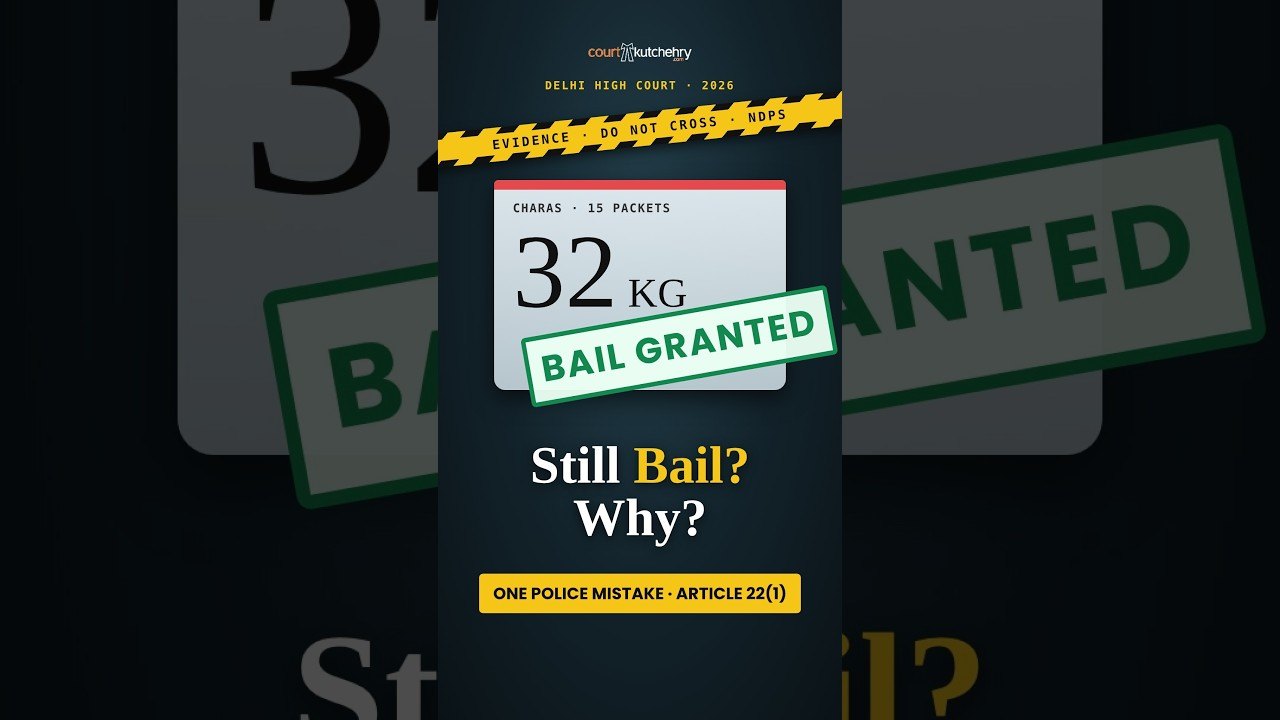
In this 1-minute video, a CourtKutchehry Short, the question is simple: 32 kg of charas was allegedly found hidden in a car, so how did the accused get bail from the Delhi High Court? The answer is one mistake by the police. This article explains that one point: the failure to give the grounds of arrest.
▶ Watch on YouTube: 32 Kg Charas… Still Bail? The One Mistake Police Made | Delhi High Court
The Mistake, in One Line
The police never told the accused, in the way the law requires, why he was being arrested. The prosecution admitted this before the court. On 3 November 2026, the Delhi High Court granted bail in Suddhi v. State (NCT of Delhi), (2026) 11 DEL CK 0148.
The background, as the prosecution tells it: in October 2023, the Special Cell recovered about 32 kg of charas from secret cavities in a car at Gazipur. The accused had spent about three years in custody, and the trial is still on. These are allegations.
Why Telling Someone “Why” Is a Constitutional Right
Article 22(1) of the Constitution says that a person who is arrested shall not be detained in custody without being informed, as soon as may be, of the grounds for the arrest, and shall not be denied the right to consult and be defended by a lawyer of his choice.
A person who does not know why he has been arrested cannot effectively seek bail or challenge the arrest. The High Court described Article 22(1) as “a substantive constitutional safeguard and not merely a procedural formality”.
Section 47 of the Bharatiya Nagarik Suraksha Sanhita, 2023 (earlier Section 50 CrPC) carries the same duty.
Written Grounds: How the Rule Developed
- Pankaj Bansal v. Union of India, (2023) 10 SC CK 0001 (3 October 2023): in a PMLA case, grounds of arrest must be given in writing.
- Ram Kishor Arora v. Directorate of Enforcement, (2023) 12 SC CK 0021: this applies to arrests after 3 October 2023.
- Mihir Rajesh Shah v. State of Maharashtra, (2025) 11 SC CK 1732 (6 November 2025): written grounds for arrests under every law.
The High Court rejected the State’s argument that the rule applied only from 6 November 2025, since this arrest came after 3 October 2023.
Remember this line: no grounds of arrest, no valid detention – however large the seizure.
Why Even NDPS Section 37 Gave Way
Thirty-two kilos is a commercial quantity under the NDPS Act, 1985, where Section 37 requires reasonable grounds to believe the accused is not guilty and will not offend on bail.
But Section 37 is a statute, and Article 22(1) is the Constitution: the statute cannot override it. The court also noted parity: a co-accused, with about 29 kg allegedly recovered from him, had already been granted bail on the same ground in Pahalman Budha Magar v. State (NCT of Delhi), (2026) 01 DEL CK 1446.
What the Order Does Not Mean
- It is not an acquittal. The trial continues, and the court said its observations were only for deciding bail.
- It is not unconditional. A ₹1 lakh bond, monthly reporting, no contact with witnesses.
- It is not about the drugs. The court did not say the seizure was false; it decided how the arrest was made.
Key Takeaways
- The Delhi High Court granted bail in a 32 kg charas case because the grounds of arrest were never supplied, as the prosecution admitted.
- Article 22(1) is “a substantive constitutional safeguard and not merely a procedural formality”.
- Written grounds: Pankaj Bansal and Mihir Rajesh Shah.
- NDPS Section 37 cannot override the constitutional right.
- Bail is not acquittal.
Frequently Asked Questions
What was the “one mistake” the police made?
They never gave the accused the grounds of his arrest, as Article 22(1) requires; the prosecution conceded this.
Can bail be granted in a commercial-quantity NDPS case?
Section 37 is strict, but the High Court held it cannot override a violation of Article 22(1).
Do the police have to give grounds of arrest in writing?
Yes. Under the Supreme Court’s rulings in Pankaj Bansal and Mihir Rajesh Shah, the grounds must be given in writing; as the Short puts it, in a language the person understands.
What should a family do if someone is arrested?
Ask for the written grounds of arrest, check the family has been informed, and contact a lawyer.
Where can I watch the video?
Watch the Short here: https://youtu.be/Qd-RbGwnCW0.
Conclusion
The size of a seizure does not suspend the Constitution. Skip the grounds of arrest, and the detention becomes vulnerable even under the strictest bail law.
Police must give written grounds; families should ask for them.
▶ Watch the video: 32 Kg Charas… Still Bail? The One Mistake Police Made | Delhi High Court
▶ Watch the full episode: Grounds of Arrest Not Given = Bail? 32 Kg Charas NDPS Case | Delhi High Court on Article 22(1)
📖 Read the full article: Grounds of Arrest Not Given, So Bail Despite 32 Kg Charas: Delhi High Court on Article 22(1) and NDPS Section 37
Research Judgments Like These on CourtKutchehry
Every judgment cited in this article, and lakhs more, can be searched and read on CourtKutchehry. Searching and reading judgments is free. A membership adds unlimited summaries, all related judgments, original court PDF downloads, bookmarks, notes and the CourtKutchehry AI assistant.
| Membership | Price | Works out to | AI credits |
|---|---|---|---|
| Monthly (1 month) | ₹599 | ₹599 / month | 1,000 / month |
| Quarterly (3 months) · Save 16% | ₹1,499 | ₹499.67 / month | 1,100 / month |
| Six-monthly (6 months) · Save 33% | ₹2,399 | ₹399.83 / month | 1,200 / month |
| Yearly (12 months) · Save 44% · Best value | ₹3,999 | ₹333.25 / month | 1,300 / month |
Every plan is a one-off purchase for a fixed period: nothing auto-renews and no card is kept on file. Prices are exclusive of applicable tax, which is added at checkout. Extra AI chat credits can be topped up from ₹99. A free verified account gets 5 summaries and 50 AI trial credits.
Prices are as displayed on courtkutchehry.com on 20 November 2026 and are subject to change without notice. Please check the pricing page for the current plans and offers.
For more judgments, legal opinions and case analysis, visit courtkutchehry.com
Visit CourtKutchehry →