

Understanding Wills in India: Supreme Court Principles and Everyday Lessons for Families
A Will is More Than Property—It is the Testator’s Voice After Death
Clarity in Drafting Prevents Disputes and Preserves Family Harmony
By Vishwas Kumar
New Delhi: March 31, 2026:
Few legal documents carry as much emotional weight as a Will. It is not just a piece of paper—it is the testator’s final voice, guiding how their property, assets, and even personal wishes should be honoured after death. In India, where family ties and inheritance often spark disputes, the law of wills plays a crucial role in ensuring fairness, clarity, and respect for the deceased’s intentions.
The extract from the [WILL WRITING SIMPLIFIED; If interested, you can also purchase book online here: Amazon | Flipkart] captures the essence of this principle:
“Will is the legal declaration of a testator’s intention with respect to disposition of his/her property(ies) and asset(s) to take effect after his/her death.”
This article unpacks the meaning of a will, its legal framework, and its implications for Indian society, while also answering common questions that families often face.
Explaining the Extract in Plain Language
The extract tells us that a Will (Last Will and Testament) is a legal document where a person (called the testator) records how their property and assets should be distributed after death.
Key points from the extract:
- A Will is a legal declaration—it must follow the law to be valid.
- It takes effect only after death.
- It is the cornerstone of estate planning.
- It allows the testator to:
- Distribute property and assets.
- Appoint executors (people who carry out the Will).
- Nominate guardians for minor children.
- Give directions about debts, funeral arrangements, digital assets, heirlooms.
- Lay down the scheme of estate administration.
- A properly drafted Will ensures clarity, reduces disputes, avoids uncertainty, and preserves the testator’s intention over default succession rules.
In simple terms: a Will is the testator’s roadmap for their estate, ensuring their wishes are respected rather than leaving matters to personal law or family quarrels.
Legal Context
Indian Succession Act, 1925
- Section 2(h): Defines a Will as the legal declaration of a person’s intention regarding property after death.
- Section 63: Lays down rules for execution—signature of testator, attestation by two witnesses.
- Section 68, Evidence Act: Requires at least one attesting witness to testify in court if the Will is disputed.
Hindu Succession Act, 1956
- Applies when there is no Will. Property devolves by intestate succession (natural heirs).
- A Will overrides these default rules, allowing the testator to distribute property differently.
Case Law Principles
- Courts have repeatedly held that suspicious circumstances must be cleared by the propounder of the Will (e.g., H. Venkatachala Iyengar v. B.N. Thimmajamma).
- Registration of a Will is not mandatory, but it can add credibility.
- Expert evidence (like handwriting analysis) is secondary to substantive proof of execution.
Examples and Case Studies
- Hypothetical Example:
A father leaves a Will giving his house to his younger son, while the elder son inherits agricultural land. Without a Will, both sons would have equal rights in all property under Hindu Succession Act. The Will ensures clarity and avoids disputes. - Case Study:
In Rani Purnima Debi v. Kumar Khagendra Narayan Deb (1961), the Supreme Court rejected a Will despite registration because it excluded close heirs and was surrounded by suspicion. Lesson: registration alone does not prove validity. - Case Study:
In Shashi Kumar Banerjee v. Subodh Kumar Banerjee (1963), the Court upheld a Will, stressing that oral and intrinsic evidence outweighed inconclusive expert testimony. Lesson: substantive proof matters more than technical doubts.
Historical and Comparative Context
- Colonial Legacy: The Indian Succession Act, 1925, consolidated earlier laws and remains the backbone of testamentary law.
- Comparative View: In the UK, Wills Act 1837 requires two witnesses, like India. In the US, requirements vary by state, but most demand written Wills with witnesses.
- Evolution in India: Courts have consistently emphasized that Wills must reflect the free will of the testator, not coercion or manipulation.
Implications for Society, Families, and Courts
- For Families: A Will reduces quarrels, ensures fairness, and protects vulnerable heirs like widows or minor children.
- For Courts: Clear Wills reduce litigation. Ambiguous or suspicious Wills increase probate disputes.
- For Society: Encourages estate planning, protects digital assets, and ensures smooth transfer of wealth across generations.
FAQ Section
1. Is registration of a Will mandatory in India?
No. Registration is optional. A properly executed and attested Will is valid even without registration.
2. Who can make a Will?
Any person above 18 years of age, of sound mind, and free from coercion or undue influence.
3. Can a Will be changed?
Yes. A testator can revoke or alter a Will any time before death. The latest valid Will prevails.
4. What happens if there is no Will?
Property devolves under personal succession laws (e.g., Hindu Succession Act for Hindus).
5. Can digital assets be included in a Will?
Yes. The extract highlights that Wills can cover digital assets, passwords, and online accounts.
6. Who executes the Will?
The executor named in the Will carries out its directions. If none is named, courts may appoint one.
7. What if witnesses are interested parties?
It raises suspicion. Courts prefer independent witnesses to prove genuineness.
Conclusion
A Will is not just a legal document—it is the testator’s final word, ensuring their wishes are respected and disputes avoided. The extract rightly calls it the cornerstone of estate planning. By drafting a clear, valid Will, individuals protect their families from uncertainty and preserve harmony. For courts, it reduces litigation; for society, it strengthens trust in law.
In India, where inheritance disputes are common, understanding the basics of Wills is essential. As the Supreme Court has repeatedly emphasized, clarity, free will, and proper execution are the pillars of a valid Will.
Book Reference
[WILL WRITING SIMPLIFIED]
Sentences Used from Extract
- “Will is the legal declaration of a testator’s intention with respect to disposition of his/her property(ies) and asset(s) to take effect after his/her death.”
- “In general, a ‘Will’ (also known as a ‘Last Will and Testament’) is a legal document in which a person (the Testator) outlines his/her wishes for how his/her property(ies) and asset(s) should be distributed after his/her death.”
- “A Will is the cornerstone of estate planning.”
- “It not only specifies the distribution of property but also allows the Testator to appoint executors, nominate guardians for minor children, give directions regarding debts, funeral arrangements, digital assets, and treasured heirlooms, and lay down the entire scheme of estate administration.”
- “A properly drafted Will ensures clarity, reduces disputes, avoids uncertainty, and preserves the Testator’s intention over the default rules of personal law.”
You Can Also Purchase the Book from here on: Buy online: Amazon | Flipkart
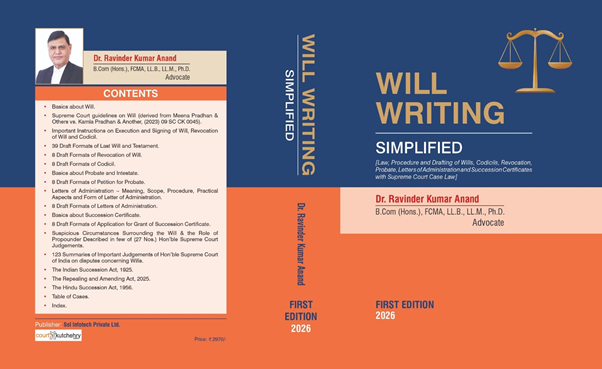
LEGAL RESEARCH RESOURCES: Check out 123 Key Judgements, as highlighted in the book, WILL WRITING SIMPLIFIED, for the quick research and reference purposes. Click the link here: https://www.courtkutchehry.com/pages/blog/123-supreme-court-judgments-on-wills/
Suggested Keywords
- Will in India law
- Indian Succession Act Will rules
- Hindu Succession Act intestate succession
- Probate disputes India
- Supreme Court Will judgments
- Estate planning India
- Digital assets in Will
- Attestation of Will India