
Watch the Video
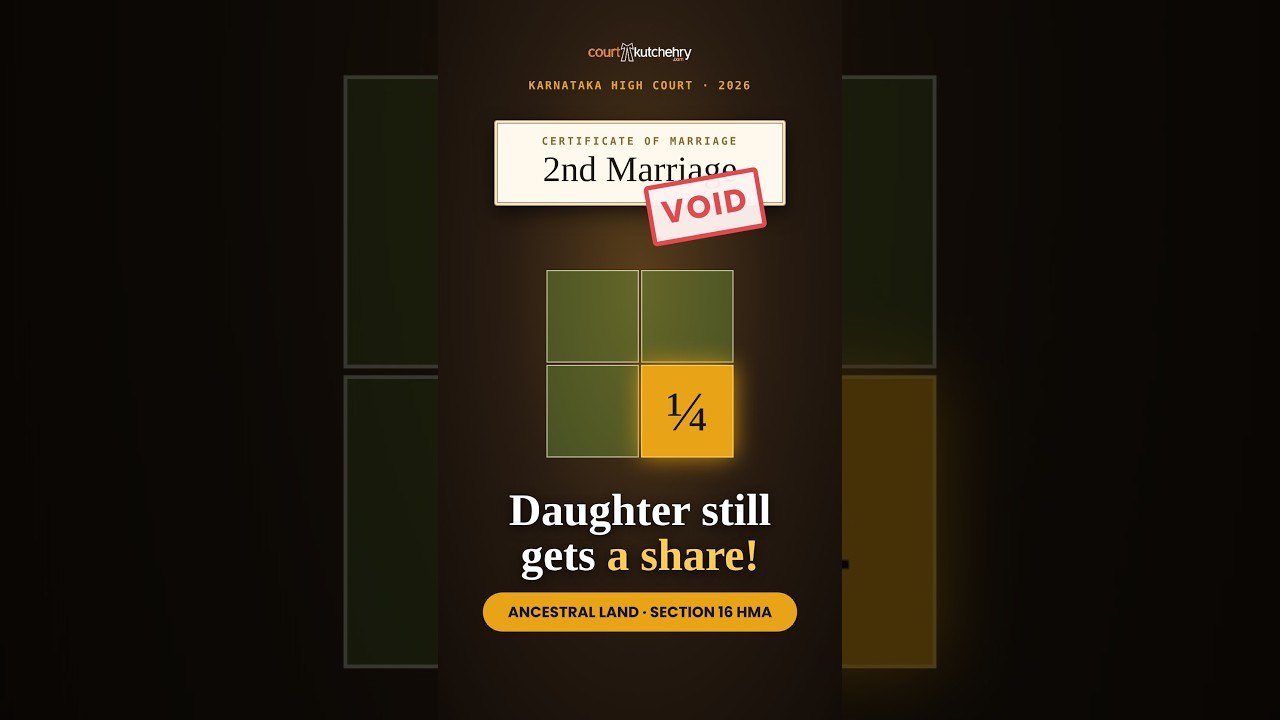
In this short video, the CourtKutchehry channel makes one sharp point from a Karnataka High Court ruling: a second marriage can be void in law, and yet the daughter born of it can still walk away with a quarter of the family’s ancestral land. This article explains why the child of a void marriage inherits and how her share is calculated.
The Puzzle in One Line
If the law says a marriage never existed, how can its child inherit? Applying settled Supreme Court law, the Karnataka High Court’s answer is that the status of the marriage and the status of the child are different questions.
The Facts, Briefly
A man married a second time while his first marriage was still subsisting. After he died, his son from the first marriage sold parts of the agricultural land of the family. The second wife and her daughter sued for partition and challenged the sales. The trial court held the second marriage void and gave the second wife nothing, but gave the daughter a quarter share. The first appellate court confirmed the quarter share, and the Karnataka High Court dismissed the son’s second appeal in Hanumanthappa v. Shanthamma and Others, 2026:KHC:56474, decided by Justice S.R. Krishna Kumar in October 2026.
Point 1: The Child of a Void Marriage Is Legitimate
A marriage performed while a spouse is living is void under Sections 5(i) and 11 of the Hindu Marriage Act, 1955. But Section 16(1) of the same Act says that a child of such a marriage is legitimate, whether or not a decree of nullity is ever passed.
There is one limit. Section 16(3) says that such a child gets rights only in the property of the parents, and not in the property of any other relative. So the daughter cannot claim her grandfather’s or uncle’s property directly. She can claim what belonged to her father.
Point 2: The Father’s Share in Ancestral Land Counts as His Property
Does a father’s interest in joint family land count as his “property”? In Revanasiddappa v. Mallikarjun, (2023) 09 SC CK 0059, decided on 1 September 2023, a three-judge Bench of the Supreme Court settled that question.
- Under Section 6(3) of the Hindu Succession Act, 1956, when a coparcener dies, his interest is worked out as if a partition had taken place immediately before his death.
- The share so worked out is the parent’s property, and the child of a void marriage shares in it along with the other heirs.
- The child does not, however, become a coparcener by birth, and does not get a share in the notional partition itself.
The High Court treated the point as “no longer res integra”.
Point 3: The Quarter, Worked Out
| Step | What happens | Result |
|---|---|---|
| 1 | Notional partition just before the father’s death between the father and his son | Father ½, son ½ |
| 2 | The father’s ½ passes to his heirs; on the courts’ findings these were his son and his daughter | ½ split in two |
| 3 | Daughter’s share | ½ of ½ = ¼ of the whole |
| 4 | Son’s share | ½ + ¼ = ¾ of the whole |
The land the son had already sold was adjusted against his own three-quarter share by the first appellate court.
Remember this line: the child of a void marriage steps into the parent’s shoes, but only the parent’s shoes.
And the Second Wife?
She got no share. A void marriage gives her no status as a wife or widow, so she does not inherit as his spouse.
Key Takeaways
- A Hindu marriage during a subsisting first marriage is void (Sections 5(i) and 11, HMA).
- A child of a void marriage is legitimate under Section 16(1), but inherits only from the parents (Section 16(3)).
- Revanasiddappa (2023): the parent’s share in coparcenary property is fixed by a notional partition just before death, and the child shares in it.
- Here, father ½ → split between son and daughter → daughter ¼.
- The second wife of a void marriage gets no share as a wife.
Frequently Asked Questions
Does a child of a void marriage need a court decree to be legitimate?
No. Section 16(1) makes the child legitimate whether or not a decree of nullity is granted.
Can such a child claim the grandfather’s property?
No. Section 16(3) limits the child’s rights to the property of the parents.
Is such a child a coparcener?
No. Revanasiddappa held that the child does not become a coparcener by birth; the child takes a share in the parent’s notional share.
Does the second wife get anything?
Not as a wife; a void marriage is no marriage in law.
Where can I watch the video?
Watch the Short here: https://youtu.be/N-zr-tlt4Gc.
Conclusion
The ruling does not create new law; it applies Section 16 of the Hindu Marriage Act and the Supreme Court’s decision in Revanasiddappa. A void marriage leaves the second wife without inheritance rights as a wife, but the daughter is legitimate and inherits her father’s share, worked out on a notional partition.
Before dividing ancestral land, count every legitimate child.
▶ Watch the video: Second Marriage Void… But the Daughter Gets ¼ of Ancestral Land! Karnataka High Court
📖 Read the full article: Second Marriage Void, but the Daughter Gets One-Quarter of Ancestral Land: Karnataka High Court Explained
Research Judgments Like These on CourtKutchehry
Every judgment cited in this article, and lakhs more, can be searched and read on CourtKutchehry. Searching and reading judgments is free. A membership adds unlimited summaries, all related judgments, original court PDF downloads, bookmarks, notes and the CourtKutchehry AI assistant.
| Membership | Price | Works out to | AI credits |
|---|---|---|---|
| Monthly (1 month) | ₹599 | ₹599 / month | 1,000 / month |
| Quarterly (3 months) · Save 16% | ₹1,499 | ₹499.67 / month | 1,100 / month |
| Six-monthly (6 months) · Save 33% | ₹2,399 | ₹399.83 / month | 1,200 / month |
| Yearly (12 months) · Save 44% · Best value | ₹3,999 | ₹333.25 / month | 1,300 / month |
Every plan is a one-off purchase for a fixed period: nothing auto-renews and no card is kept on file. Prices are exclusive of applicable tax, which is added at checkout. Extra AI chat credits can be topped up from ₹99. A free verified account gets 5 summaries and 50 AI trial credits.
Prices are as displayed on courtkutchehry.com on 20 November 2026 and are subject to change without notice. Please check the pricing page for the current plans and offers.
For more judgments, legal opinions and case analysis, visit courtkutchehry.com
Visit CourtKutchehry →