
Watch the Video
In this 1-minute video, the CourtKutchehry channel explains a Karnataka High Court ruling on what a daughter from a void second marriage can inherit from her father’s ancestral land. This article sets out the facts, the law and the arithmetic behind her one-quarter share.
A Void Marriage, a Daughter and a Piece of Family Land
A man in Karnataka married a second time while his first marriage was still subsisting. After his death, his son from the first marriage sold parts of the family’s agricultural land. The second wife and her daughter then filed a suit for partition, claiming a share in the property, and also challenged the sales.
The case reached the Karnataka High Court as a regular second appeal filed by the son: Hanumanthappa v. Shanthamma and Others, 2026:KHC:56474, decided by Justice S.R. Krishna Kumar in October 2026. The High Court dismissed the son’s appeal. The daughter kept her share; the second wife did not get one.
Why the Second Wife Got Nothing
Under Section 5(i) read with Section 11 of the Hindu Marriage Act, 1955, a marriage performed while either party has a living spouse is void. In law, it is treated as if it never took place. The trial court found the relationship proved, but also found that the second marriage happened while the first marriage was alive, so it was void.
A woman whose marriage is void is not a legal “widow” of the man. She therefore cannot inherit from him as his wife. That is why the courts held that the second wife was not entitled to any share in the property.
Why the Daughter Is Treated Differently: Section 16
The law does not punish children for the status of their parents’ marriage. Section 16(1) of the Hindu Marriage Act says that a child of a void marriage is legitimate. Section 16(3) then sets a limit: such a child has rights only in the property of the parents, and not in the property of any other relative.
Can such a child claim the father’s interest in ancestral (coparcenary) property? In 2023, a three-judge bench of the Supreme Court settled the question in Revanasiddappa v. Mallikarjun, (2023) 09 SC CK 0059. The Court held that children of void or voidable marriages are entitled to their parent’s share, and that this share is worked out by imagining a partition of the coparcenary property just before the parent’s death.
The Karnataka High Court said the issue was “no longer res integra” after Revanasiddappa, and applied it directly.
How the Daughter’s One-Quarter Was Worked Out
Section 6(3) of the Hindu Succession Act, 1956 says that when a coparcener dies, his interest is worked out as if a partition had taken place immediately before his death. The courts applied this step by step:
- The land was joint family property of the father and his son. On a notional partition just before the father’s death, each of them held one-half.
- The father’s half then passed to his heirs. His heirs were his son and his daughter (the second wife was not an heir, because her marriage was void).
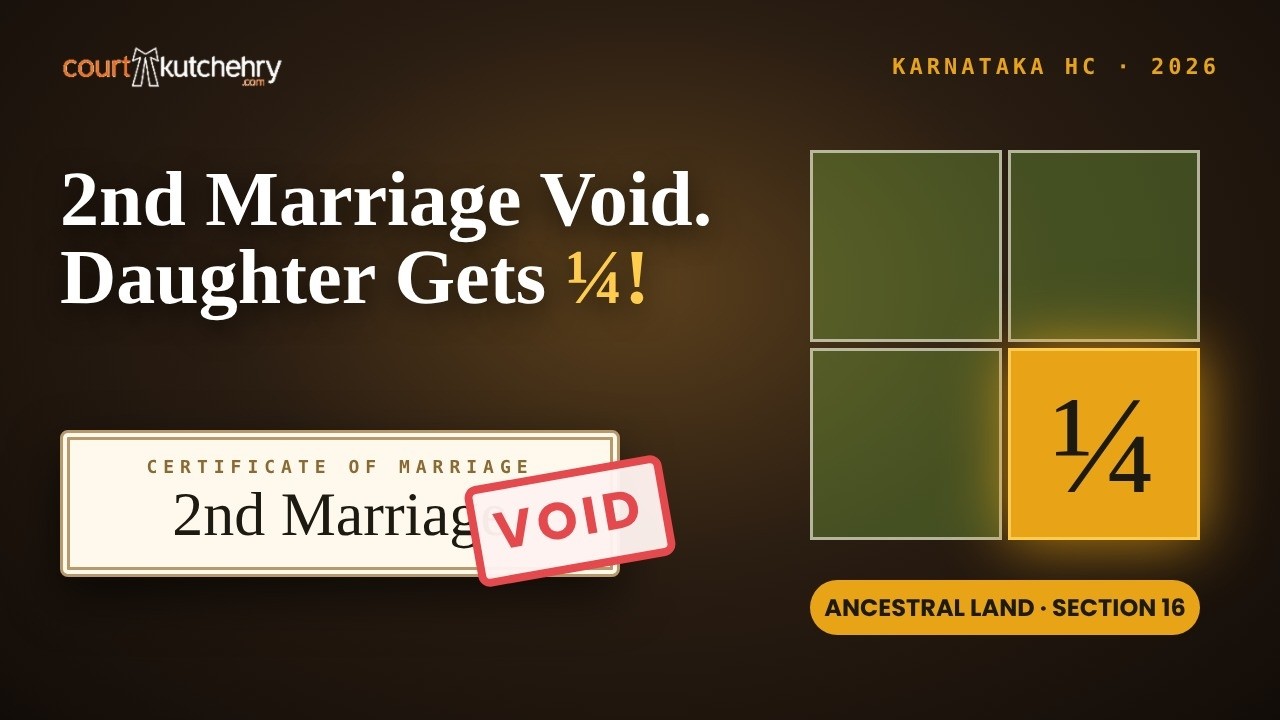
- So the father’s half was divided equally: one-quarter of the whole property to the son and one-quarter to the daughter.
- Result: the daughter gets one-quarter of the entire land; the son gets three-quarters (his own half plus one-quarter as his father’s heir).
Remember this line: the child of a void marriage steps into the parent’s share, and only the parent’s share.
What Happened to the Land the Son Sold?
The trial court had directed cancellation of the sale deeds. The first appellate court set that direction aside, because no such relief had been claimed, and instead modified the decree: the parcels the son had already sold would be allotted to the son’s own three-quarter share at the time of the final partition. This is called an equitable partition. The buyers keep the land, and the daughter’s quarter is carved out of the remaining property.
The plaintiffs did not challenge that modification. In the second appeal, the only real question was whether the daughter could take a share in her father’s notional half. The High Court found no substantial question of law and dismissed the appeal, so the preliminary decree stands.
Key Takeaways
- A second marriage during a subsisting first marriage is void under the Hindu Marriage Act; the second wife cannot inherit as a wife.
- Under Section 16, a child of a void marriage is legitimate and inherits from the parents.
- Following Revanasiddappa (2023), the child takes the parent’s share worked out on a notional partition just before the parent’s death.
- Here, the father’s half was split between son and daughter, so the daughter got one-quarter of the whole land.
- Land already sold by the son was adjusted in the son’s own share through equitable partition.
Frequently Asked Questions
Is a second marriage valid if the first marriage is still on?
No. Under Sections 5(i) and 11 of the Hindu Marriage Act, it is void. It may also expose the husband to prosecution for bigamy (Section 82 of the Bharatiya Nyaya Sanhita, earlier Section 494 IPC).
Is a child of a void marriage legitimate?
Yes. Section 16(1) of the Hindu Marriage Act declares such a child legitimate.
Can that child claim a share in ancestral property?
Yes, but only the parent’s share. The Supreme Court held in Revanasiddappa v. Mallikarjun (2023) that the share is computed on a notional partition just before the parent’s death.
Does the second wife get anything?
Not as a wife or widow, because a void marriage is no marriage in law. In this case the courts gave her no share.
Where can I watch the full explanation?
Watch the 1-minute explanation here: https://youtu.be/M9NpAu-5S1A.
Conclusion
The Karnataka High Court applied settled law. A void marriage gives the second wife no inheritance rights as a wife, but the daughter of that marriage is legitimate and steps into her father’s share in the ancestral land.
For families, the lesson is to look at both the validity of the marriage and the history of the property before assuming who gets what. A single wrong assumption can lead to years of litigation.
▶ Watch the video: Second Marriage Void… But the Daughter Gets ¼ of Ancestral Land! Karnataka High Court
📖 Read more: “Children Are Children”: Bombay High Court Strikes Down Railway Circular Denying Passes to Children of Void Marriages
Research Judgments Like These on CourtKutchehry
Every judgment cited in this article, and lakhs more, can be searched and read on CourtKutchehry. Searching and reading judgments is free. A membership adds unlimited summaries, all related judgments, original court PDF downloads, bookmarks, notes and the CourtKutchehry AI assistant.
| Membership | Price | Works out to | AI credits |
|---|---|---|---|
| Monthly (1 month) | ₹599 | ₹599 / month | 1,000 / month |
| Quarterly (3 months) · Save 16% | ₹1,499 | ₹499.67 / month | 1,100 / month |
| Six-monthly (6 months) · Save 33% | ₹2,399 | ₹399.83 / month | 1,200 / month |
| Yearly (12 months) · Save 44% · Best value | ₹3,999 | ₹333.25 / month | 1,300 / month |
Every plan is a one-off purchase for a fixed period: nothing auto-renews and no card is kept on file. Prices are exclusive of applicable tax, which is added at checkout. Extra AI chat credits can be topped up from ₹99. A free verified account gets 5 summaries and 50 AI trial credits.
Prices are as displayed on courtkutchehry.com on 20 November 2026 and are subject to change without notice. Please check the pricing page for the current plans and offers.
For more judgments, legal opinions and case analysis, visit courtkutchehry.com
Visit CourtKutchehry →