
Watch the Video
In this 7-minute video, Episode 5 of “RERA Act Explained with Judgments”, the series takes up a question that comes up again and again: can a co-operative housing society or a welfare society avoid RERA by saying “we are not a builder”? The video covers two 2025 judgments of the Delhi High Court that answer it under Section 2(zk). This article explains both, with links to the judgments on CourtKutchehry.
The Argument: “We Are a Society, Not a Builder”
Thousands of Indian families have put money into housing schemes run not by companies but by societies: multi-State co-operative societies, group housing societies, welfare societies of employees. When such a scheme stalls and members ask for their money back before the RERA Authority, the society’s first defence is often that it is not a “promoter” at all. In 2025, two Division Benches of the Delhi High Court rejected that defence.
Revanta Multistate CGHS v. Sunny Sapen: The Facts
The first case is M/s Revanta Multistate CGHS Ltd. v. Sunny Sapen, (2025) 05 DEL CK 2059, RERA Appeal 1 of 2024, decided on 30 May 2025 by Justices Navin Chawla and Shalinder Kaur.
Revanta was registered as a multi-State co-operative society in 2014. It said it was formed to pool land under the DDA’s Land Pooling Policy and had not yet received developed land back. A buyer joined in 2015, chose a 3BHK unit of 1,475 sq ft, and paid about ₹13.27 lakh in three instalments. He was told construction would begin by December 2015. Nothing was built. The Delhi RERA Authority ordered a refund with interest, and the society appealed.
Revanta: The Reasoning
- Substance, not label. The Court looked at how the society actually worked. Its brochure invited investment from “clients”, and its payment plan broke the price down into land cost and construction cost per square foot. The “membership” was a facade hiding its real role as a real estate developer.
- Promoter under Section 2(zk). A primary co-operative housing society that constructs apartments for its members is expressly a promoter. Not yet having developed land did not change that.
- Section 3 violated. Whether or not registration was yet due under the land pooling scheme, the society had advertised the project and collected money without RERA registration, which Section 3 forbids.
- Right forum. Applying Newtech Promoters, a claim for refund with interest belongs before the Authority, while compensation goes to the Adjudicating Officer. The Authority had correctly decided the complaint.
The appeal was dismissed with costs of ₹50,000, and the Authority’s refund order, with interest from the date of each payment, stood.
Sansadiya Adhikari Welfare Society v. Utpal Kumar Tripathi
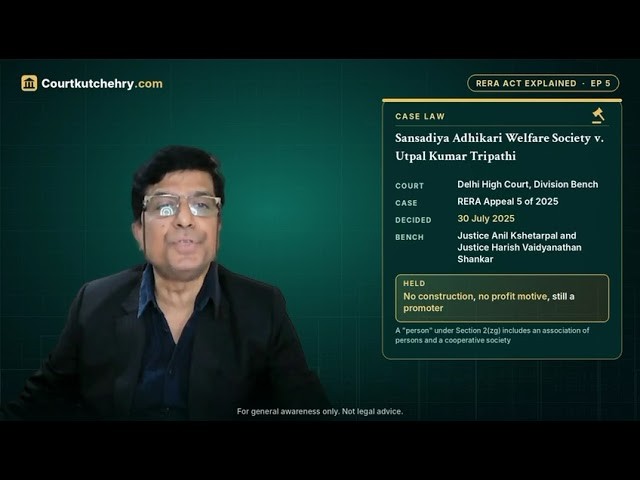
The second case is Sansadiya Adhikari Welfare Society v. Utpal Kumar Tripathi, (2025) 07 DEL CK 1921, RERA Appeal 5 of 2025, decided on 30 July 2025 by Justices Anil Kshetarpal and Harish Vaidyanathan Shankar.
The society had been formed to provide affordable housing to its members, who were government officials. In 2013, the complainants joined and each paid about ₹12.4 lakh, which the society used to buy land in Delhi. Later changes in the land pooling policy stalled the plan, and no houses were ever built. The RERA Authority ordered refunds with interest at 10.75% per annum. The Appellate Tribunal dismissed the society’s appeal because it had not made the pre-deposit required by Section 43(5), and the society went to the High Court.
Sansadiya: A Different Argument
This society argued that it was a welfare society registered under the Societies Registration Act, 1860, and that it had never constructed anything or carved out any plot, so it could not be a promoter. The High Court disagreed:
- A society is a “person”. Section 2(zg) defines “person” inclusively, covering a co-operative society and an association of persons. A registered society is also a body corporate that can hold land.
- Building is not required. A society is a promoter even if it never built anything. Its land purchase was aimed at providing apartments to members, and Section 2(zk) covers one who “causes to be constructed” as well as one who constructs.
- Profit is not the test. The absence of a profit motive does not take a society outside the Act.
The appeal was dismissed, so the Authority’s order for refund with interest at 10.75% stood.
The Common Lesson
The two cases rest on slightly different arguments, but the lesson is the same. The definition of promoter in Section 2(zk) is deliberately wide, and the courts read it by looking at what the body actually did. A society that collects money from people on the promise of flats is doing the work of a promoter, whatever its registration certificate says.
Remember this line: look at the substance, not the label.
Practice Point and Quick Test
Ask three questions: who collected the money, for what, and on what promise? If the answer is “money for flats”, the collector is almost always a promoter. Plead the society’s brochures, payment plans and allotment promises, not just its bye-laws. Where the money was collected before registration, plead the Section 3 violation too, as in Revanta.
A quick test in the same spirit as the video’s: a welfare society of employees buys land, collects ₹10 lakh from each member for future flats, and never builds. Is it a promoter? (Yes, on the reasoning in Sansadiya.)
The next episode turns to Section 3 and the projects that are exempt from registration.
Key Takeaways
- A co-operative or welfare society cannot escape RERA by saying it is not a builder.
- In Revanta (Delhi HC, 30 May 2025), the society was a facade for a developer; collecting money and advertising without registration violated Section 3; appeal dismissed with ₹50,000 costs.
- A refund claim with interest belongs before the Authority, applying Newtech.
- In Sansadiya (Delhi HC, 30 July 2025), a society was a promoter even though it never built anything; profit motive is not the test.
- A “person” under Section 2(zg) includes a co-operative society and an association of persons.
Frequently Asked Questions
Is a co-operative housing society a promoter under RERA?
Yes. Section 2(zk) expressly includes a primary co-operative housing society that constructs apartments or buildings for its members, and the Delhi High Court applied it in Revanta.
Can a society that never built anything be a promoter?
Yes. In Sansadiya, the Delhi High Court held the society was a promoter because it collected money and bought land to provide apartments to its members.
Does it matter that the society does not make a profit?
No. The Delhi High Court held that profit motive is not the test for being a promoter.
Where should a member claim a refund with interest?
Before the RERA Authority. Compensation is for the Adjudicating Officer, as the Supreme Court explained in Newtech.
What costs did the Delhi High Court impose in Revanta?
It dismissed the society’s appeal with costs of ₹50,000 payable to the buyer.
Where can I watch the full explanation?
Watch Episode 5 of RERA Act Explained with Judgments, in 7 minutes: https://youtu.be/KjO5EsUtaHM.
Conclusion
Calling oneself a society does not change what one does. When a body collects money on the promise of flats, the Delhi High Court has twice said in 2025 that it is a promoter, answerable to RERA.
For buyers stuck in society schemes, these two judgments open the door to the Authority’s refund jurisdiction. For lawyers, they are a reminder to plead the facts of the arrangement, not just its paperwork.
▶ Watch the video: Who Is a Promoter Under RERA? Societies Can’t Escape: 2 Delhi HC Judgments | Section 2(zk) | Ep 5
Research Judgments Like These on CourtKutchehry
Every judgment cited in this article, and lakhs more, can be searched and read on CourtKutchehry. Searching and reading judgments is free. A membership adds unlimited summaries, all related judgments, original court PDF downloads, bookmarks, notes and the CourtKutchehry AI assistant.
| Membership | Price | Works out to | AI credits |
|---|---|---|---|
| Monthly (1 month) | ₹599 | ₹599 / month | 1,000 / month |
| Quarterly (3 months) · Save 16% | ₹1,499 | ₹499.67 / month | 1,100 / month |
| Six-monthly (6 months) · Save 33% | ₹2,399 | ₹399.83 / month | 1,200 / month |
| Yearly (12 months) · Save 44% · Best value | ₹3,999 | ₹333.25 / month | 1,300 / month |
Every plan is a one-off purchase for a fixed period: nothing auto-renews and no card is kept on file. Prices are exclusive of applicable tax, which is added at checkout. Extra AI chat credits can be topped up from ₹99. A free verified account gets 5 summaries and 50 AI trial credits.
Prices are as displayed on courtkutchehry.com on 20 November 2026 and are subject to change without notice. Please check the pricing page for the current plans and offers.
For more judgments, legal opinions and case analysis, visit courtkutchehry.com
Visit CourtKutchehry →