
Case at a Glance
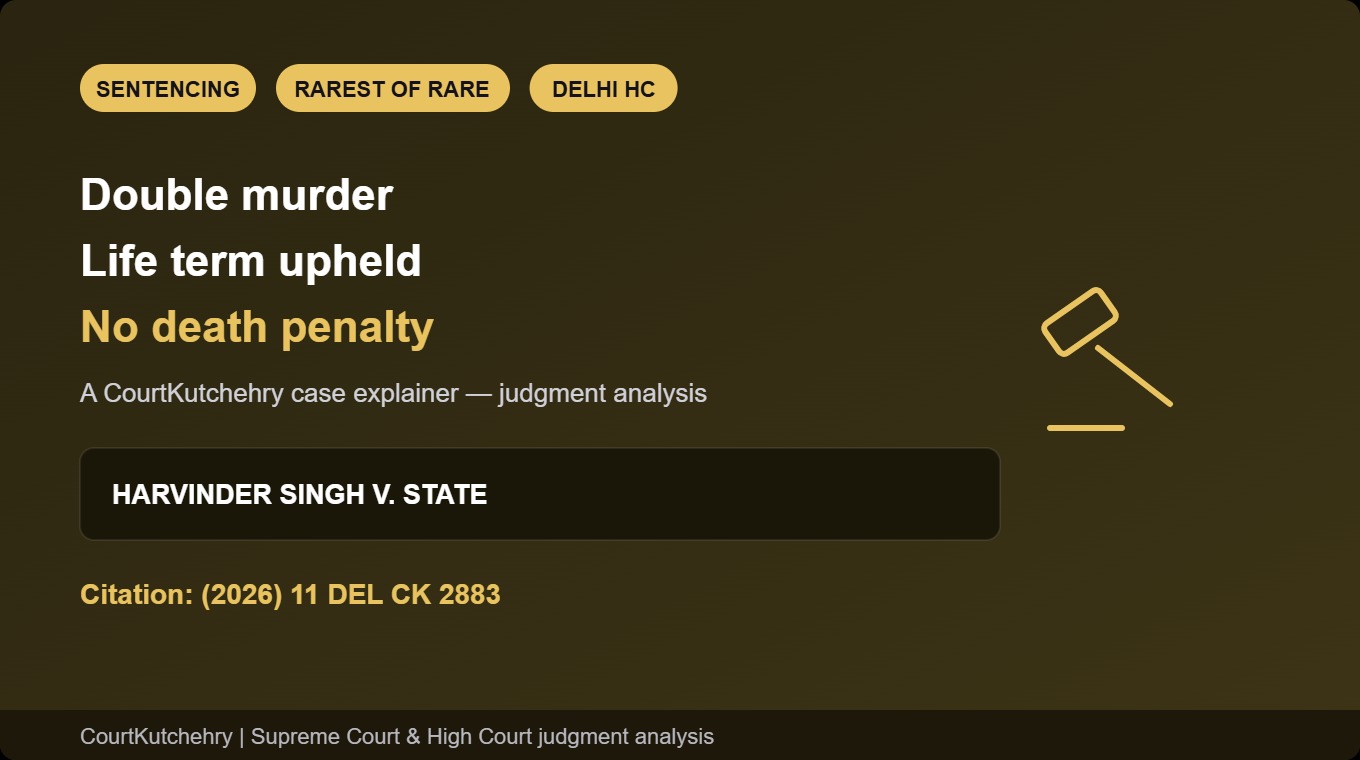
The Delhi High Court on 17 November 2026 dismissed three connected appeals arising from a 2011 robbery and double murder near Pul Mithai in Central Delhi. Ajay Kumar Tomar's appeal against his conviction failed, and so did the appeals of the State and of Harvinder Singh @ Vimpy Chaddha, the son of one of the deceased, who wanted the life sentences raised to death. A Division Bench of Justice Navin Chawla and Justice Ravinder Dudeja held that the case did not fall in the “rarest of rare” category and left the trial court's sentences undisturbed.
According to the prosecution, at about 9 pm on 24 September 2011, near Railway Hospital on SPM Marg, a man in police uniform robbed a person of gold chains and lockets and shot him; he died at Tirath Ram Hospital. During the chase that followed, the accused shot a second man in the neck, who died on 26 September 2011. The FIR was registered at PS Lahori Gate in the early hours of 25 September 2011, and the accused was arrested the same day. Two pistols, about 160 grams of gold ornaments and a uniform shirt were recovered. The prosecution examined 49 witnesses. On 24 December 2021 the Additional Sessions Judge, Tis Hazari, acquitted him under Sections 170, 171 and 468 IPC but convicted him under Sections 397/302 IPC for the first killing, Section 302 IPC for the second, and Sections 25 and 27 of the Arms Act. By order of 13 May 2022 he received life imprisonment for each murder, with fines of Rs 2 lakh and Rs 5 lakh, and the trial court held the case was not rarest of rare.
The defence argued that the main eyewitness's presence was doubtful given the PCR and ambulance timings, that recoveries were suspect, that forensic evidence was inconclusive and that a key witness was planted. On sentence, it relied on about 15 years in custody and good jail conduct. The State and the son sought death or, alternatively, life for the rest of natural life or a fixed term without remission, pointing to two killings and the accused's position as a police official.
The Key Question Before the Court
Was the conviction for the two murders sound, and did the case call for the death penalty or only life imprisonment?
Why the conviction was upheld
On the first killing, the Court relied on the earliest police information recording that the injured man had been shot by a person in police uniform, and found the eyewitness who was beside him substantially trustworthy. His account was supported by the scene of crime, medical and post-mortem evidence, empty cartridges and blood in the car, ballistic matching, fingerprints and the recoveries. The discrepancies pointed out by the defence were treated as “investigative deficiencies and lapses” that did not touch the core of the case, and the Court noted the principle that a faulty investigation cannot benefit the accused.
On the second killing, the Court accepted the evidence of the head constable who chased the accused on a borrowed motorcycle, and of another eyewitness whom it refused to discard as an interested or planted witness. It held that the absence of prior enmity does not defeat murder under Section 300 IPC: intention can form on the spur of the moment, and firing at a pursuer's neck showed it.
Why death was refused
The Court weighed the aggravating features: two deaths, an officer who abused a position of trust, a killing for gain and the killing of an innocent civilian during escape. Applying Bachan Singh v. State of Punjab (1980) and Machhi Singh v. State of Punjab, (1983) 07 SC CK 0002, and the later catalogue of circumstances in Ramnaresh v. State of Chhattisgarh (2012), Madan v. State of U.P. (2023) and Sundar v. State (2024), it held that life imprisonment is the rule and death the exception. The material did not show exceptional brutality or that reform was impossible, and two murders, however grave, do not by themselves call for death.
What the Court Actually Held
- CRL.A. 362/2022 filed by Ajay Kumar Tomar against conviction and sentence was dismissed.
- CRL.A. 651/2022 (State) and CRL.A. 321/2022 (victim's son) seeking enhancement were dismissed.
- The trial court's conviction under Sections 302/397 IPC, Section 302 IPC and Sections 25/27 of the Arms Act, and its sentences, were maintained.
- A copy of the judgment was directed to be sent to the trial court and the Jail Superintendent.
Why This Judgment Matters
- It reaffirms that the number of victims alone does not convert a case into a rarest of rare case.
- It shows how courts separate investigative lapses from the core evidence that proves guilt.
- It treats an offender's misuse of a police position as aggravating, yet still insists that reform must be shown to be impossible before death is imposed.
What Should Advocates Take Away From the Judgment?
For Defence Counsel
- Attacks on timing and minor omissions rarely succeed where ballistic, fingerprint and recovery evidence line up with the eyewitness.
- Build a mitigation record (custody period, jail conduct) early; the sentence hearing on enhancement depends on it.
For Prosecutors and Victims' Counsel
- A plea for death must address the reform question directly; listing aggravating factors is not enough.
- Where death is refused, the alternative prayer for a fixed term without remission needs separate reasoning.
For Trial Courts
- A clear sentencing order explaining why a case is not rarest of rare is likely to be maintained on appeal.
Key Takeaways
- Delhi High Court upheld the conviction of Ajay Kumar Tomar for two murders committed in September 2011.
- Appeals by the State and the victim's son for the death penalty were dismissed.
- The Court held that life imprisonment is the rule and death the exception, even for two killings.
- Investigative lapses did not displace consistent eyewitness, ballistic and forensic evidence.
Frequently Asked Questions
Why did the Delhi High Court not award death?
It found no exceptional brutality or depravity and nothing to show that reform was impossible. Applying Bachan Singh and Machhi Singh, it held that two murders do not mechanically warrant death.
Who filed the appeals?
Three appeals were heard together: the accused against conviction, the State for enhancement, and the son of one deceased, Harvinder Singh @ Vimpy Chaddha, also for enhancement.
Does the absence of motive or enmity help the accused in a murder case?
Not here. The Court said intention can form at the spur of the moment, and firing at a pursuer's neck showed the intention needed for Section 300 IPC.
Conclusion
The Delhi High Court has upheld both the conviction and the trial court's refusal to impose death. The judgment is a reminder that sentencing in murder cases turns on careful balancing, and that the gravity of the crime, even with two victims and a uniformed offender, must still be weighed against the possibility of reform.
Practical takeaway: On enhancement appeals, counsel must engage with reformation evidence; on conviction appeals, minor gaps rarely outweigh corroborated forensic evidence.
For more judgments, legal opinions and case analysis, visit courtkutchehry.com