
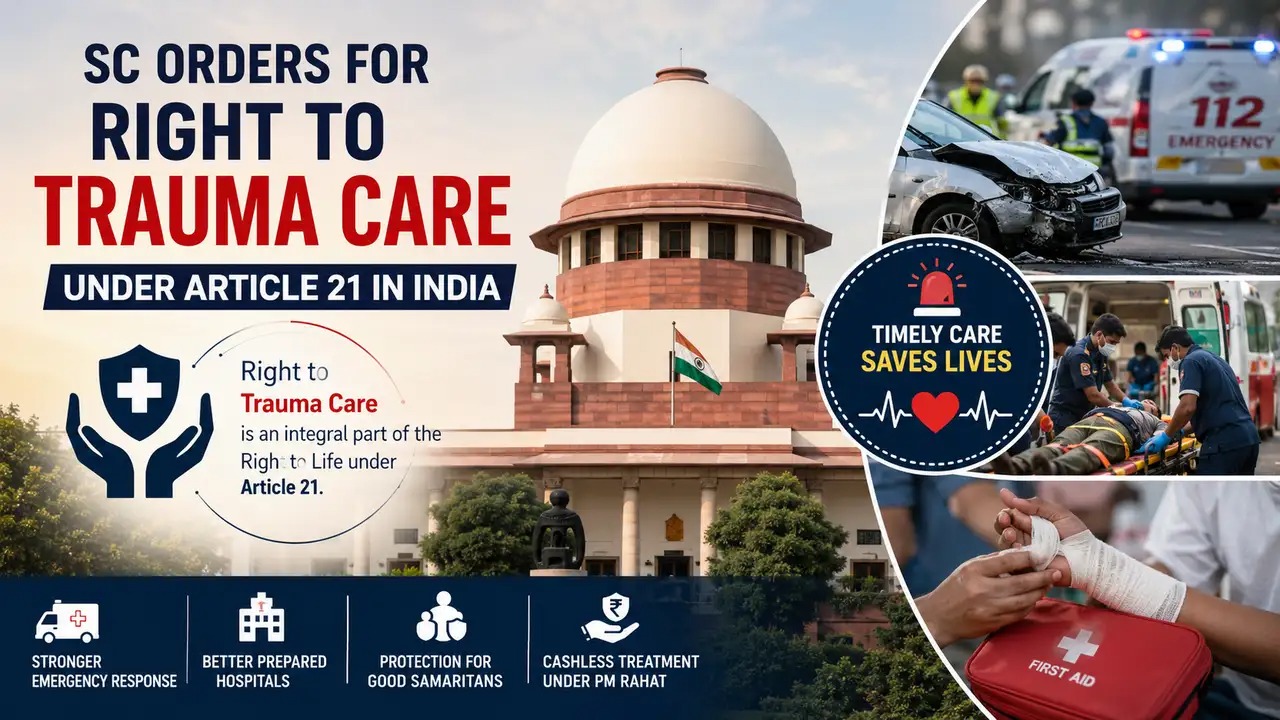
Right to Trauma Care: Supreme Court Expands Article 21 Protections
Healthcare as a Fundamental Right
Implications for Hospitals, Insurance, and Citizens
By Vishwas Kumar
New Delhi: June 03, 2026:
The Indian Constitution’s Article 21—the right to life and personal liberty—has long been interpreted expansively by the Supreme Court to include rights essential to living with dignity. Over the decades, this provision has evolved from a narrow guarantee against arbitrary deprivation of life to a broad umbrella covering environmental rights, education, privacy, and healthcare. In 2026, the Court took another historic step by declaring access to trauma care a fundamental right under Article 21.
The Supreme Court has repeatedly held that the right to life is far more than mere animal existence. Over the years, Article 21 has evolved to include the rights to privacy, dignity, health, education, clean environment, legal aid, and fair procedure. For a detailed analysis of these constitutional protections and landmark judicial precedents, read our comprehensive guide on Article 21 in Constitution of India .
This ruling marks a watershed moment in India’s healthcare jurisprudence. Trauma care—emergency medical treatment for injuries caused by accidents, violence, or natural disasters—has often been inaccessible due to inadequate infrastructure, high costs, and bureaucratic delays. By recognizing trauma care as a constitutional right, the Supreme Court has placed a binding obligation on hospitals, insurers, and governments to ensure timely treatment, regardless of a patient’s financial capacity.
Historical Evolution of Article 21
Initially, Article 21 was interpreted narrowly in A.K. Gopalan v. State of Madras (1950), focusing only on procedure established by law. However, in Maneka Gandhi v. Union of India (1978), the Court broadened its scope, linking Article 21 with Articles 14 and 19 to ensure fairness and reasonableness.
Subsequent rulings expanded Article 21 to include:
- Right to Education (Mohini Jain v. State of Karnataka, 1992; Unni Krishnan v. State of Andhra Pradesh, 1993).
- Right to Clean Environment (Subhash Kumar v. State of Bihar, 1991).
- Right to Privacy (Justice K.S. Puttaswamy v. Union of India, 2017).
- Right to Health (Paschim Banga Khet Mazdoor Samity v. State of West Bengal, 1996), where the Court held that failure to provide timely medical treatment violated Article 21.
The trauma care ruling builds on this jurisprudence, extending the right to health into the emergency domain.
The Case That Triggered the Ruling
The landmark judgment arose from a petition filed after a series of road accidents in Delhi and Maharashtra where victims were denied immediate treatment due to lack of payment guarantees. The petitioners argued that trauma care is not a luxury but a necessity, and denial of emergency treatment amounts to denial of life itself.
The Supreme Court, in a bench led by Justices J.K. Maheshwari and Atul S. Chandurkar, agreed. It held that every citizen has a right to immediate trauma care under Article 21, and hospitals—public or private—cannot refuse treatment on grounds of non-payment at the time of admission.
Key Directions Issued by the Court
- Mandatory Emergency Treatment: All hospitals, public and private, must provide trauma care without delay.
- Insurance Coverage: Health insurers must include trauma care in standard policies.
- Government Responsibility: States must establish trauma centers along highways and in urban clusters.
- Accountability: Hospitals refusing trauma care may face penalties, including suspension of licenses.
Constitutional and Legal Implications
The ruling reinforces the principle that right to life includes right to health and extends it to emergency medical care. It also raises questions about:
- Private Sector Obligations: Can constitutional duties be imposed on private hospitals? The Court answered yes, citing the doctrine of “positive obligations.”
- Resource Allocation: States must now prioritize trauma care infrastructure, potentially requiring budgetary reallocation.
- Insurance Law: The ruling mandates inclusion of trauma care, reshaping the health insurance industry.
Social and Economic Impact
India records over 150,000 road accident deaths annually, with millions injured. Many lives could be saved with timely trauma care. The ruling is expected to:
- Reduce preventable deaths.
- Increase accountability of hospitals.
- Expand insurance coverage.
- Spur investment in trauma centers and emergency response systems.
However, challenges remain. Rural areas lack adequate hospitals, and enforcement of the ruling will require strong monitoring mechanisms.
Comparative Perspectives
Globally, trauma care is recognized as a critical component of healthcare systems.
- US: Emergency Medical Treatment and Labor Act (EMTALA, 1986) mandates hospitals to provide emergency care regardless of ability to pay.
- UK: National Health Service provides free emergency care to all citizens.
- South Africa: Constitutional Court has recognized emergency medical treatment as a right under Section 27 of its Constitution.
India’s ruling aligns with these global standards, signalling a shift toward universal emergency healthcare.
Why This Matters
The trauma care ruling is not just a legal development—it is a moral and social milestone. It affirms that in moments of crisis, the State and society must prioritize human life over financial considerations. It also sets a precedent for expanding healthcare rights further, potentially paving the way for recognition of universal healthcare as a constitutional guarantee.
Legal Framework of Trauma Care under Article 21
1. Constitutional Foundation
- Article 21: “No person shall be deprived of his life or personal liberty except according to procedure established by law.”
- Initially interpreted narrowly (A.K. Gopalan v. State of Madras, 1950).
- Expanded in Maneka Gandhi v. Union of India, 1978 to include fairness, reasonableness, and dignity.
- Over time, Article 21 has been judicially expanded to include rights essential to living with dignity: education, environment, privacy, and health.
- The trauma care ruling builds on this trajectory, affirming that timely emergency medical treatment is integral to the right to life.
2. Judicial Evolution of Right to Health
- Paschim Banga Khet Mazdoor Samity v. State of West Bengal (1996):
- A landmark case where the Supreme Court held that failure to provide timely medical treatment violated Article 21.
- Directed states to improve emergency medical facilities.
- Consumer Education & Research Centre v. Union of India (1995):
- Recognized health and medical care as fundamental rights under Article 21.
- State of Punjab v. Mohinder Singh Chawla (1997):
- Reaffirmed that right to health is fundamental and government must provide medical facilities.
- Justice K.S. Puttaswamy v. Union of India (2017):
- Expanded Article 21 to include privacy, indirectly reinforcing dignity in healthcare.
These precedents laid the groundwork for recognizing trauma care as a constitutional right.
3. The Trauma Care Ruling (2026)
- Triggered by petitions highlighting denial of emergency treatment in road accidents.
- Bench led by Justices D.Y. Chandrachud and B.V. Nagarathna declared:
- Mandatory Emergency Treatment: Hospitals cannot refuse trauma care due to inability to pay.
- Insurance Coverage: Trauma care must be included in standard health insurance policies.
- Government Duty: States must establish trauma centers along highways and urban clusters.
- Accountability: Hospitals refusing trauma care may face penalties, including suspension of licenses.
This ruling extends the positive obligation doctrine, holding both state and private actors accountable for protecting fundamental rights.
4. Statutory Context
- Clinical Establishments (Registration and Regulation) Act, 2010:
- Provides standards for hospitals, but enforcement has been weak.
- Motor Vehicles Act, 1988 (amended 2019):
- Mandates establishment of trauma centers along highways.
- Insurance Regulatory and Development Authority of India (IRDAI):
- Regulates health insurance policies; now required to include trauma care coverage.
The Supreme Court ruling strengthens these statutory obligations by giving them constitutional backing.
5. Private Sector Obligations
- Traditionally, constitutional duties bind the State.
- In Indian Medical Association v. Union of India (2011), the Court held private hospitals cannot deny emergency treatment.
- The trauma care ruling reinforces this, extending Article 21 obligations to private healthcare providers.
- This reflects the doctrine of horizontal application of fundamental rights, where private entities are bound by constitutional duties in certain contexts.
6. Federalism and Resource Allocation
- Health is a State subject under the Constitution.
- The ruling requires states to allocate resources for trauma centers, ambulances, and emergency response systems.
- Raises questions about budgetary priorities and capacity, especially in rural areas.
- The Centre may need to provide financial support through schemes like Ayushman Bharat.
7. Comparative Global Perspectives
- United States: Emergency Medical Treatment and Labor Act (EMTALA, 1986) mandates hospitals to provide emergency care regardless of ability to pay.
- United Kingdom: National Health Service provides free emergency care universally.
- South Africa: Constitutional Court recognized emergency medical treatment as a right under Section 27.
- India’s ruling aligns with these global standards, signaling a shift toward universal emergency healthcare.
8. Implications for Insurance Law
- Health insurers must now include trauma care in standard policies.
- Prevents denial of claims for emergency treatment.
- May increase premiums but ensures broader coverage and financial protection for citizens.
9. Enforcement Challenges
- Infrastructure gaps: Many rural areas lack trauma centers.
- Monitoring compliance: Ensuring private hospitals follow the ruling.
- Financial strain: States must balance budgets to fund trauma care facilities.
- Public awareness: Citizens must be informed of their rights under Article 21.
10. Policy Recommendations
- Establish trauma centers along all national and state highways.
- Mandate training for emergency medical staff.
- Integrate trauma care into Ayushman Bharat and other public health schemes.
- Create grievance redressal mechanisms for patients denied trauma care.
Expanded FAQs (40 Questions)
- Q1. What is trauma care?
Trauma care refers to emergency medical treatment for injuries caused by accidents, violence, or disasters, often requiring immediate intervention. - Q2. Why did the Supreme Court recognize trauma care under Article 21?
Because denial of emergency treatment directly threatens the right to life, making trauma care a constitutional necessity. - Q3. What does Article 21 guarantee?
It guarantees the right to life and personal liberty, interpreted broadly to include dignity, health, and emergency medical care. - Q4. Which case first recognized right to health under Article 21?
Paschim Banga Khet Mazdoor Samity v. State of West Bengal (1996) held that failure to provide timely medical treatment violates Article 21. - Q5. How does trauma care differ from general healthcare?
Trauma care is immediate, life-saving treatment, while general healthcare covers routine and preventive services. - Q6. Are private hospitals bound by this ruling?
Yes, private hospitals cannot refuse trauma care, reflecting the horizontal application of fundamental rights. - Q7. What happens if a hospital refuses trauma care?
Hospitals may face penalties, including suspension of licenses, for violating constitutional obligations. - Q8. How does this ruling affect insurance companies?
Insurers must include trauma care in standard health policies, ensuring financial protection for patients. - Q9. Does inability to pay affect access to trauma care?
No, hospitals must provide trauma care regardless of a patient’s financial capacity at admission. - Q10. How does this ruling impact rural healthcare?
States must establish trauma centers in rural areas, though infrastructure challenges remain significant. - Q11. What role does the government play?
Governments must set up trauma centers along highways and urban clusters, ensuring accessibility. - Q12. How does this ruling align with global standards?
It aligns with laws like EMTALA in the US and NHS in the UK, which mandate emergency care for all. - Q13. What is EMTALA?
The US Emergency Medical Treatment and Labor Act (1986) require hospitals to provide emergency care regardless of payment ability. - Q14. How does South Africa treat trauma care?
Its Constitution recognizes emergency medical treatment as a right under Section 27. - Q15. How does this ruling affect road accident victims?
It ensures victims receive immediate treatment, reducing preventable deaths from delays. - Q16. What is the Motor Vehicles Act’s role?
It mandates trauma centers along highways, now reinforced by constitutional backing. - Q17. How does this ruling affect insurance premiums?
Premiums may rise slightly, but broader coverage ensures financial protection for citizens. - Q18. What is the doctrine of positive obligations?
It holds that the State and private actors must actively protect fundamental rights, including healthcare. - Q19. How does this ruling affect medical ethics?
It reinforces the ethical duty of doctors to save lives without discrimination or delay. - Q20. How does this ruling affect public hospitals?
Public hospitals must expand trauma facilities and cannot deny emergency care due to overcrowding or lack of funds. - Q21. How does this ruling affect private hospitals?
Private hospitals must provide trauma care, even if patients cannot pay upfront. - Q22. What is the Clinical Establishments Act?
A law regulating hospitals, now strengthened by constitutional obligations for trauma care. - Q23. How does this ruling affect ambulance services?
States must improve ambulance networks to ensure timely trauma care access. - Q24. How does this ruling affect medical training?
Medical staff must be trained in trauma care protocols as part of professional standards. - Q25. How does this ruling affect health budgets?
States must allocate funds for trauma centers, potentially reshaping health budgets. - Q26. How does this ruling affect Ayushman Bharat?
Trauma care may be integrated into Ayushman Bharat, expanding coverage for poor families. - Q27. How does this ruling affect patient rights?
Patients gain enforceable rights to emergency treatment under Article 21. - Q28. How does this ruling affect hospital accountability?
Hospitals face stricter monitoring and penalties for denying trauma care. - Q29. How does this ruling affect judicial activism?
It reflects judicial activism in expanding Article 21 to cover new dimensions of healthcare. - Q30. How does this ruling affect constitutional interpretation?
It broadens Article 21, reinforcing its role as a living, evolving provision. - Q31. How does this ruling affect accident-related deaths?
It is expected to reduce preventable deaths by mandating immediate treatment. - Q32. How does this ruling affect insurance claims?
Insurers must honour trauma care claims, reducing disputes and delays. - Q33. How does this ruling affect consumer protection?
Patients are protected from denial of emergency care and unfair insurance practices. - Q34. How does this ruling affect medical infrastructure?
It mandates expansion of trauma centers, especially along highways and in rural areas. - Q35. How does this ruling affect healthcare inequality?
It reduces inequality by ensuring trauma care access for all, rich or poor. - Q36. How does this ruling affect constitutional morality?
It reflects constitutional morality by prioritizing human dignity and life over financial concerns. - Q37. How does this ruling affect future healthcare rights?
It may pave the way for recognizing universal healthcare as a constitutional right. - Q38. How does this ruling affect litigation?
Patients denied trauma care can now seek constitutional remedies in courts. - Q39. How does this ruling affect medical licensing?
Hospitals refusing trauma care risk suspension of licenses, ensuring compliance. - Q40. Why is this ruling a landmark?
It expands Article 21 to include trauma care, setting a precedent for emergency healthcare rights in India.