

COURTKUTCHEHRY EXCLUSIVE: EXTRACTS FROM BEST SELLING BOOK: WILL WRITING SIMPLIFIED
Transfer vs Will in Indian Law: Understanding the Crucial Differences
Transfers take effect immediately, while Wills operate only after death.
Testamentary succession preserves control and prevents misuse during a testator’s lifetime.
By Vishwas Kumar
New Delhi: April 01, 2026:
Property disputes in India often hinge on one fundamental question: was the asset transferred during the owner’s lifetime, or was it meant to pass on after death through a Will? The distinction between a transfer and a Will is not just technical—it determines rights, responsibilities, and the very nature of succession.
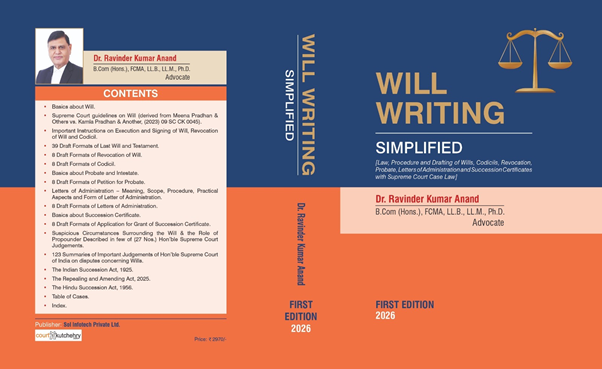
The extract from Will Writing Simplified by Dr. Ravinder Kumar Anand [📘 Buy Will Writing Simplified online: Amazon 🔹 Flipkart] explains this difference with clarity. A transfer is an immediate conveyance of property between living persons, while a Will is a revocable declaration of how property should be distributed after death. This article unpacks the extract in plain language, situates it within Indian succession law, and explores its implications for families, society, and courts.
Detailed Explanation of the Extract in Plain Language
The extract states: “A ‘Transfer’ is an immediate conveyance of an existing property by one living person to another (transfer inter vivos). A Will, however, does not involve any transfer during the Testator’s lifetime. It merely expresses the Testator’s wishes regarding succession to be carried out after death.”
Breaking this down:
- Transfer: Happens during the lifetime of the property owner. For example, selling a house or gifting land. It is immediate and irrevocable.
- Will: Does not transfer property while the testator is alive. It only takes effect after death. Until then, the testator can revoke or change it.
The extract further clarifies:
- Transfer is irrevocable: Once done, it cannot be undone except by another legal act.
- Will is revocable: The testator can change or cancel it any time before death.
- No rights during lifetime: Beneficiaries under a Will gain no rights while the testator is alive. This prevents misuse and ensures the testator retains full control.
- Testamentary succession vs non-testamentary succession: Wills represent testamentary succession, while transfers and personal laws govern non-testamentary succession.
Legal Context
- Indian Succession Act, 1925: Governs Wills, stating they operate only after death and can be revoked any time before.
- Transfer of Property Act, 1882: Governs transfers inter vivos, which are immediate and binding.
- Hindu Succession Act, 1956: Governs intestate succession (when no Will exists), contrasting with testamentary succession under Wills.
Thus, the law draws a sharp line: transfers are present acts, Wills are future declarations.
Examples and Case Studies (Hypothetical)
- Example 1: Transfer vs Will
A father gifts his house to his son during his lifetime. This is a transfer—immediate and irrevocable. If instead he writes a Will leaving the house to his son, the son gets no rights until the father’s death. - Example 2: Revocability of Will
An elderly woman writes a Will leaving her jewellery to her niece. Later, she changes her mind and revokes it. This is valid because Wills are revocable. If she had transferred the jewellery during her lifetime, she could not take it back. - Example 3: Preventing misuse
A man writes a Will leaving property to his friend. The friend cannot misuse it while the man is alive, because no rights are transferred until death.
Historical and Comparative Context
- India: The distinction between transfers and Wills has long been recognized, ensuring clarity in succession law.
- England: Similar principles apply—transfers are immediate, Wills operate after death.
- United States: Wills are revocable until death, while transfers are binding once executed.
This global consistency reflects the universal principle: testamentary freedom must be preserved until death, while transfers reflect present ownership decisions.
Implications for Society, Families, and Courts
- For families: Understanding the difference prevents disputes. Beneficiaries under a Will cannot claim rights prematurely.
- For society: Protects elders from pressure to part with property during their lifetime.
- For courts: Clarifies succession disputes, distinguishing between present transfers and future testamentary declarations.
Conclusion
The difference between a transfer and a Will is fundamental in Indian property law. Transfers are present acts, binding and irrevocable. Wills are future declarations, revocable until death, ensuring the testator’s control. Families, lawyers, and courts must respect this distinction to avoid disputes and uphold testamentary freedom
FAQ Section
1. What is the main difference between a transfer and a Will?
A transfer is immediate and irrevocable; a Will is revocable and operates only after death.
2. Do beneficiaries under a Will have rights during the testator’s lifetime?
No. They gain rights only after the testator’s death.
3. Can a Will be changed?
Yes. A Will can be revoked or altered any time before death.
4. Is a transfer revocable?
No. Once made, a transfer is binding unless legally reversed.
5. What is testamentary succession?
Succession through a Will, effective after death.
6. What is non-testamentary succession?
Succession under personal laws or transfers made during lifetime.
7. Why is revocability important in Wills?
It ensures the testator retains full control until death, preventing misuse.
Book Reference
Exact Sentences Used from the Extract
- “A ‘Transfer’ is a immediate conveyance of an existing property by one living person to another (transfer inter vivos).”
- “A Will, however, does not involve any transfer during the Testator’s lifetime. It merely expresses the Testator’s wishes regarding succession to be carried out after death.”
- “A transfer is irrevocable and takes effect immediately or on a defined contingency, whereas a Will is revocable and operates only upon death.”
- “No beneficiary under a Will obtains any right during the Testator’s lifetime, which prevents misuse and preserves absolute control.”
- “Testamentary succession therefore stands in contrast to non-testamentary succession under personal laws.”
[📘 Buy Will Writing Simplified online: Amazon 🔹 Flipkart]
Suggested Keywords for SEO
- Difference between transfer and Will India
- Indian Succession Act Will law
- Transfer of Property Act vs Will
- Testamentary succession India
- Revocability of Wills India
- Will Writing Simplified Dr Ravinder Kumar Anand