

COURTKUTCHEHRY EXCLUSIVE: EXTRACTS FROM BEST SELLING BOOK: WILL WRITING SIMPLIFIED
Suspicious Circumstances in Indian Will Law: Why Courts Demand Stronger Proof
When doubts arise, the burden shifts to the propounder of the Will.
Indian courts scrutinize secrecy, signatures, and family exclusions to protect true intentions.
By Vishwas Kumar
April 01, 2026:
In India, writing a Will is often seen as the final act of control over one’s property. Yet, disputes over Wills are among the most common cases in succession law. Families frequently clash in court, questioning whether the document truly reflects the testator’s free will or whether it was influenced by others. The law recognizes that certain situations raise suspicion, and when these arise, courts demand stronger proof before accepting the Will.
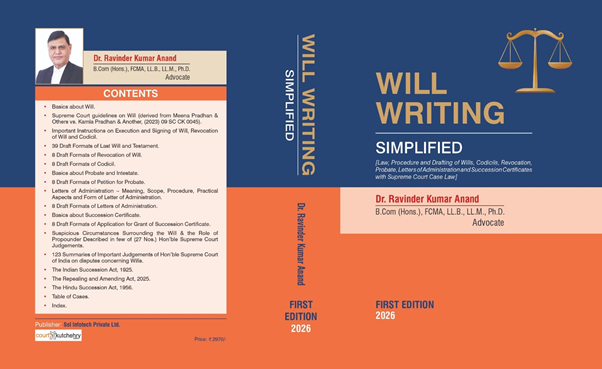
You can explore the detailed Supreme Court judgments on wills, featuring a curated list of 123 key judgments highlighted in the book “Will Writing Simplified” for quick research and legal reference.
The extract from Will Writing Simplified by Dr. Ravinder Kumar Anand [📘 Buy Will Writing Simplified online: Amazon 🔹 Flipkart] provides a clear framework for understanding what counts as “suspicious circumstances” in Will disputes. This article explains those circumstances in plain language, places them in the context of Indian succession law, and explores their impact on families and courts.
Explanation of the Extract in Plain Language
The extract defines suspicious circumstances as facts that raise doubt about whether the Will truly reflects the testator’s free and conscious intention.
Key points from the extract:
- Burden of proof shifts: If suspicion arises, the person who wants the Will to be accepted (the propounder) must prove it is genuine.
- Examples of suspicious circumstances:
- Excluding close family members without reason.
- A major beneficiary being actively involved in drafting or executing the Will.
- Doubts about the testator’s mental condition, frailty, or medication.
- Doubtful signatures or conflicting witness testimonies.
- Execution in secrecy or unusual circumstances.
- Non-registration where registration was reasonably expected.
- Contradictions or gaps in evidence.
- Effect: These situations do not automatically invalidate a Will but require stronger proof.
- How to dispel suspicion: Medical records, contemporaneous notes, and independent witnesses often help remove doubts.
Legal Context
Suspicious circumstances are not directly defined in statutes but are recognized through judicial interpretation.
- Indian Succession Act, 1925: Governs Wills for most communities (except Hindus, Muslims, Buddhists, Sikhs, and Jains, who are covered under personal laws). Section 63 outlines execution requirements: signature of the testator and attestation by two witnesses.
- Hindu Succession Act, 1956: Deals with intestate succession but indirectly influences disputes when a Will excludes heirs.
- Case law: Courts have repeatedly held that when suspicious circumstances exist, the propounder must remove them with convincing evidence. For example, exclusion of natural heirs without explanation is treated as suspicious.
Examples and Case Studies
- Hypothetical Example 1: A father leaves all property to one son, excluding his daughters without explanation. The court may ask why. If the son was involved in drafting the Will, suspicion deepens.
- Hypothetical Example 2: An elderly woman on heavy medication signs a Will in secrecy, leaving property to her caretaker. Unless medical records and independent witnesses confirm her sound mind, the Will may be challenged.
- Hypothetical Example 3: A Will is unregistered though the testator had earlier registered property documents. Courts may ask why registration was avoided.
Historical and Comparative Context
- Evolution in India: Earlier, courts were more formalistic, focusing only on signatures and witnesses. Over time, they recognized that undue influence and fraud could be hidden behind formal compliance.
- Comparative view: In England, courts also scrutinize suspicious circumstances, especially when beneficiaries are involved in drafting. In the U.S., “undue influence” is a common ground for challenge. India’s approach is similar but places heavier emphasis on family exclusions and secrecy.
Implications for Society, Families, and Courts
- For families: Suspicious circumstances often lead to bitter disputes, breaking family bonds.
- For society: They highlight the need for transparent Will-making practices, such as involving independent witnesses and doctors.
- For courts: Suspicion increases workload, requiring detailed examination of evidence, medical records, and witness credibility.
FAQ Section
1. Does suspicion automatically cancel a Will?
No. Suspicion only means stronger proof is required. The Will can still be valid if doubts are dispelled.
2. Is registration of a Will compulsory?
No. But if registration was expected, non-registration may raise suspicion.
3. Can exclusion of family members be valid?
Yes, but the testator should provide reasons. Otherwise, courts may treat it as suspicious.
4. What if a beneficiary helped draft the Will?
It is not illegal, but it raises suspicion. Independent witnesses and clear evidence are needed.
5. How can suspicion be removed?
Through medical records, contemporaneous notes, and testimony of independent witnesses.
6. What if signatures look doubtful?
Expert handwriting analysis and credible witness testimony can help.
7. Are secret Wills valid?
Yes, but secrecy itself may raise suspicion unless explained.
Conclusion
Suspicious circumstances are a safeguard in Indian succession law. They ensure that Wills reflect genuine intention, not manipulation. Families should draft Wills transparently, involve independent witnesses, and keep medical records when necessary. Courts, by demanding stronger proof, protect both the testator’s wishes and the rights of heirs.
Book Reference
📘 Buy Will Writing Simplified online: Amazon 🔹 Flipkart
Exact Sentences Used from the Extract
- “Suspicious Circumstances are facts that raise doubt as to whether the Will truly reflects the Testator’s free and conscious intention.”
- “When suspicion arises, the burden shifts to the propounder to dispel it by clear and convincing evidence.”
- “Courts treat the following as suspicious circumstances: (i) Unnatural or unjust dispositions such as exclusion of close family members without reason; (ii) Active involvement of a major beneficiary in drafting or executing the Will; (iii) Doubts regarding the Testator’s mental condition, frailty, or medication; (iv) Doubtful signatures or contradicting testimonies of witnesses; (v) Execution in secrecy or unusual circumstances; (vi) Non-registration where registration was reasonably expected; (vii) material Contradictions or gaps in evidence.”
- “These situations require stronger proof but do not automatically invalidate a Will.”
- “Medical records, contemporaneous notes, and independent witnesses often help remove doubts.”
Suggested Keywords for SEO
- Suspicious circumstances in Indian Wills
- Indian Succession Act Will disputes
- Hindu Succession Act and Wills
- Burden of proof in Will cases
- Will registration India
- Will writing simplified Dr Ravinder Kumar Anand
- Probate and suspicious circumstances India