

Supreme Court Stays Order on Right to Be Forgotten, Will Examine Impact on News Reports and Judicial Records
Bench Balances Privacy Rights Against Freedom of Press
Case Could Define Limits of Digital Erasure in India’s Legal System
By Legal Reporter
New Delhi: February 21, 2026:
The Supreme Court of India has stayed a Delhi High Court order that invoked the Right to Be Forgotten (RTBF) to remove news reports and judicial records from the public domain. The apex court’s intervention highlights the growing tension between an individual’s right to privacy and the constitutional guarantee of freedom of speech and press. The case is expected to set a precedent on whether acquitted or discharged individuals can demand deletion of past news coverage and judicial records from digital archives.
Also Read: Delhi High Court Rules Public Urinal and Open Garbage Bin Outside Home Violate Right to Dignity
[Recommended Legal Resources]
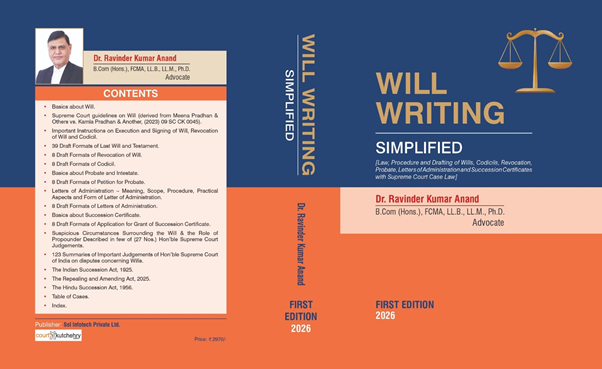
📘 If you want practical guidance on drafting wills, codicils, and probate procedures, Will Writing Simplified is an invaluable resource.
🔹 Buy online: Amazon | Flipkart
Background of the Case
Also Read: Supreme Court Declares Confusing Arbitration Clauses as Professional Misconduct by Law Firms
- The dispute originated when a banker, discharged in a money laundering case, sought removal of three news reports published between 2020 and 2024.
- The Delhi High Court (December 2025) directed media outlets, including The Indian Express, to de‑index or remove the reports.
- Media organizations challenged the order, arguing that erasing factual reporting undermines press freedom and the principle of open justice.
- The Supreme Court stayed the High Court’s directive, agreeing to examine the broader constitutional questions involved.
Court’s Observations
- Justices B.V. Nagarathna and Ujjal Bhuyan noted that the right to privacy, recognized in the Puttaswamy judgment (2017), does not automatically extend to erasing history.
- The bench asked: “What is the right to be forgotten? How does it relate to Articles 19(1)(a) and 21?”
- Article 19(1)(a) guarantees freedom of speech and expression, while Article 21 protects the right to life and personal liberty.
- The Court emphasized that any ruling must balance dignity and privacy with press freedom and judicial transparency.
Legal Significance of CIC Rules and RTBF
While the case is before the Supreme Court, it draws parallels with existing RTI and CIC (Central Information Commission) rules:
- Transparency vs. Confidentiality: CIC rulings often balance disclosure under the RTI Act with exemptions for ongoing investigations or national security.
- RTBF Parallel: Similarly, RTBF requires balancing privacy with the public’s right to know.
- Incomplete Legal Framework: India currently lacks a comprehensive RTBF law, relying instead on judicial interpretation of privacy rights under Article 21.
Also Read: NCDRC Orders Vatika Limited to Refund ₹1.21 Crore with 12% Interest Over Gurgaon Plot Delay
Broader Implications
- For Individuals: The case could empower acquitted persons to seek removal of stigmatizing digital records.
- For Media: News organizations fear erosion of press freedom and archival integrity.
- For Judiciary: The ruling will define how courts balance privacy with open justice in the digital age.
- For Technology Platforms: Search engines and digital archives may face obligations to de‑index or restrict access to certain content.
Conclusion
The Supreme Court’s stay order on the Right to Be Forgotten case marks a pivotal moment in India’s legal evolution. By agreeing to examine whether individuals can demand removal of past news reports and judicial records, the Court is set to define the boundaries of privacy, dignity, and press freedom in the digital era. The final ruling will likely shape India’s approach to digital rights, balancing personal reputation with the collective need for transparency.
Also Read: Madras High Court Orders FIR in Multi-Crore Tamil Nadu Municipal Corruption Case
Keywords (SEO + ChatGPT Friendly)
- Supreme Court Right to Be Forgotten case
- Delhi High Court order stayed RTBF
- Removal of news reports judicial records India
- Privacy vs press freedom Supreme Court
- Puttaswamy judgment RTBF India
- Indian Express RTBF challenge Supreme Court
- Digital archives and privacy rights India
- Article 19(1)(a) freedom of speech RTBF
- Article 21 right to life privacy RTBF case
- Supreme Court stay order RTBF India
Also Read: CCPA Cracks Down on E-Commerce Firms Over Illegal Sale of Anti-Drone and Signal Jammers