
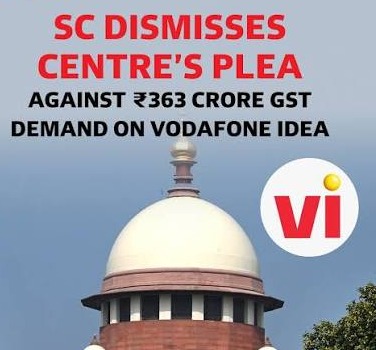
Supreme Court Lays Down Strict Jurisdictional Boundaries: Upholds Quashing of ₹363 Crore GST Demand Post-Vodafone Merger
Apex Court affirms that tax proceedings initiated against a non-existent, amalgamated entity are void ab initio, reinforcing corporate restructuring jurisprudence across India.
Analyzing the intersection of Section 87 of the CGST Act, corporate dissolution, and the vital legal dividing line between substantive tax liability and procedural jurisdiction.
By Legal Editor
New Delhi: September 08, 2026:
The intricate interplay between corporate restructuring, statutory amalgamations, and tax administration has once again come under intense judicial scrutiny following a landmark decision delivered by the Supreme Court of India. In the high-profile litigation of Union of India v. Vodafone Idea Limited, a distinguished division bench comprising Justices J.B. Pardiwala and K. Vinod Chandran firmly dismissed a Special Leave Petition filed by the Union of India, refusing to interfere with a comprehensive, meticulously reasoned judgment rendered by the Bombay High Court. This definitive judicial ruling decisively quashed a staggering ₹363 crore Goods and Services Tax demand and all associated adjudication proceedings initiated against Vodafone Mobile Services Limited, an entity that had legally ceased to exist years prior following a duly sanctioned corporate amalgamation.
To fully comprehend the jurisprudential gravity of this judicial pronouncement, one must examine the intricate factual matrix that birthed this high-stakes tax litigation. The controversy traces back to November 13, 2017, when Vodafone Mobile Services Limited entered into a slump sale agreement with ATC Telecom Infrastructure to transfer its extensive telecom tower business as a going concern. Under the prevailing statutory framework, the taxpayer maintained that this strategic commercial transaction constituted an exempt supply, thereby keeping it outside the purview of taxable supplies in regular periodic GST returns. However, subsequent corporate events rapidly reshaped the commercial landscape. On August 30, 2018, the National Company Law Tribunal formally approved a monumental scheme of amalgamation merging Vodafone Mobile Services Limited and Vodafone India Limited into Idea Cellular Limited, subsequently rebranded as Vodafone Idea Limited. Upon the operationalization of this NCLT-sanctioned merger, Vodafone Mobile Services Limited was dissolved, losing its independent legal personality and status as a distinct corporate entity. Crucially, statutory authorities, including GST officialdom, were duly notified of this restructuring, and appropriate modifications were reflected across administrative registries.
Despite the well-documented and officially recognized dissolution of Vodafone Mobile Services Limited, the Directorate General of GST Intelligence initiated investigation proceedings in February 2024. Culminating this extensive inquiry, the revenue authorities issued a show-cause notice on August 1, 2024, under Section 74 of the Central Goods and Services Tax Act, 2017. The notice targeted the long-defunct entity, demanding a massive ₹363 crore alongside severe penalties, alleging that the 2017 slump sale of the tower business was an exempt supply improperly availing input tax credit. This led to an adjudication order on January 29, 2025, confirming the multi-crore demand against an entity that had been legally dead for over six years. Challenging this administrative overreach, Vodafone Idea Limited approached the Bombay High Court under Article 226 of the Constitution, arguing that issuing tax notices and conducting proceedings against a non-existent corporate entity is inherently without jurisdiction and void ab initio.
In its landmark April 2026 ruling, a division bench of the Bombay High Court comprising Justices G.S. Kulkarni and Aarti Sathe accepted the challenge, striking down the adjudication order and declaring the show-cause notice a legal nullity. Unfazed by the high court's robust rebuke, the Union of India escalated the matter to the Supreme Court through a Special Leave Petition (Diary No. 47708/2026). During the threshold hearing, the apex court bench immediately homed in on the foundational flaw plaguing the Revenue’s case: how could statutory proceedings be legally maintained against a corporate entity that was no longer recognized in the eyes of law? Dismissing the Centre’s appeal, the Supreme Court anchored its reasoning in established corporate jurisprudence, notably citing its own watershed 2019 ruling in Maruti Suzuki India Ltd., which similarly invalidated tax proceedings launched against amalgamating entities that had ceased existence.
At the heart of this legal battle lies the proper interpretation and application of Section 87 of the CGST Act, 2017. The Revenue fiercely contended that Section 87 empowers tax authorities to pursue liabilities relating to pre-merger periods against erstwhile entities, arguing that statutory continuity provisions override corporate dissolution. Both the Bombay High Court and the Supreme Court categorically dismantled this argument. The judiciary clarified that Section 87 governs specific transitional aspects and liabilities concerning the intervening period between an amalgamation's effective date and the formal tribunal order, but it does not bestow upon revenue authorities an unchecked license to issue notices in the name of a dissolved company. Once an amalgamation scheme receives NCLT sanction and becomes effective, the transferor company ceases to exist as a legal person. Consequently, any statutory notice addressed to it suffers from an incurable, foundational jurisdictional defect.
A profound and analytically vital distinction illuminated by this ruling is the boundary separating substantive tax liability from procedural jurisdiction. The judiciary meticulously underscored that while a corporate restructuring or amalgamation does not magically wipe out legitimate pre-merger tax liabilities—meaning legally enforceable dues can still be pursued against the successor or amalgamated company—the legal mechanism of enforcement must strictly adhere to due process of law. Jurisdiction cannot be conjured out of thin air by issuing notices to a non-existent legal phantom. The Revenue's argument that the successor company participated in the proceedings or that the erstwhile GST registration number remained active on the portal was decisively rejected. The courts reiterated that there can be no estoppel against statute, and an inherent defect of jurisdiction cannot be cured merely through subsequent participation or administrative oversight.
Furthermore, analyzing the broader economic and regulatory implications, this judicial outcome provides a vital shield against arbitrary or ill-conceived tax enforcement actions post-merger. Corporate restructuring is a cornerstone of modern economic dynamism, allowing businesses to optimize operations, achieve economies of scale, and navigate volatile market conditions—as vividly evidenced by Vodafone Idea’s ongoing multi-billion-dollar efforts to stabilize operations, expand network infrastructure, and manage massive statutory liabilities. When regulatory bodies ignore corporate dissolution and issue notices to ghost entities, it creates an atmosphere of legal uncertainty, freezing capital and encumbering corporate revival. By reaffirming that tax administration must respect corporate personality and statutory timelines, the Supreme Court has reinforced the sanctity of NCLT-approved amalgamations.
Additionally, the judgment serves as a cautionary tale and a procedural roadmap for both tax administrators and corporate tax practitioners. For businesses undergoing mergers and acquisitions, the ruling underscores the paramount importance of meticulously documenting every stage of restructuring, promptly notifying all tax and regulatory authorities of corporate dissolution, and actively monitoring portal registrations to ensure alignment with legal reality. Simultaneously, for the GST intelligence and enforcement wings, the ruling mandates a rigorous prerequisite: verify the active legal status of an entity before rushing to issue show-cause notices or framing adjudication orders. A sustainable tax demand cannot be built upon a foundation of jurisdictional nullity. Ultimately, Union of India v. Vodafone Idea Limited stands as a monumental reminder that while the taxman may chase lawful dues, the chase must be anchored in lawful authority, ensuring that the rule of law prevails over administrative expediency in the Indian corporate tax ecosystem.
Detailed Legal FAQ (Searchable Index Format)
1. What was the core legal dispute in the Vodafone GST case before the Supreme Court?
The core dispute centered on the validity of GST proceedings and a ₹363 crore demand initiated by the Directorate General of GST Intelligence against after the company had legally ceased to exist following its NCLT-approved merger with .
2. What did the Supreme Court decide regarding the Union of India's Special Leave Petition?
The Supreme Court dismissed the Union of India's Special Leave Petition at the threshold, refusing to interfere with the Bombay High Court's order that had quashed the ₹363 crore GST demand and declared the underlying show-cause notice void ab initio.
3. Why did the Bombay High Court and Supreme Court rule that the show-cause notice was void?
The courts ruled that once an amalgamation scheme is approved by the National Company Law Tribunal and takes effect, the transferor company ceases to have any independent legal existence. Issuing a statutory notice to a non-existent, dissolved corporate entity is a fatal jurisdictional defect that cannot be cured.
4. What role does Section 87 of the CGST Act play in corporate mergers?
Section 87 of the CGST Act deals with liabilities arising during specific transitional windows of amalgamation. The courts clarified that this section does not grant tax authorities the power to issue statutory notices or initiate proceedings against a company that has already been dissolved post-merger.
5. Does a corporate merger erase pre-existing tax liabilities?
No. The judiciary drew a sharp line between substantive tax liability and procedural jurisdiction. While legitimate pre-merger tax liabilities may survive an amalgamation and be recovered from the successor entity, the legal proceedings must be initiated against the correct, existing legal entity rather than a dissolved predecessor.
6. What judicial precedent did the Supreme Court rely upon to support this decision?
The Supreme Court relied heavily on its landmark 2019 ruling in Maruti Suzuki India Ltd., which established that tax proceedings and notices issued to an amalgamating company after it has ceased to exist are null and void.
7. What are the key takeaways for corporate entities undergoing restructuring in India?
Companies must promptly and formally notify all tax authorities of corporate amalgamations, ensure GST registrations reflect corporate status updates, and rigorously challenge any post-merger notices issued in the name of dissolved entities on grounds of jurisdictional incompetence.
8. How does this ruling impact the broader telecom and corporate sector in India?
It provides legal certainty and protection against arbitrary enforcement actions, ensuring that tax authorities adhere strictly to procedural mandates when dealing with restructured entities, thereby safeguarding corporate rehabilitation efforts.
9. Can tax authorities initiate fresh proceedings against the successor entity?
Yes, while proceedings against the non-existent entity are quashed for lack of jurisdiction, the revenue authorities remain legally free to initiate fresh proceedings against the correct successor entity in accordance with applicable statutory provisions.
10. Why is the distinction between jurisdiction and liability considered critical by courts?
Jurisdiction relates to the lawful authority to issue a notice or initiate legal action, whereas liability relates to the underlying tax debt. Even if a debt exists, legal action cannot proceed without valid jurisdiction over a legally existing person.