

Supreme Court: Specific Pleadings on Date and Mode of Dispossession Mandatory in Property Recovery Suits
Plaintiffs must clearly state when and how possession was lost
Apex court dismisses appeal, sets strong precedent for property disputes
By Legal Reporter
New Delhi: February 11, 2026:
The Supreme Court of India has delivered a landmark judgment that will significantly impact property litigation across the country. The Court ruled that a suit for recovery of possession cannot succeed unless the plaintiff provides specific pleadings on the date and mode of dispossession. This decision emphasizes the importance of precision in legal drafting and reinforces the principle that vague or incomplete claims cannot stand in court.
Also Read: Kerala’s First Visually Challenged Woman Judge Marks Breakthrough in Disability Rights
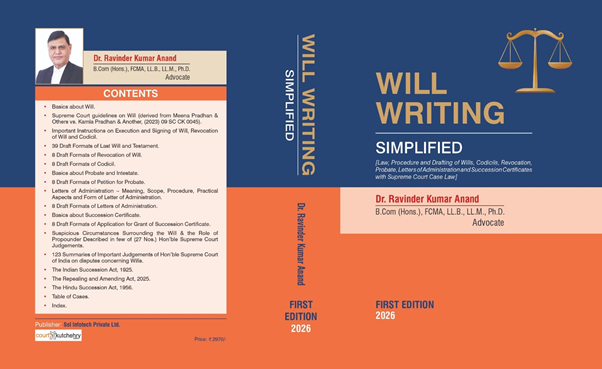
[Legal professionals and students alike will benefit from Will Writing Simplified, which covers procedure and case law in detail.]
🔹 Buy online: Amazon | Flipkart
Case Background
Also Read: Calcutta High Court: Partition Decree Executable Only After Stamp Duty Payment
- The case arose from a property dispute in Himachal Pradesh.
- The plaintiff filed a suit for perpetual injunction and recovery of possession, claiming wrongful dispossession.
- However, the plaint did not specify when and how the dispossession occurred.
- The Himachal Pradesh High Court had earlier dismissed the suit, and the matter reached the Supreme Court.
The Bench, comprising Justice Pankaj Mithal and Justice S.V.N. Bhatti, upheld the High Court’s decision, stressing that material pleadings are essential for relief.
Supreme Court’s Observations
The Court made several key points:
- Date and Mode of Dispossession: Plaintiffs must clearly state the exact date and circumstances under which possession was lost.
- Proof of Actual Possession: For perpetual injunction, the plaintiff must prove that they were in possession of the property at the time of filing the suit.
- No Relief Without Specifics: General allegations of dispossession are insufficient; courts require detailed pleadings and evidence.
- Concurrent Claims: A suit for injunction and recovery of possession must stand or fall on precise pleadings and proof.
Why This Matters
This ruling is crucial for property disputes in India:
Also Read: Punjab & Haryana High Court Slams Misuse of Contempt Law, Imposes ₹3 Lakh Cost
- It prevents misuse of the legal system through vague claims.
- It ensures that only genuine cases with clear evidence proceed.
- It strengthens the importance of legal drafting and documentation in civil suits.
Lawyers believe this judgment will reduce frivolous litigation and encourage plaintiffs to prepare stronger, evidence-backed cases.
Broader Legal Context
- Perpetual Injunction: A remedy to protect possession, requiring proof of actual possession at the time of filing.
- Recovery of Possession: A claim to regain property, requiring specific details of dispossession.
- Legal Drafting Standards: The ruling highlights the need for precision in pleadings, aligning with established principles of civil procedure.
This decision builds on earlier Supreme Court rulings that stressed the importance of specific pleadings in civil suits.
Expert Opinions
- Senior advocates say the ruling will serve as a guide for drafting property-related suits.
- Law professors note that it will be studied in law schools as a precedent-setting case.
- Property lawyers emphasize that families and individuals must maintain proper documentation to avoid disputes.
Impact on Families and Society
Property disputes are among the most common civil cases in India. This ruling:
- Provides clarity for litigants on what courts expect in pleadings.
- Encourages transparency and accuracy in property transactions.
- Helps courts filter out weak cases, reducing judicial backlog.
Also Read: CCPA Orders Barbeque Nation to Stop Levelling Mandatory Service Charges
Conclusion
The Supreme Court’s ruling on mandatory pleadings for recovery of possession suits is a milestone in property law. By insisting on specific details of dispossession, the Court has reinforced the principle that justice must be based on clarity and evidence, not vague allegations.
This judgment will serve as a reference point for future property disputes, guiding both litigants and courts in ensuring fair and efficient resolution.
Keywords for Faster Searches
- Supreme Court India recovery of possession
- Property dispute pleadings India
- Date and mode of dispossession case law
- Perpetual injunction property law India
- Himachal Pradesh property case Supreme Court
- Civil procedure property disputes India
- Landmark SC judgment property recovery
Also Read: Delhi High Court Slams Advocate for Misleading Family Court into Granting Divorce in Void Marriage