
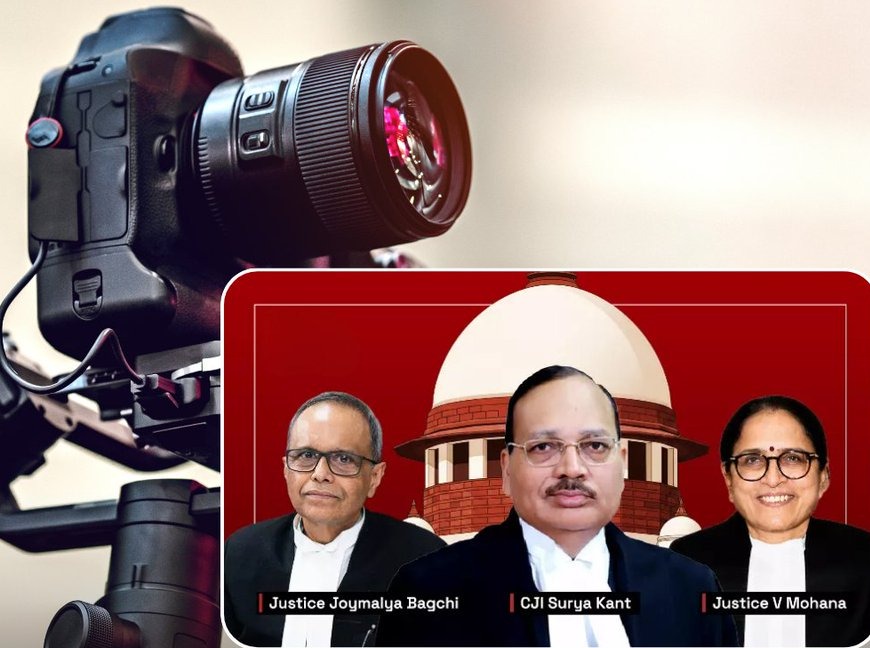
"Demon Out of the Bag": Supreme Court Reins in Viral Courtroom Clips to Safeguard Judicial Dignity and Open Justice
Balancing Constitutional Transparency with Digital Guardrails Against Sensationalism and Misinformation
A Comprehensive Analysis of the Apex Court’s Interim Directives, Statutory Restrictions, and the Evolving Jurisprudence of Live Courtroom Broadcasts
By Legal Editor
New Delhi: July 25, 2026:
I. Introduction: The Judicial Paradox of Digital Access
On July 24, 2026, a Supreme Court Bench comprising Chief Justice of India Surya Kant, Justice Joymalya Bagchi, and Justice V. Mohana issued a landmark interim directive that marks a critical turning point in India's digital judicial era. In response to a Public Interest Litigation (PIL) highlighting the unchecked proliferation of selectively edited, decontextualized court video clips across social media platforms, the apex court instituted a strict prohibition on the extraction, modification, dissemination, posting, reposting, uploading, or monetization of judicial recordings without prior administrative permission. Characterizing the unregulated viral spread of court audio-visual footage as a "demon out of the bag," the bench made it unequivocally clear that while the judiciary remains steadfastly committed to the principle of open courts, judicial halls cannot be allowed to degenerate into a "24x7 entertainment channel".
This interim ruling brings into sharp focus the complex tension between the fundamental right to access justice and the imperative of protecting the dignity, decorum, and independence of the judicial process. Over the past decade, Indian courts have made remarkable strides in leveraging technology to democratize legal proceedings. However, the unchecked proliferation of short-form video reels, clickbait commentary, AI-driven voice modifications, and sensationalized social media posts has created significant challenges. By requiring litigants, content creators, and digital platforms to obtain explicit authorization from the Secretary General of the Supreme Court or the Registrar General of the respective High Courts before sharing court recordings, the Supreme Court has reasserted regulatory authority over its digital footprint while preserving fair news reporting.
II. The Constitutional Framework: Article 19(1)(a), Article 19(2), and Article 21
To fully appreciate the legal foundations of the court's order, one must examine the constitutional architecture governing freedom of speech, open justice, and personal liberty in India.
The Doctrine of Open Justice and Article 21: The principle of "open justice"—that justice must not only be done but must manifestly be seen to be done—is an essential facet of the rule of law. In Indian constitutional jurisprudence, the right to access justice and observe judicial proceedings flows directly from Article 21 (Right to Life and Personal Liberty). Physical access to courtrooms has historically served as a check against judicial arbitrariness, ensuring transparency and public trust. When digital live-streaming was introduced, it was recognized as a modern extension of Article 21, enabling citizens across the country to witness constitutional discourse without logistical or financial barriers.
Freedom of Speech vs. Reasonable Restrictions (Article 19): Article 19(1)(a) guarantees all citizens the fundamental right to freedom of speech and expression, which encompasses freedom of the press and the public's right to receive information. However, this right is not absolute. Under Article 19(2), the State and the Judiciary can impose reasonable restrictions in the interests of public order, decency, morality, or in relation to contempt of court, defamation, or incitement to an offence.
The Supreme Court’s recent interim order carefully navigates this constitutional equilibrium. Justice V. Mohana and CJI Surya Kant explicitly clarified that the restriction does not constitute a "gag order" on journalists or the press. Journalists retain their constitutional right under Article 19(1)(a) to attend, analyze, and report on courtroom proceedings in print, electronic, or digital formats. What the court has restricted is the unauthorized extraction, reproduction, and commercial monetization of raw or edited video feeds—actions that do not fall under protected journalistic speech but rather constitute unauthorized digital exploitation that threatens the administration of justice.
III. Evolution of Live-Streaming Jurisprudence: Swapnil Tripathi to the Present
The current directive represents a necessary recalibration of the principles laid down in the landmark judgment Swapnil Tripathi v. Supreme Court of India (2018).
In Swapnil Tripathi, a three-judge bench of the Supreme Court recognized that live-streaming court proceedings of constitutional importance is a vital component of public interest and the open court principle. Writing for the court, former CJI Dipak Misra, Justice A.M. Khanwilkar, and Justice D.Y. Chandrachud held that live broadcasting fosters public confidence, educates law students, reduces misinformation, and enhances judicial accountability. The court directed the formulation of comprehensive rules to govern live broadcasts, emphasizing that transparency serves as a powerful antidote to public skepticism.
Following Swapnil Tripathi, the e-Committees of the Supreme Court and various High Courts developed infrastructure to operationalize live broadcasts. However, as live streams became widespread—particularly during and after the COVID-19 pandemic—an unforeseen problem emerged: the gamification and monetization of courtroom exchanges. Out-of-context video clips featuring judges admonishing counsel or lawyers arguing passionately were routinely carved into short, dramatic videos on YouTube, Instagram, and X. These clips were frequently embellished with sensational titles, background music, and biased commentary to maximize user engagement.
In the July 2026 proceedings, the Supreme Court acknowledged that while Swapnil Tripathi established the right to view proceedings, it never envisioned an unregulated digital environment where courtroom exchanges are distorted for clicks, ad revenue, or character assassination. Justice Joymalya Bagchi observed that live-streaming was intended primarily for cases of significant public importance, rather than as an uninterrupted 24x7 broadcast stream open to exploitation by digital content creators.
IV. Statutory Regimes and the Model Rules Framework
The Supreme Court’s interim prohibition relies on and reinforces several key statutory frameworks and regulatory guidelines that govern judicial recordings and digital content in India:
Model Rules for Live-Streaming and Recording of Court Proceedings (2022):
Drafted by the Supreme Court e-Committee, the Model Rules set out strict protocols regarding live broadcasts. Rule 8.4 explicitly prohibits any unauthorized person or entity—including print media, electronic media, and social media platforms—from recording, sharing, modifying, uploading, or disseminating live-streamed proceedings or archival data without express written permission. The Model Rules also stipulate mandatory exceptions where live-streaming is barred to protect privacy and sensitive topics, such as:
Matrimonial, child custody, and adoption matters.
Sexual offences and cases under the Protection of Children from Sexual Offences (POCSO) Act.
Matters involving national security or topics that could provoke communal discord.
Protection of witness identity and confidential testimony through face-masking or voice-distortion.
The Information Technology Act, 2000 & IT Intermediary Rules, 2021:
Under Section 67 and Section 69A of the IT Act, 2000, the government and judiciary hold powers to block access to digital content that threatens public order or violates judicial mandates. Furthermore, under the IT (Intermediary Guidelines and Digital Media Ethics Code) Rules, 2021, social media intermediaries (such as Meta, X, and YouTube) are legally obligated to exercise due diligence. Upon receiving judicial notice or official orders, intermediaries must expeditiously remove or disable access to unauthorized courtroom footage to maintain their "safe harbor" protection under Section 79 of the IT Act. In the July 2026 order, the Supreme Court formally issued notices to major social media platforms, putting them on legal notice regarding their obligation to curb the viral spread of unauthorized court videos.
The Indian Copyright Act, 1957:
As per Rule 8.4 of the Model Rules, audio-visual recordings, live-stream feeds, and archival data generated during court proceedings remain the exclusive intellectual property of the court. Unauthorized extraction, reproduction, or monetization of these broadcasts constitutes an infringement of copyright owned by the judicial institution, exposing offenders to civil damages and criminal prosecution under Sections 51, 63, and 64 of the Copyright Act, 1957.
The Contempt of Courts Act, 1971:
A primary legal mechanism to enforce judicial dignity is the power to punish for contempt under Article 129 (Supreme Court) and Article 215 (High Courts) of the Constitution, read alongside the Contempt of Courts Act, 1971. Selectively editing courtroom clips to portray judges or legal proceedings in a derogatory, scandalous, or misleading light directly scandalizes the court and lowers its authority. Such acts constitute "criminal contempt" under Section 2(c) of the Act, punishable by imprisonment, fine, or both.
V. Emerging Threats: Artificial Intelligence, Deepfakes, and Judicial Security
A critical dimension raised during the July 2026 Supreme Court hearing was the growing risk posed by Artificial Intelligence (AI) and deepfake technology. Solicitor General Tushar Mehta specifically drew the court’s attention to how generative AI tools can be weaponized to alter the spoken words of judges and advocates, creating hyper-realistic yet entirely fabricated video or audio clips.
CJI Surya Kant similarly reflected on how judicial observations during oral arguments are frequently mischaracterized or falsely reported across online channels before the formal order is even signed. Oral exchanges between the bench and bar are fundamentally exploratory; judges frequently play "devil's advocate" or ask probing questions to test the merits of an argument. When these tentative exchanges are extracted as isolated short video reels without legal context, they generate outrage, misinform the public, and subject individual judges to coordinated online harassment.
VI. International Comparative Perspectives
India’s cautious recalibration aligns with practices across major global jurisdictions:
United Kingdom: The UK Supreme Court broadcasts its hearings live, but strict statutory rules under the Broadcasting Act and Court of Judicature provisions restrict the reuse of footage for comedy, satire, drama, or commercial advertising.
United States: The US Supreme Court strictly prohibits television cameras in its courtroom, providing only real-time live audio feeds. Federal trial courts generally ban audio-visual recording entirely to prevent trial-by-media.
European Court of Human Rights (ECHR): While ECHR hearings are recorded and made available online, the feeds are managed strictly by court administrators, and strict licensing rules prevent unauthorized commercial exploitation or misleading editing.
These comparative models demonstrate an international consensus: while transparency is vital, raw judicial proceedings must be protected from commercialization, sensationalism, and digital distortion.
VII. Conclusion: Safeguarding the Sanctuary of Justice
The Supreme Court’s interim order banning unauthorized court video dissemination is a necessary measure to protect the integrity of India's judicial system. By enforcing administrative permissions through the Secretary General and High Court Registrar Generals, the court has re-established control over its proceedings without compromising legitimate journalism or public access. As technology continues to evolve, the challenge will lie in maintaining this equilibrium—ensuring that the doctrine of open justice serves as a beacon of public trust rather than a source of digital entertainment.
Searchable Legal FAQ Index: Understanding the Directives and Rules
================================================================================
SEARCHABLE LEGAL FAQ INDEX & GUIDE
================================================================================
[FAQ-01] What did the Supreme Court order regarding court video sharing?
[FAQ-02] Does this order act as a gag order on news reporting?
[FAQ-03] What fundamental rights are involved in this directive?
[FAQ-04] Which laws and rules prohibit unauthorized court video sharing?
[FAQ-05] How can someone obtain permission to use official court recordings?
[FAQ-06] What penalties exist for violating court recording directives?
[FAQ-07] Why did the Supreme Court call court clips a "demon out of the bag"?
[FAQ-08] How do AI and deepfakes impact live court broadcasting rules?
[FAQ-09] What types of court cases are strictly prohibited from live streaming?
[FAQ-10] What is the liability of social media platforms like X, Meta, and YouTube?
================================================================================
[FAQ-01] What did the Supreme Court order regarding court video sharing?
Answer: On July 24, 2026, a Supreme Court Bench (CJI Surya Kant, Justice Joymalya Bagchi, and Justice V. Mohana) issued an interim order prohibiting the extraction, modification, dissemination, posting, reposting, uploading, or monetization of audio/video recordings of judicial proceedings on social media or digital platforms without prior written permission. Permission must be formally granted by the Secretary General of the Supreme Court or the Registrar General of the respective High Court.
[FAQ-02] Does this order act as a gag order on news reporting?
Answer: No. The Supreme Court explicitly clarified that the interim directive is not a gag order and does not restrict fair, accurate news reporting by journalists and media outlets. Accredited journalists remain fully free to cover court hearings and publish written or spoken news reports. The restriction specifically targets the unauthorized extraction, selective editing, viral sharing, and monetization of video and audio footage.
[FAQ-03] What fundamental rights are involved in this directive?
Answer: The directive balances two key constitutional rights under the Constitution of India:
Article 19(1)(a): Freedom of Speech and Expression, which covers press freedom and public access to information, subject to reasonable restrictions under Article 19(2) regarding contempt of court and public order.
Article 21: Right to Life and Personal Liberty, which encompasses the right to access justice and a fair trial in an environment free from trial-by-media or digital sensationalism.
[FAQ-04] Which laws and rules prohibit unauthorized court video sharing?
Answer: Unauthorized dissemination of courtroom footage violates multiple legal statutes:
Model Rules for Live-Streaming and Recording of Court Proceedings (2022) (Rule 8.4).
Indian Copyright Act, 1957 (Sections 51, 63, and 64 regarding unauthorized reproduction of court intellectual property).
Information Technology Act, 2000 (Sections 67, 69A, and 79) and the IT Intermediary Rules, 2021.
Contempt of Courts Act, 1971 (Section 2(c) for scandalizing or obstructing the administration of justice).
[FAQ-05] How can someone obtain permission to use official court recordings?
Answer: Under the Model Rules and the Supreme Court’s interim order, an applicant must submit a formal written request detailing the intended purpose to:
The Secretary General (for Supreme Court proceedings).
The Registrar General (IT) (for respective High Court proceedings).
Permission is generally restricted to academic, educational, training, or official news dissemination purposes, and approved clips cannot be further edited, modified, or monetized.
[FAQ-06] What penalties exist for violating court recording directives?
Answer: Unauthorized recording or uploading of court proceedings can result in severe legal consequences:
Contempt of Court: Fines or imprisonment up to 6 months under the Contempt of Courts Act, 1971.
Copyright Infringement: Imprisonment ranging from 6 months to 3 years and fines under the Copyright Act, 1957.
IT Act Penalties: Criminal liability and immediate takedown notices issued to platforms under the IT Act, 2000.
[FAQ-07] Why did the Supreme Court call court clips a "demon out of the bag"?
Answer: The phrase "demon out of the bag" was used by Justice Joymalya Bagchi during oral observations to describe how unchecked, out-of-context video clips spread uncontrollably once released into the digital sphere. Because short video reels lack full context, they encourage clickbait commentary, trivialize serious legal arguments, and undermine public confidence in the judicial system.
[FAQ-08] How do AI and deepfakes impact live court broadcasting rules?
Answer: Generative AI tools allow malicious actors to alter court video and audio, distorting the words of judges or lawyers. As Solicitor General Tushar Mehta pointed out, deepfake technology makes unregulated court feeds especially dangerous, as edited clips can easily spread fake news and manipulate public opinion regarding pending cases.
[FAQ-09] What types of court cases are strictly prohibited from live streaming?
Answer: Under Section 5.7 of the Model Rules, the following categories are strictly excluded from live-streaming and public recording to protect privacy and public safety:
Matrimonial disputes, child custody, and adoption matters.
Sexual assault and POCSO cases.
Cases involving national security or sensitive state secrets.
Matters where public broadcast could provoke communal disharmony or endanger witness safety.
[FAQ-10] What is the liability of social media platforms like X, Meta, and YouTube?
Answer: Social media intermediaries are required under the IT Intermediary Rules, 2021 to maintain due diligence. Upon receiving court orders or legal notices, platforms must promptly block or take down unauthorized courtroom recordings. Failure to do so exposes intermediaries to loss of their "safe harbor" protection, making them liable as co-infringers under copyright and contempt laws.