
COURTKUTCHEHRY EXCLUSIVE: EXTRACTS FROM BEST SELLING BOOK: WILL WRITING SIMPLIFIED
Supreme Court Guidelines on Wills in India established in Meena Pradhan & Others vs. Kamla Pradhan & Another: Landmark Principles for Proof and Validity
The apex court consolidates rules on execution, attestation, and suspicious circumstances.
Landmark judgment clarifies duties of testators, witnesses, and propounders in succession disputes.
By Vishwas Kumar
New Delhi: April 01, 2026:
Few legal documents carry as much weight as a Will. It is the final declaration of a person’s wishes, determining how property and assets will be distributed after death. Yet, Wills are also among the most contested documents in Indian courts. Questions of authenticity, execution, and fairness often arise, leading to bitter family disputes.
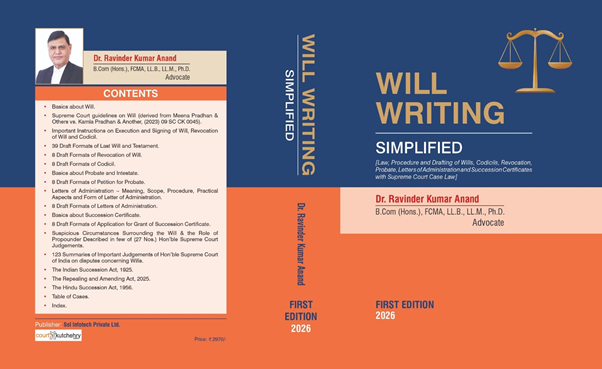
In 2023, the Supreme Court of India, in Meena Pradhan & Others vs. Kamla Pradhan & Another, consolidated and restated several foundational principles governing the proof, validity, and acceptance of Wills. The guidelines derived from this case serve as a roadmap for courts, lawyers, executors, and families. The extract from Will Writing Simplified by Dr. Ravinder Kumar Anand [📘 Buy Will Writing Simplified online: Amazon 🔹 Flipkart] captures these principles in a simplified yet authoritative manner.
This article explains the Supreme Court’s guidelines in plain language, situates them within the Indian Succession Act, and explores their implications for society and families.
Read landmark Supreme Court judgments on wills here. Click the link here: https://www.courtkutchehry.com/pages/blog/123-supreme-court-judgments-on-wills/
Detailed Explanation of the Extract in Plain Language
The Supreme Court guidelines cover several key areas:
1. Proof of Execution and Finality
The Court emphasized that two things must be proved:
- The Will was executed by the testator.
- It was the testator’s last and final Will.
This ensures no contradictory or later document exists.
2. The “Prudent Mind Test”
A Will need not be proved with mathematical certainty. Courts ask: would a prudent and reasonable mind be satisfied with the evidence and circumstances?
3. Compliance with Section 63 of the Indian Succession Act, 1925
The Court reiterated statutory requirements:
- Signature of the testator: Must clearly indicate intention to give effect to the Will.
- Attestation by two witnesses: Mandatory, though no specific format is required.
- Witnesses must see or acknowledge signature: Transparency is key.
- Witnesses must sign in presence of testator: Ensures awareness and authenticity.
4. Examination of Witnesses
At least one attesting witness must be examined in court, as required under Section 68 of the Evidence Act.
5. Evidence by Witnesses
Witnesses must confirm not only the testator’s signature but also that attestation was done in the testator’s presence.
6. One Witness Is Enough
If one witness proves the Will satisfactorily, others need not be examined.
7. If First Witness Fails
If the first witness cannot recall or prove execution, the second witness must be called.
8. Duty of Propounder to Remove Suspicion
If suspicious circumstances exist, the propounder must dispel them with clear evidence.
9. Judicial Conscience Test
In suspicious cases, courts must be fully satisfied about:
- Testator’s awareness of contents.
- Fairness of dispositions.
- Soundness of mind.
- Absence of coercion or undue influence.
10. Burden of Proof in Fraud or Coercion
The person alleging fraud must prove it. But if suspicion arises, the propounder must dispel doubts.
11. Suspicious Circumstances Must Be Real
Suspicion must be based on objective facts, not imagination. Examples include shaky signatures, weak testators, unjust exclusion of heirs, or disproportionate benefits to certain beneficiaries.
Legal Context
- Indian Succession Act, 1925: Section 63 governs execution of Wills.
- Evidence Act, 1872: Section 68 requires examination of at least one attesting witness.
- Hindu Succession Act, 1956: Governs intestate succession, highlighting the importance of valid Wills.
The Supreme Court’s guidelines reinforce statutory provisions while clarifying practical application.
Examples and Case Studies (Hypothetical)
- Example 1: Suspicious exclusion
A father excludes all daughters from his Will without explanation. Courts may demand stronger proof of authenticity. - Example 2: Witness testimony
A Will is attested by two witnesses. One testifies in court, confirming execution. The Will is valid even without the second witness. - Example 3: Shaky signature
An elderly testator’s signature appears inconsistent. Courts may require medical records or additional evidence. - Example 4: Fraud allegation
A nephew alleges fraud. He must prove it. But if circumstances raise suspicion, the propounder must dispel doubts.
Historical and Comparative Context
- India: Earlier judgments emphasized strict compliance with formalities. The 2023 ruling consolidated principles, balancing strictness with practicality.
- England: Courts apply the “sound mind and free will” test, similar to India’s judicial conscience test.
- United States: The doctrine of “undue influence” is widely applied, echoing India’s emphasis on removing suspicion.
Globally, courts strive to protect testamentary freedom while preventing fraud and coercion.
Implications for Society, Families, and Courts
- For families: Clear guidelines reduce disputes and ensure fairness.
- For society: Reinforces trust in testamentary succession.
- For courts: Provides a structured framework for evaluating Wills, reducing ambiguity.
FAQ Section
1. What must be proved for a Will to be valid?
Execution by the testator and confirmation that it is the final Will.
2. How many witnesses are required?
At least two witnesses must attest the Will.
3. Must both witnesses testify in court?
No. One witness is sufficient if testimony is complete.
4. What if the first witness fails?
The second witness must be called to prove execution.
5. What is the “prudent mind test”?
Courts ask whether a reasonable mind would be satisfied with the evidence.
6. What if suspicious circumstances exist?
The propounder must dispel them with clear evidence.
7. Who bears the burden of proving fraud?
The person alleging fraud must prove it.
Conclusion
The Supreme Court’s 2023 guidelines on Wills mark a significant consolidation of principles. They balance strict statutory compliance with practical flexibility, ensuring that Wills reflect genuine intention while preventing fraud and undue influence. For families, these rules provide clarity; for courts, they offer a structured framework; and for society, they reinforce trust in testamentary succession.
Book Reference
Exact Sentences Used from the Extract
- “The Hon’ble Supreme Court, in the above landmark decision, has consolidated and restated several foundational principles governing the proof, validity, and acceptance of a Will.”
- “These guidelines serve as an essential roadmap not only for courts, but also for testators, drafting advocates, and executors who must appreciate how the law examines the authenticity of a Will.”
- “Requirement of Proving Execution and Finality of the Will…The Will must be proved to have been executed by the testator, and it must be established that this was indeed the testator’s last and final Will.”
- “Prudent Mind Test — Proof Need Not be Mathematical…Instead, the standard is whether a prudent and reasonable mind is satisfied with the explanation, surrounding circumstances, and the evidence produced.”
- “Compliance with Section 63 of the Indian Succession Act, 1925…Signature or Mark of the Testator…Mandatory Attestation by Two or More Witnesses…Witnesses Must See the Testator Sign or Receive Acknowledgment…Witnesses Must Sign in Presence of the Testator.”
- “Necessity of Examining at Least One Attesting Witness…This is a mandatory requirement under Section 68 of the Evidence Act.”
- “Evidence by Attesting Witness Must Cover All Essential Facts.”
- “If One Witness Proves the Will, Other Witnesses Need Not be Examined.”
- “If First Witness Fails, Second Witness Must be Called.”
- “Duty of Propounder to Remove Suspicion, if Any.”
- “Test of Judicial Conscience in Suspicious Circumstances.”
- “Burden of Proof in Cases of Alleged Fraud, Coercion, or Undue Influence.”
- “Suspicious Circumstances Must Be Real and Not Imaginary.”
[📘 Buy Will Writing Simplified online: Amazon 🔹 Flipkart]
Suggested Keywords for SEO
- Supreme Court guidelines on Wills India
- Indian Succession Act Section 63 Will
- Evidence Act Section 68 Will proof
- Suspicious circumstances in Will disputes
- Testamentary succession India
- Will Writing Simplified Dr Ravinder Kumar Anand