
Supreme Court Expands Scope of Functional Disability Compensation
Beyond Medical Percentages: Recognizing Livelihood Loss
Global Lessons on Human-Centered Accident Awards
By Legal Editor
New Delhi: June 29, 2026:
The Case in Focus
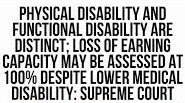
The Supreme Court of India has consistently emphasized that compensation for accident victims must reflect functional disability—the real impact on livelihood—rather than merely the medical percentage of disability. In Jagdish v. Mohan (2018, SC), the Court held that a carpenter who lost a leg suffered 100% functional disability, even though doctors assessed his medical disability at 50%. This principle has since guided tribunals and High Courts, ensuring that compensation awards are not reduced to sterile numbers but reflect the lived realities of victims.
In Shankar Dutt v. Uttarakhand (2026, SC), the Court reiterated that functional disability must be assessed in terms of earning capacity. A driver who lost partial vision was deemed functionally disabled from his profession, warranting enhanced compensation. Similarly, in Motor Accident Claim (2026, SC), the Court stressed that the loss suffered by parents due to a child’s death cannot be measured with arithmetical precision, reinforcing the human dimension of compensation law.
Key Legal Principles
The jurisprudence on accident compensation in India is anchored in a set of core principles that ensure fairness, dignity, and justice for victims.
The Motor Vehicles Act, 1988 (Section 166) provides the statutory foundation for compensation claims. It empowers Motor Accident Claims Tribunals (MACT) to award damages to victims or their families for injuries, disabilities, or fatalities caused by negligent driving. This provision is designed to deliver swift and effective relief, ensuring that victims are not left destitute due to accidents beyond their control.
Central to this framework is the Functional Disability Doctrine, which emphasizes that compensation must reflect the actual impact of an injury on livelihood, not just the medical percentage of disability. For example, a carpenter who loses a leg may be medically assessed at 50% disability, but functionally, his ability to earn is destroyed, warranting compensation for 100% loss of earning capacity. This doctrine humanizes the law by recognizing the lived realities of victims rather than reducing them to clinical statistics.
The Doctrine of Just Compensation further guides courts to award damages that fairly restore victims to their pre-accident financial position. Compensation must neither enrich victims unjustly nor deprive them of rightful recovery. It covers medical expenses, loss of income, pain and suffering, and future prospects, ensuring that awards are realistic and adequate.
The Constitutional Backdrop strengthens these principles. Article 21 guarantees the right to life with dignity, which includes the right to fair compensation for injuries or loss of life. Article 41, part of the Directive Principles of State Policy, directs the State to provide assistance in cases of disablement. Together, they justify protective laws like the Motor Vehicles Act and reinforce the Supreme Court’s stance that compensation must be humane, fair, and reflective of livelihood realities.
Judicial Precedents
The doctrine of functional disability and just compensation in accident law has been shaped by several landmark judicial precedents, each reinforcing the principle that compensation must reflect lived realities rather than mere statistics.
In Jagdish v. Mohan (2018, SC), the Supreme Court held that functional disability must guide compensation awards. The Court recognized that a carpenter who lost a leg was functionally 100% disabled, even though the medical assessment was only 50%. This precedent established that livelihood loss, not medical percentage, is the true measure of disability in compensation law.
In Shankar Dutt v. Uttarakhand (2026, SC), the Court applied the same principle to a driver who lost partial vision. Although medically assessed at a lower percentage, the Court ruled that his profession was effectively destroyed, warranting enhanced compensation. This case reinforced that vocational realities must be central to judicial assessment.
The Supreme Court also addressed the immeasurable nature of emotional loss in Motor Accident Claim (2026, SC). Here, the Court emphasized that the grief suffered by parents due to the death of a child cannot be quantified with mathematical precision. Compensation must acknowledge emotional and relational loss, reflecting the human dimension of justice.
Finally, in Rajnesh v. Neha (2021, SC), though primarily a maintenance case, the Court mandated transparency in financial disclosure. This principle has influenced accident compensation cases as well, ensuring that both claimants and insurers provide accurate financial details to enable fair and realistic awards.
Together, these precedents highlight the judiciary’s evolving approach: moving beyond rigid medical percentages and arithmetic calculations toward a holistic understanding of compensation. They ensure that awards reflect livelihood realities, emotional suffering, and constitutional values, thereby making accident law more humane and just
Comparative Perspectives
UK: Courts distinguish between medical impairment and vocational disability, awarding damages based on earning capacity.
US: The concept of “loss of earning capacity” ensures victims are compensated for livelihood impact, not just medical impairment.
Canada: Compensation law recognizes economic disadvantage from disability, focusing on functional loss.
Australia: Courts assess vocational disability, ensuring awards reflect real-world consequences.
Humanizing the Law: Case Narratives
Case 1: A carpenter losing a leg was awarded compensation for 100% functional disability, recognizing his livelihood was destroyed.
Case 2: A driver with partial vision loss was compensated for inability to continue his profession, despite lower medical disability.
Case 3: Parents of a deceased student were awarded enhanced compensation, acknowledging emotional and relational loss.
Case 4: A homemaker injured in an accident received compensation for functional disability, recognizing her unpaid domestic labour as valuable.
Case 5: In Delhi, a victim needing lifelong care was awarded a lump sum, ensuring dignity and certainty.
Extended FAQ Index
What is functional disability? It refers to the impact of an injury on a person’s ability to earn or perform livelihood tasks, beyond medical impairment percentages.
How is functional disability different from medical disability? Medical disability is a clinical percentage of impairment; functional disability measures how that impairment affects earning capacity and daily life.
What is Section 166 MV Act? It allows victims or their families to file claims for compensation due to negligence in motor accidents.
Can compensation exceed medical percentage of disability? Yes, courts may award higher compensation if livelihood loss is greater than the medical percentage suggests.
How do courts assess livelihood loss? By considering profession, income, skills, and how the injury affects the ability to work.
What is “just compensation”? Fair compensation that restores victims to their pre-accident financial position without unjust enrichment.
Can parents claim for emotional loss? Yes, courts award compensation for loss of love, affection, and consortium.
How is loss of earning capacity calculated? By multiplying income with disability percentage adjusted for functional impact and future prospects.
Can homemakers claim functional disability? Yes, courts recognize unpaid domestic labour as valuable and compensable.
What if victim is self-employed? Compensation is based on actual earnings and the impact of disability on livelihood.
Can compensation cover vocational retraining? Yes, courts may include costs for retraining or rehabilitation.
What if victim changes profession? Compensation considers reduced earning potential in the new profession.
Can compensation include pain and suffering? Yes, non-economic damages like trauma and loss of enjoyment are compensable.
How do courts assess future prospects? By considering age, career trajectory, and potential income growth.
What if victim is a minor? Courts award compensation considering future prospects and parental loss.
Can functional disability apply to students? Yes, if injury affects future career opportunities.
What if victim dies during proceedings? Legal heirs can continue the claim for compensation.
Can compensation be enhanced on appeal? Yes, higher courts can increase awards if they find them inadequate.
What role does Article 21 play? It guarantees the right to life with dignity, forming the basis for fair compensation.
What role does Article 41 play? It directs the State to provide assistance in cases of disablement, supporting welfare laws.
Can lump sum awards replace lifetime payments? Yes, courts often prefer lump sums for certainty and ease of enforcement.
What if victim has multiple jobs? Compensation considers total income and impact across professions.
Can compensation cover artificial limbs? Yes, costs of prosthetics and rehabilitation are included.
How do courts assess emotional loss? By awarding damages for grief, loss of companionship, and mental trauma.
Can symbolic awards be challenged? Yes, inadequate awards can be appealed for enhancement.
What if victim exaggerates disability? Courts scrutinize medical and vocational evidence to prevent inflated claims.
How do courts balance fairness and welfare? By ensuring victims are compensated adequately without unjust enrichment.
Can compensation include attendant charges? Yes, costs for caregivers and attendants are compensable.
What if victim lives abroad? Compensation is still payable; enforcement may involve international mechanisms.
How do global systems compare? US, UK, Canada, and Australia all recognize functional disability and vocational loss.
What if victim had no insurance? Compensation under MV Act remains available regardless of insurance coverage.
Can Mediclaim affect functional disability awards? No, Mediclaim is contractual and independent of statutory compensation.
What if victim is partially disabled? Compensation reflects reduced earning capacity, not just medical percentage.
Can compensation cover rehabilitation costs? Yes, expenses for therapy, retraining, and recovery are included.
What if victim is unemployed? Courts assess earning capacity and potential livelihood, not just current status.
Can compensation include loss of consortium? Yes, spouses and family members can claim for emotional and relational loss.
What if victim is an athlete? Functional disability may be treated as 100% if career is destroyed.
Can courts award compensation for future medical needs? Yes, awards often include anticipated medical expenses.
How do tribunals calculate vocational loss? By considering profession, income, disability impact, and future prospects.
What is the Supreme Court’s latest ruling? Functional disability must guide compensation, ensuring awards reflect livelihood loss, not just medical percentages.
Op-Ed Style Closing Vision
The Supreme Court’s emphasis on functional disability marks a profound shift in India’s compensation jurisprudence. By moving beyond medical percentages, the Court has recognized that disability is not just a clinical measure but a lived reality that affects livelihood, dignity, and human potential.
This principle ensures that victims are compensated not merely for physical impairment but for the actual impact on their ability to earn and live with dignity. A carpenter losing a leg, a driver losing vision, or a homemaker incapacitated by injury—all face livelihood losses that cannot be captured by medical charts alone. Functional disability bridges this gap, aligning compensation law with human experience.
The constitutional backdrop is crucial. Article 21 guarantees the right to life with dignity, and Article 41 directs the State to provide assistance in disablement. Functional disability jurisprudence operationalizes these ideals, ensuring that compensation awards reflect both financial realities and constitutional values.
Globally, similar doctrines exist. In the US, “loss of earning capacity” guides awards. In the UK, vocational disability is distinguished from medical impairment. Canada and Australia also recognize functional loss. India’s jurisprudence now stands aligned with these progressive standards, reinforcing its commitment to welfare and fairness.
The human stories are poignant. Victims whose livelihoods are destroyed, families grieving irreparable loss, and individuals facing lifelong care needs—all remind us that compensation law is not about numbers but about lives. By recognizing functional disability, courts have ensured that justice is compassionate, realistic, and human-centered.
The challenge ahead lies in implementation. Tribunals must consistently apply functional disability principles, avoiding token awards. Transparency in financial disclosure, realistic assessment of needs, and swift enforcement are essential. Symbolic sums must give way to meaningful compensation that restores dignity.
Society must also evolve. Compensation should not be seen as charity but as justice. Victims deserve recognition of their lived realities, not sterile percentages. Functional disability jurisprudence is a step toward a more humane legal system, one that values dignity over arithmetic.
In conclusion, the Supreme Court’s recognition of functional disability is a landmark in India’s compensation law. It ensures that victims are not reduced to medical statistics but are seen as human beings with livelihoods, families, and dignity. By aligning statutory law, constitutional values, and global standards, the Court has reaffirmed that justice in accident compensation must be both compassionate and rational.