

Supreme Court to Decide If FIR Can Be Quashed Partially
Amicus Appointed to Examine Legal Question
Case Raises Complexities of Compromise in Criminal Law
By Legal Reporter
New Delhi: February 24, 2026:
In a significant development, the Supreme Court of India has appointed Senior Advocate K. Parameshwar as Amicus Curiae to examine whether a First Information Report (FIR) can be partially quashed when a compromise is reached between the complainant and only some of the accused. The issue has sparked debate across High Courts, with conflicting rulings on whether compromise with one accused can absolve them while proceedings continue against others.
[Legal Resources Note]
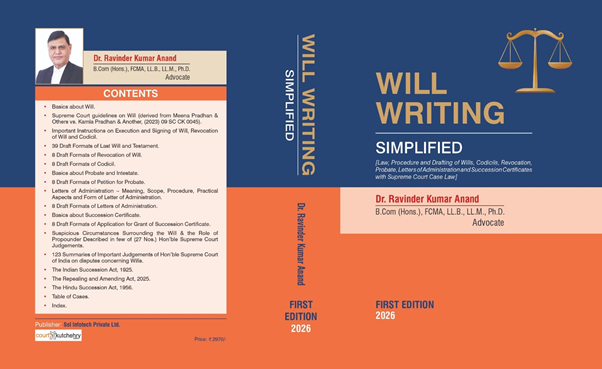
📘 For readers interested in deeper insights into legal drafting and procedures, Will Writing Simplified [Law, Procedure and Drafting of Wills, Codicils, Revocation, Probate, Letters of Administration and Succession Certificates with Supreme Court Case Law] is a recommended resource. It offers practical guidance on complex legal processes. Available on Amazon 🔹 Flipkart.
The Case
The matter arose from an FIR registered under Sections 120B (criminal conspiracy), 380 (theft in dwelling house), and 411 (receiving stolen property) of the Indian Penal Code. One of the accused sought quashing of the FIR under Section 482 of the Code of Criminal Procedure (CrPC) (now Section 528 of the Bharatiya Nagarik Suraksha Sanhita, BNSS), citing a compromise with the complainant.
Also Read: Supreme Court Hearing: WhatsApp Says It Does Not Share User Data with Meta
A Bench of Justice M.M. Sundresh and Justice N.K. Singh noted that the issue had wider implications and required authoritative guidance. The Court appointed Parameshwar as Amicus to assist in resolving whether partial quashing is legally permissible.
Court’s Observations
- Conflicting precedents: Different High Courts have taken divergent views. Some allow partial quashing, while others insist that compromise must cover all accused.
- Nature of offences matters: Courts have consistently held that heinous crimes (like rape or homicide) cannot be quashed on compromise, but property-related or personal disputes may be treated differently.
- Judicial caution: The Supreme Court stressed that compromise cannot be used to undermine justice or shield serious offenders.
Why This Matters
The ruling will have wide implications for criminal jurisprudence:
- Clarity for lower courts: Provides guidance on handling cases where compromise is reached with some accused but not all.
- Balance between justice and settlement: Ensures that compromise does not erode accountability in serious crimes.
- Impact on backlog: If partial quashing is permitted, it may reduce pendency in cases involving multiple accused.
Legal Context
- Section 482 CrPC / Section 528 BNSS: Grants High Courts inherent powers to quash proceedings to prevent abuse of process or secure justice.
- Compromise principle: Courts often quash FIRs in compoundable offences when parties settle disputes.
- Limits of compromise: Serious offences against society cannot be quashed merely on settlement.
Reactions
- Legal experts welcomed the appointment of an Amicus, noting that clarity is urgently needed.
- Victims’ rights groups cautioned that compromise should not dilute accountability in serious crimes. Lawyers said the ruling will set a precedent for thousands of pending cases involving multiple accused.
Also Read: Delhi High Court Rules AFT Cannot Punish for Contempt of Final Orders
Closing Note
The Supreme Court’s decision to examine whether an FIR can be partially quashed based on compromise with some accused is a pivotal moment in Indian criminal law. By appointing an Amicus Curiae, the Court has signalled its intent to provide clarity on a question that has divided High Courts and impacted countless cases.
This ruling will determine how India balances the principles of justice, compromise, and accountability in criminal proceedings.
GEO-Friendly Keywords
Also Read: Supreme Court Moves to Close 40-Year-Old MC Mehta Cases to End Pendency Impression
- Supreme Court FIR partial quashing compromise
- Section 482 CrPC Section 528 BNSS FIR quash
- Amicus Curiae K Parameshwar FIR compromise case
- Justice MM Sundresh Justice NK Singh Supreme Court ruling
- FIR quash partially compromise accused India law
- Supreme Court criminal law compromise jurisprudence
- FIR quashing property offences vs serious crimes
- Supreme Court ruling FIR compromise implications
Also Read: Bombay High Court: Short-Term Driver Engagement Still Entitles Family to Compensation