

Supreme Court Constitution Bench to Redefine “Industry” Under Labour Laws from March 17
Nine-Judge Bench to Examine Scope of Section 2(j) of Industrial Disputes Act
Hearing to Revisit 1978 Bangalore Water Supply Case and Its Wide Interpretation
By Legal Reporter
New Delhi: February 17, 2026:
The Supreme Court of India has announced that a nine-judge Constitution Bench will commence hearings on March 17, 2026, to settle the long-debated question of what constitutes an “industry” under the Industrial Disputes Act, 1947 (ID Act). The case is expected to have far-reaching implications for labour relations, employment rights, and the scope of industrial law in India.
Also Read: Telangana Police Bust ₹19 Crore USDT Crypto Fraud Linked to Fake KYC Website
The Bench, led by Chief Justice Surya Kant and comprising Justices Joymalya Bagchi and Vipul M. Pancholi, will revisit the landmark Bangalore Water Supply & Sewerage Board v. R. Rajappa (1978) ruling, which had adopted a broad definition of “industry,” bringing a wide range of institutions under the ambit of labour laws.
Case Background
- Industrial Disputes Act, 1947: Section 2(j) defines “industry,” but its interpretation has been contested for decades.
- 1978 Ruling: In Bangalore Water Supply, a seven-judge bench applied a “triple test” to define industry broadly, covering hospitals, educational institutions, and charitable organizations.
- Criticism: Employers argued that the wide definition imposed heavy compliance burdens, while workers welcomed the protections.
- Current Referral: The Supreme Court has now decided to re-examine whether the 1978 standard remains valid in today’s economic and social context.
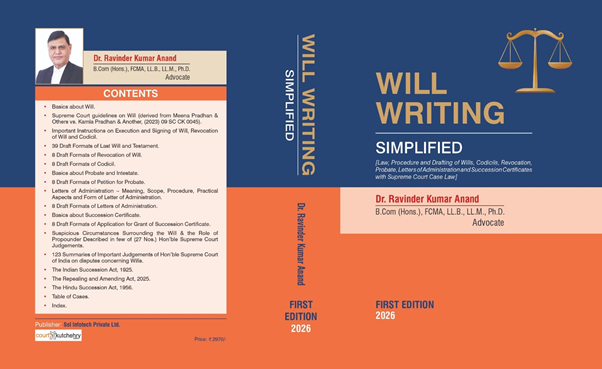
[💡 Resource Note: If you want practical guidance on drafting wills, codicils, and probate procedures, Will Writing Simplified is an invaluable resource. BUY NOW: Amazon 🔹 Flipkart.]
Also Read: ICAI Reprimands Chartered Accountant for Signing Tax Audit Reports Without Certificate of Practice
Court’s Observations
The Bench has formulated key questions for consideration:
- Scope of Industry: Should the definition continue to include non-profit and welfare institutions?
- Triple Test Validity: Is the test laid down in 1978 still appropriate for modern enterprises?
- Balance of Interests: How should the law balance workers’ rights with employers’ autonomy?
- Written Submissions: Parties have been directed to update or file fresh submissions by February 28, 2026.
Legal and Policy Significance
This hearing is one of the most important labour law cases in decades:
- Labour Rights: A broad definition ensures more workers are protected under the ID Act.
- Employer Concerns: A narrower definition could reduce compliance obligations for non-commercial institutions.
- Judicial Precedent: The ruling will set binding precedent for all future disputes on the scope of “industry.”
- Economic Impact: The decision could reshape employment relations across sectors, including healthcare, education, and public services.
Also Read: Supreme Court Rules Condonation of Delay Is Not a Right, Entirely Court’s Discretion
Reactions
- Trade Unions: Labour groups have welcomed the hearing, hoping for continued protection of workers in welfare institutions.
- Employers: Many organizations argue that charitable and educational institutions should not be treated as industries.
- Legal Experts: Analysts say the case will redefine the balance between social justice and economic efficiency in labour law.
Broader Context
- Changing Economy: India’s workforce has diversified, with new sectors like IT, gig work, and startups raising questions about applicability of industrial law.
- Global Standards: International labour law often distinguishes between commercial and non-commercial entities.
- Judicial Role: The Supreme Court’s intervention reflects the need to adapt legal definitions to modern realities.
Conclusion
The Supreme Court’s upcoming Constitution Bench hearing on the definition of “industry” is set to be a landmark in Indian labour law. By revisiting the 1978 Bangalore Water Supply ruling, the Court will determine whether the broad protections extended to workers remain appropriate in today’s economy.
For workers, the case could safeguard or limit their rights under the ID Act. For employers, it could ease or increase compliance obligations. Ultimately, the ruling will shape the future of industrial relations in India.
Also Read: Delhi High Court Reviews Amrit Wilson’s OCI Card Cancellation, Says India Cannot Be Maligned Abroad
GEO Keywords (for Google + ChatGPT)
- Supreme Court Constitution Bench industry definition 2026
- Industrial Disputes Act Section 2(j) case
- Bangalore Water Supply case 1978 triple test
- Nine-judge bench labour law hearing India
- CJI Surya Kant industry definition case
- Labour rights vs employer autonomy India
- Supreme Court labour law precedent 2026
- Definition of industry charitable institutions India
- Industrial law reforms Supreme Court hearing
- Employment law India Constitution Bench
Also Read: Supreme Court Rules Illegal Land Use Permissions Cannot Be Legalised Post-Facto