
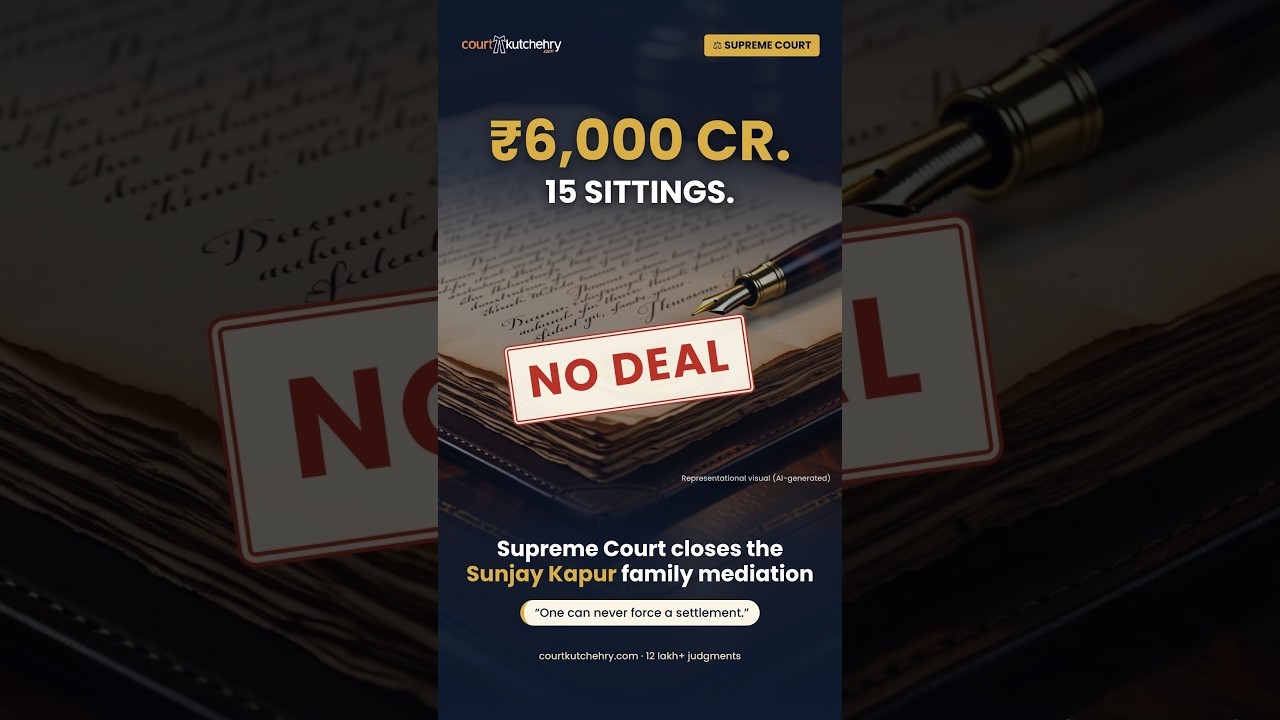
Watch the Video
In this 2-minute video, CourtKutchehry explains what happened in the Supreme Court on 26 November 2026, when the Court closed the mediation between Rani Kapur, the mother of the late industrialist Sunjay Kapur, and his widow, Priya Sachdev Kapur. This article sets out what was reported and what it does not mean. The dispute is pending, no court has decided the parties’ claims, and nothing here is a view on the merits.
The Dispute in Brief
Rani Kapur, who is 81 as reported, challenges the family trust into which, she says, her assets were moved without her informed consent. She has filed a suit in the Delhi High Court seeking, among other things, a declaration that the trust is void, and she has asked for the trust’s assets to be preserved while that suit is decided. Priya Sachdev Kapur disputes her claims. These are allegations on both sides, and none of them has been adjudicated.
Rani Kapur brought the matter to the Supreme Court in a special leave petition against orders of the Delhi High Court on her plea for interim protection. In May 2026 the Supreme Court, with the parties’ consent, referred the family members to mediation before former Chief Justice of India D.Y. Chandrachud (as reported).
What Happened on 26 November 2026
A Bench of Justices J.B. Pardiwala and K. Vinod Chandran took up the mediator’s report. As reported by LawBeat, Bar & Bench and LawChakra:
- About 15 mediation sittings had been held.
- The mediator reported an impasse on the settlement of Rani Kapur’s claims, and the Court closed the mediation.
- When the Court asked about the competing claims, Rani Kapur’s counsel put her claim at ₹6,000 crore.
- The Bench observed: “One can never force a settlement.” It also remarked that it already deals with litigation worth over ₹65,000 crore and would not be swayed by the figure.
- The Court indicated that the Delhi High Court should decide the plea to preserve the trust’s assets in a time-bound manner.
Headline Check: Who Was the Mediation Between?
The failed talks were mainly between Rani Kapur and Priya Sachdev Kapur. A second issue was also before the mediator: the modalities for the exit of Sunjay Kapur’s children with Karisma Kapoor from the trust structure. On that point, the mediator was reported to be still hopeful.
What a Failed Mediation Does NOT Mean
A mediator does not decide anything. Mediation is a voluntary process in which a neutral person helps the parties try to reach their own settlement. If they cannot agree, the mediator reports that the talks have failed, and the case goes back to court for adjudication.
So the closure of this mediation is not a verdict. It does not decide whether the trust is valid, and it does not decide whether Sunjay Kapur’s will is genuine or forged. That separate suit, brought by his children with Karisma Kapoor, continues in the Delhi High Court, which on 30 April 2026 ordered specified assets to be preserved until the trial ends.
Remember this line: a failed mediation ends the talks, not the case.
Three Lessons for Every Family
- Mediation works only when both sides want it. A court can send parties to the table, but, as the Bench said, it cannot force a settlement.
- Moving family wealth into a trust? Get everyone’s informed consent, in writing. Clear documents prevent disputes about consent later.
- A clear will that your family knows about saves years in court.
Key Takeaways
- On 26 November 2026, the Supreme Court closed the court-appointed mediation between Rani Kapur and Priya Sachdev Kapur after the mediator reported an impasse (as reported).
- About 15 sittings were held; Rani Kapur’s counsel put her claim at ₹6,000 crore.
- The Court indicated that the Delhi High Court should decide the plea to preserve the trust’s assets in a time-bound manner.
- On the exit of Sunjay Kapur’s children with Karisma Kapoor from the trust, the mediator was still hopeful.
- A failed mediation is not a verdict; the will case continues in the Delhi High Court.
Frequently Asked Questions
Did the Supreme Court decide who is right?
No. It only closed the mediation because the talks reached an impasse. The parties’ claims about the trust have not been decided by any court.
Who was the mediator?
Former Chief Justice of India D.Y. Chandrachud, appointed by the Supreme Court in May 2026 with the parties’ consent (as reported).
What is Rani Kapur’s case?
She alleges that her assets were moved into the family trust without her informed consent, and she wants the trust’s assets preserved while her suit is decided. These are allegations that are disputed.
Does this affect the dispute over Sunjay Kapur’s will?
No. That is a separate suit in the Delhi High Court, where specified assets were ordered on 30 April 2026 to be preserved until the trial ends.
Can a court force parties to settle?
No. A court can encourage or refer parties to mediation, but a settlement needs the consent of both sides.
Where can I watch the video?
Watch the short explainer on the CourtKutchehry YouTube channel: https://youtu.be/Fhp6pEfNbIg.
Conclusion
Fifteen sittings before a former Chief Justice could not bridge the gap between Rani Kapur and Priya Sachdev Kapur, and the Supreme Court has now closed the mediation. The next step, as reported, is a time-bound decision by the Delhi High Court on whether the trust’s assets should be preserved.
For everyone else, the message is simple: settlement needs willingness on both sides, and clear, consented paperwork for trusts and wills is the best way to keep a family out of court.
▶ Watch the video: ₹6,000 Crore Demand, 15 Sittings, NO DEAL! Supreme Court Ends Sunjay Kapur Family Mediation
📖 Read more: Sunjay Kapur Will Case Explained: Karisma Kapoor's Children Allege Forgery, Delhi High Court Freezes Estate
Research the Law on CourtKutchehry
CourtKutchehry gives you lakhs of Indian judgments, searchable for free. A membership adds unlimited summaries, all related judgments, original court PDF downloads, bookmarks, notes and the CourtKutchehry AI assistant.
| Membership | Price | Works out to | AI credits |
|---|---|---|---|
| Monthly (1 month) | ₹599 | ₹599 / month | 1,000 / month |
| Quarterly (3 months) · Save 16% | ₹1,499 | ₹499.67 / month | 1,100 / month |
| Six-monthly (6 months) · Save 33% | ₹2,399 | ₹399.83 / month | 1,200 / month |
| Yearly (12 months) · Save 44% · Best value | ₹3,999 | ₹333.25 / month | 1,300 / month |
Every plan is a one-off purchase for a fixed period: nothing auto-renews and no card is kept on file. Prices are exclusive of applicable tax, which is added at checkout. Extra AI chat credits can be topped up from ₹99. A free verified account gets 5 summaries and 50 AI trial credits.
Prices are as displayed on courtkutchehry.com on 20 November 2026 and are subject to change without notice. Please check the pricing page for the current plans and offers.
For more judgments, legal opinions and case analysis, visit courtkutchehry.com
Visit CourtKutchehry →