
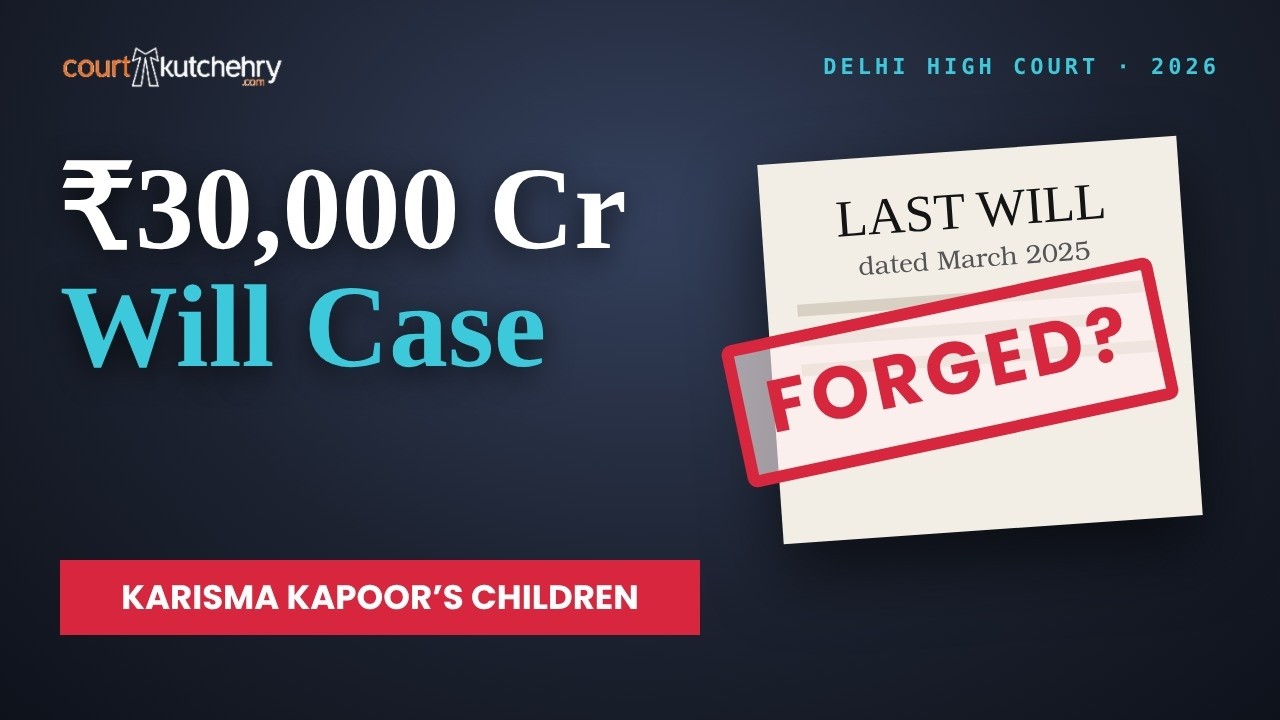
Watch the Video
In this 1-minute video, Advocate Vinayak Pawar explains the dispute over the will of the late industrialist Sunjay Kapur: what the Delhi High Court decided, why each of Karisma Kapoor’s children claims one-fifth, and what it means for your own family’s will. This article covers the same ground, neutrally, and the matter remains pending.
▶ Watch on YouTube: Sunjay Kapur Will Case Explained: Karisma Kapoor's Children Allege Forgery
A Large Estate and a Disputed Will
Industrialist Sunjay Kapur died in June 2025. His estate has been widely reported to be worth about ₹30,000 crore. About a month after his death, the family was shown a will dated 21 March 2025. His wife, Priya Kapur, relies on that will.
His two children with actor Karisma Kapoor have filed a suit in the Delhi High Court. They allege that the will is forged and fabricated, and in any case surrounded by suspicious circumstances. These are allegations. The will’s genuineness has not yet been decided.
Why Each Child Claims One-Fifth
The children’s case is simple. If there is no valid will, a Hindu man’s property passes under Section 8 of the Hindu Succession Act, 1956 to his Class I heirs. These include his mother, his widow and his children, and under Section 10 each of them takes one equal share.
Sunjay Kapur’s Class I heirs would be five people: his mother, his wife and his three children. Five heirs means one-fifth each. That is why the children have sought a preliminary decree of partition giving each of them a one-fifth share, along with accounts of the estate.
What the Delhi High Court Decided on 30 April 2026
In Samaira Kapur v. Priya Kapur, (2026) 04 DEL CK 2412, Justice Jyoti Singh decided the children’s application for interim protection. The court did not decide whether the will is genuine. It decided a narrower question: should the estate be protected while the trial goes on?
- The court noted that suspicious circumstances had been raised under three heads: an unnatural disposition, the circumstances around the making of the will, and the chain of custody of the original.
- It held that the onus to remove those circumstances lies on Priya Kapur, the person relying on the will, and that this “is a matter of trial.”
- It found a prima facie case and held that the estate must be preserved until the suit is decided.
What Has Been Frozen
Priya Kapur has been restrained from selling, transferring or otherwise dealing with listed assets, including:
- equity shareholdings in specified companies;
- Employees’ Provident Fund withdrawals;
- personal effects such as watches, jewellery and artworks;
- money in specified Indian and foreign bank accounts (with an exception for obligations under the earlier divorce decree); and
- cryptocurrency holdings.
The court did not grant an injunction over immovable property outside India, leaving the parties to other remedies.
Remember this line: the will has not been declared forged. The court has only frozen the estate until the trial decides.
The Law on Suspicious Wills
Why is the burden on the person relying on the will? Since H. Venkatachala Iyengar v. B.N. Thimmajamma, AIR 1959 SC 443, the Supreme Court has held that the propounder of a will must prove that the testator signed it with a sound and free mind, knowing what it contained. Where the circumstances are suspicious, the propounder must remove those suspicions to the court’s satisfaction. A will speaks only after death, and the one person who could explain it is no longer there.
The matter is pending in the Delhi High Court, and nothing here is a comment on its merits.
Lessons for Your Own Will
- Two witnesses. Under Section 63 of the Indian Succession Act, 1925, a will must be signed by the testator and attested by at least two witnesses who saw the testator sign.
- Register it. Registration of a will is optional, not compulsory, but a registered will is much stronger evidence.
- Tell someone you trust. Let a trusted person know where the original is kept. A will that appears suddenly, weeks after death, invites questions and a court fight.
Key Takeaways
- Karisma Kapoor’s children allege that the will dated 21 March 2025, relied on by Priya Kapur, is forged; this has not been decided.
- Without a valid will, the estate would go to five Class I heirs, one-fifth each.
- On 30 April 2026, the Delhi High Court held the onus to remove suspicious circumstances lies on Priya Kapur, as a matter of trial.
- The court ordered the estate to be preserved: shares, bank accounts, jewellery and crypto are frozen pending trial.
- For your own will: two attesting witnesses, consider registration, and tell someone you trust where it is.
Frequently Asked Questions
Has the Delhi High Court declared Sunjay Kapur’s will forged?
No. The court said the genuineness of the will is a matter for trial. It only ordered the estate to be preserved meanwhile.
Why do the children claim one-fifth each?
If there is no valid will, a Hindu man’s estate goes to his Class I heirs in equal shares. Here that would be his mother, his wife and three children: five heirs.
Who has to prove the will?
The person relying on it. The court held that the onus to remove the suspicious circumstances lies on Priya Kapur.
Is it compulsory to register a will in India?
No. Registration is optional, but a registered will is stronger evidence of genuineness.
How many witnesses does a will need?
At least two attesting witnesses, under Section 63 of the Indian Succession Act, 1925.
Where can I watch the full explanation?
Watch Advocate Vinayak Pawar explain it here: https://youtu.be/c35SqcPigAQ.
Conclusion
The Sunjay Kapur dispute is still at the trial stage. The Delhi High Court has not ruled on whether the will is genuine; it has only protected the estate so that whoever succeeds at trial does not find the assets gone.
The practical lesson is for every family: a will that is properly witnessed, preferably registered, and whose existence is known to someone trustworthy is far less likely to end up in court.
▶ Watch the video: Sunjay Kapur Will Case Explained: Karisma Kapoor's Children Allege Forgery
📖 Read more: Sunjay Kapur’s ₹30,000 Crore Will Sparks Legal Battle in Delhi High Court
Research Judgments Like These on CourtKutchehry
Every judgment cited in this article, and lakhs more, can be searched and read on CourtKutchehry. Searching and reading judgments is free. A membership adds unlimited summaries, all related judgments, original court PDF downloads, bookmarks, notes and the CourtKutchehry AI assistant.
| Membership | Price | Works out to | AI credits |
|---|---|---|---|
| Monthly (1 month) | ₹599 | ₹599 / month | 1,000 / month |
| Quarterly (3 months) · Save 16% | ₹1,499 | ₹499.67 / month | 1,100 / month |
| Six-monthly (6 months) · Save 33% | ₹2,399 | ₹399.83 / month | 1,200 / month |
| Yearly (12 months) · Save 44% · Best value | ₹3,999 | ₹333.25 / month | 1,300 / month |
Every plan is a one-off purchase for a fixed period: nothing auto-renews and no card is kept on file. Prices are exclusive of applicable tax, which is added at checkout. Extra AI chat credits can be topped up from ₹99. A free verified account gets 5 summaries and 50 AI trial credits.
Prices are as displayed on courtkutchehry.com on 20 November 2026 and are subject to change without notice. Please check the pricing page for the current plans and offers.
For more judgments, legal opinions and case analysis, visit courtkutchehry.com
Visit CourtKutchehry →