
COURTKUTCHEHRY SPECIAL SERIES ON LANDMARKS JUDGEMENTS ON WILLS, CODICIL & PROBATE
Shakuntala Bai and Others v. Mahaveer Prasad: Supreme Court Validates 1978 Will
Attesting Witnesses and Forensic Reports Confirm Genuineness
1978 Will Supersedes 1974 Registered Will, Succession Certificate Granted
By Vishwas Kumar
New Delhi: March 22, 2026:
In Shakuntala Bai and Others v. Mahaveer Prasad (Civil Appeal Nos. 1630–1631 of 2010), decided on 2 July 2015, the Supreme Court of India addressed a contentious inheritance dispute revolving around the genuineness of a 1978 Will. The appellants alleged that the Will was fabricated on blank signed papers, challenging its validity.
best Supreme Court rulings on wills and probate
The Trial Court initially agreed with the appellants, but the High Court reversed this finding, holding the Will valid. On appeal, a Division Bench comprising Justice Amitava Roy and Justice R.K. Agrawal upheld the High Court’s ruling. The Court emphasized that both attesting witnesses, Mohan Lal and Mangi Lal, had satisfactorily proved the execution and attestation of the Will. Further, expert and forensic reports confirmed the authenticity of the testator’s signatures, eliminating any suspicion surrounding the document.
The Bench also noted that the 1978 Will superseded the earlier registered Will of 1974, thereby establishing Mahaveer Prasad’s claim. His adoption by the testator, coupled with the support of the testator’s wife and daughter, further strengthened his entitlement. The Supreme Court concluded that no suspicious circumstances existed, and the Will was validly executed.
Consequently, the Court confirmed the High Court’s direction granting Mahaveer Prasad the succession certificate, dismissing the appellants’ challenge. This ruling underscore the importance of credible witness testimony and forensic validation in resolving disputes over testamentary documents. It also highlights the principle that a later Will, if proven genuine, overrides earlier instruments, ensuring clarity in succession matters.
For More, Read Here the Summary of the Judgement from the Book: WILL WRITING SIMPLIFIED, read below or open page no 436, Chapter 14.1 in the book. (Online book purchase link available here on: Buy online: Amazon | Flipkart
|
|
Case Summary |
: |
Shakuntala Bai and Others v. Mahaveer Prasad. |
|
|
Court |
: |
Supreme Court of India |
|
|
Citations |
: |
(2015) 07 SC CK 0040: Civil Appeal Nos.: 1630–1631 of 2010. |
|
|
Link |
: |
https://www.courtkutchehry.com/judgements/689716/shakuntala-bai-and-others-vs-mahaveer-prasad/
|
|
|
Decided on |
: |
July 2, 2015 |
|
|
Coram |
: |
Hon’ble Mr. Justice Amitava Roy and Hon’ble Mr. Justice R.K. Agrawal. |
|
|
Relevant Paragraphs |
: |
Para Nos. 3–15, 15–16. |
1. Facts of the Case:
The dispute revolved around two competing Wills executed by one Kanhaiya Lal dated 23.12.1974 (registered) and 15.11.1978 (unregistered). Respondent Mahaveer Prasad, the adopted son of Kanhaiya Lal, applied for a succession certificate under Section 372 of the Indian Succession Act, 1925, claiming rights based on the later Will (15.11.1978). The appellants (Shakuntala Bai & others—other heirs) alleged that the 1978 Will was forged and that the 1974 Will was the genuine last testament. The Trial Court rejected the 1978 Will as forged and deceitfully obtained on blank papers bearing Kanhaiya Lal’s signatures. The High Court reversed this finding and upheld the 1978 Will. The appellants appealed to the Supreme Court.
2. Law Points Involved:
(i). Proof of execution and attestation of a Will under Section 63 of the Indian Succession Act, 1925 and Section 68 of the Indian Evidence Act, 1872.
(ii). Role and evaluation of expert opinion and attesting witnesses in establishing genuineness of a Will.
(iii). Determination of “suspicious circumstances” surrounding execution of a Will and the onus on the propounder.
(iv). Validity of a subsequent unregistered Will superseding an earlier registered one.
(v). Effect of adoption and the adopted son’s rights in the absence or presence of a Will.
3. Acts / Provisions / Articles Referred:
(i). Section 372, Indian Succession Act, 1925
(ii). Sections 63 & 68, Indian Succession Act & Evidence Act (by implication in reasoning)
4. Judgments Referred:
References were made to the High Court’s earlier orders dated 25.09.2003 (Single Bench) and 23.08.2007 (Division Bench). The Supreme Court primarily analyzed the reasoning of the lower courts without citing external precedent in detail but applied settled principles on proof of Wills and “suspicious circumstances.”
5. Obiter Dicta:
The Supreme Court observed that the approval and support of the testator’s wife and daughter for the 1978 Will, coupled with the adopted son’s pre-existing filial status, strongly indicated bona fides. It emphasized that spiritual reflection and reconciliation by the testator could explain a change of mind revoking the earlier Will. Mere existence of a registered earlier Will does not by itself invalidate a later unregistered one, if the latter is duly proved.
6. Ratio Decidendi:
The Will dated 15.11.1978 was duly executed and attested in compliance with Section 63 of the Succession Act. The signatures of the testator were genuine as confirmed by expert opinion and attesting witnesses. There were no suspicious circumstances invalidating the bequest. The findings of the High Court reversing the Trial Court were upheld as being based on correct appreciation of evidence.
7. Final Ruling:
Appeals dismissed. The Supreme Court affirmed the High Court’s decision upholding the 15.11.1978 Will as valid and directed that the succession certificate in favour of Respondent Mahaveer Prasad stands confirmed. No costs awarded.
8. Gist Highlighting Dispute with Final Decision:
The appellants challenged the genuineness of the 1978 Will, alleging it was fabricated on blank signed papers. The Trial Court agreed, but the High Court and Supreme Court held the Will valid. The Court found that both attesting witnesses (Mohan Lal & Mangi Lal) satisfactorily proved execution and attestation, expert and forensic reports confirmed the signatures, and no suspicious circumstances existed. The 1978 Will superseded the 1974 registered Will; the adoption of Mahaveer Prasad and the support of the testator’s wife and daughter strengthened his claim. The Supreme Court thus confirmed the High Court’s direction granting him the succession certificate.
Read full Judgement Here:
Shakuntala Bai and Others v. Mahaveer Prasad.
Supreme Court of India
(2015) 07 SC CK 0040: Civil Appeal Nos.: 1630–1631 of 2010.
https://www.courtkutchehry.com/judgements/689716/shakuntala-bai-and-others-vs-mahaveer-prasad/
You Can Also Purchase the Book from here on: Buy online: Amazon | Flipkart
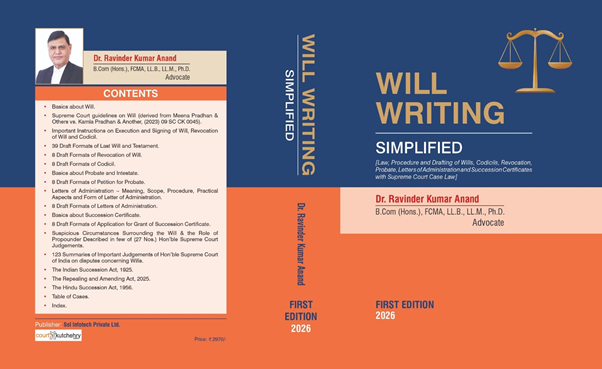
OUR RECOMMENDATION: Check out 123 Key Judgements, as highlighted in the book, WILL WRITING SIMPLIFIED, for the quick research and reference purposes. Click the link here: https://www.courtkutchehry.com/pages/blog/123-supreme-court-judgments-on-wills/
SEO-Friendly Keywords
- Shakuntala Bai v. Mahaveer Prasad Supreme Court case
- 1978 Will validity inheritance dispute India
- Supreme Court ruling on succession certificate
- Attesting witnesses Mohan Lal Mangi Lal Will case
- 1974 registered Will superseded by 1978 Will
- Civil Appeal Nos. 1630–1631 of 2010 inheritance law