
Case at a Glance
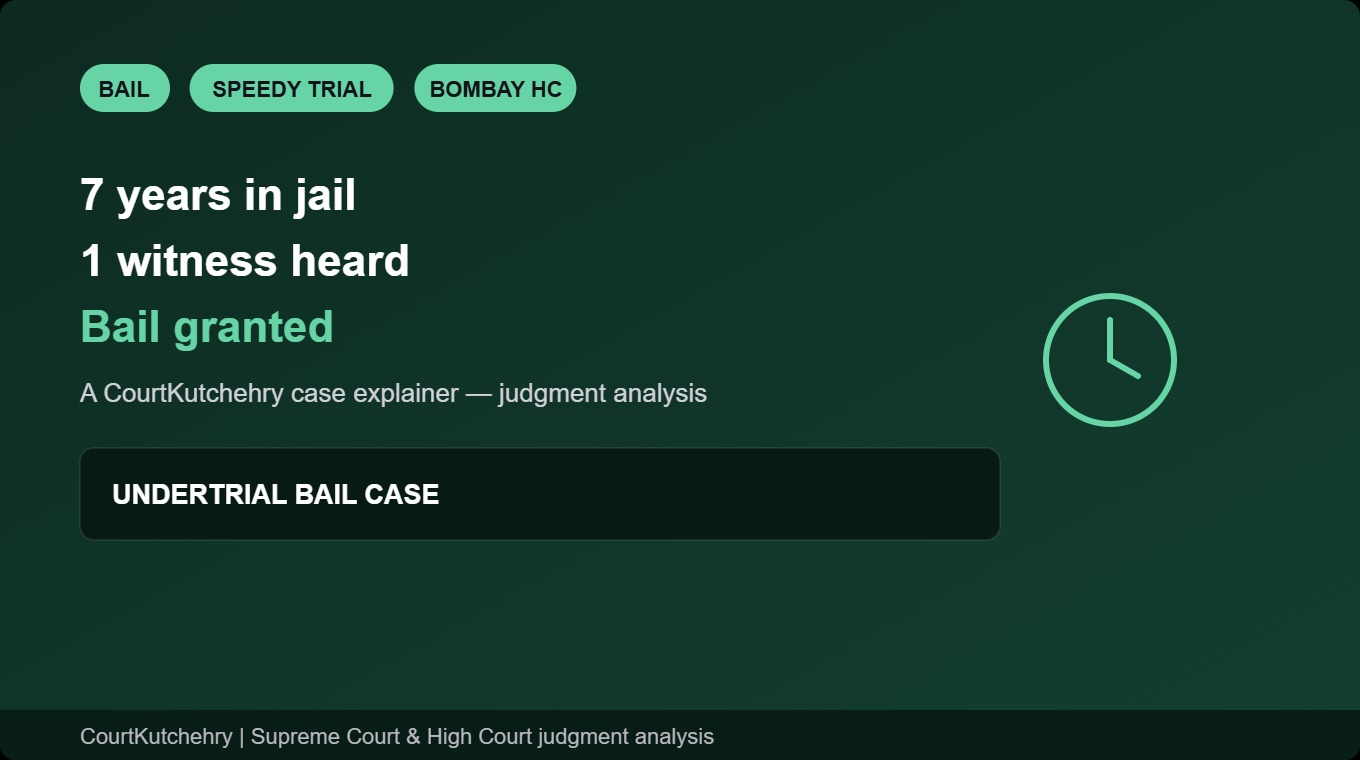
An undertrial accused in a 2019 case under the IPC and the POCSO Act wrote to the High Court from jail. The Court called for the papers and found he had been in custody for over seven years and four months, while only one witness had been examined and the trial had made no progress for about four years. Justice Milind N. Jadhav, without commenting on the merits, held that continued detention with no end of trial in sight violated his Article 21 right to a speedy trial and granted bail on strict conditions, including a ban on any contact with the victim.
The petitioner, one of two accused, was arrested on 7 June 2019 in a case registered under Sections 363, 366 and 376 of the IPC and provisions of the Protection of Children from Sexual Offences Act, 2012. The trial had started, but only one witness had been examined and, as the Court noted, there had been no progress for about four years.
The matter reached the High Court through a letter from the jail dated 17 September 2026. The Court listed it as a writ petition, called for the charge-sheet papers, and appointed legal aid counsel for both the petitioner and the victim. The Court recorded the petitioner’s poverty and that he had no one to help him.
The Key Question Before the Court
Can an undertrial accused of serious offences be released on bail when he has been in custody for over seven years and the trial is unlikely to conclude in the foreseeable future?
Bail is the rule; prolonged custody without trial offends Article 21
Justice Jadhav restated the settled considerations for bail — likelihood of the accused appearing at trial, gravity of the offence, risk of repetition, influence on witnesses and antecedents — and the principle that bail is the rule and jail the exception, drawing on Emperor v. H.L. Hutchinson, (1931) 04 AHC CK 0032, Gudikanti Narasimhulu v. Public Prosecutor, (1977) 12 SC CK 0006, Gurbaksh Singh Sibbia v. State of Punjab, (1980) 04 SC CK 0005, Sanjay Chandra v. CBI, (2011) 11 SC CK 0038 and Satender Kumar Antil v. CBI, (2022) 07 SC CK 0064. The Court also referred to a 2024 report on severe overcrowding at Arthur Road Jail, Mumbai, noting similar conditions across the State.
On the right to a speedy trial, the Court relied on Maneka Gandhi v. Union of India, (1978) 01 SC CK 0026, Hussainara Khatoon v. Home Secretary, State of Bihar, Abdul Rehman Antulay v. R.S. Nayak, (1991) 12 SC CK 0006, Union of India v. K.A. Najeeb, (2021) 02 SC CK 0001 and Javed Gulam Nabi Shaikh v. State of Maharashtra, (2024) 08 SC CK 1104, along with several earlier Bombay High Court bail orders on long incarceration. Applying them, it found that “There is no possibility of the trial concluding in the near foreseeable future.” It made clear that it was expressing no opinion on the merits and that its observations were confined to the bail question.
What the Court Actually Held
- The petitioner was granted bail solely on the ground of long incarceration (over seven years) and the unlikelihood of the trial ending soon, without any opinion on the merits.
- Release on a personal bond of ₹5,000 with one or two sureties, with provisional cash bail of ₹5,000 and sureties to be furnished within four weeks.
- Conditions include monthly reporting to the trial court, attending every date, living outside the jurisdiction of the concerned police station till the trial ends, not leaving Maharashtra without permission, and no contact of any kind with the victim or witnesses.
- Legal aid counsel’s fees are to be paid by the High Court Legal Services Authority; any breach of conditions may lead to cancellation of bail.
Why This Judgment Matters
- It shows the High Court acting on a prisoner’s letter — a reminder that access to justice for poor undertrials can begin with a simple letter from jail.
- It applies K.A. Najeeb and Javed Gulam Nabi Shaikh: even in grave offences, prolonged pre-trial detention without trial can justify bail under Article 21.
- Strict conditions, including residence away from the area and no contact with the victim, show how courts balance liberty with victim protection.
What Should Advocates Take Away From the Judgment?
For Undertrials and Families
- Long custody with slow trial progress is a recognised ground for bail, even in serious cases.
- Free legal aid is available through Legal Services Authorities; the Court appointed panel lawyers here.
- Bail conditions must be followed strictly; breach can lead to cancellation.
For Counsel
- Place on record the exact period of custody, the number of witnesses examined and the pace of trial.
- Rely on K.A. Najeeb, Javed Gulam Nabi Shaikh and Satender Kumar Antil for Article 21 arguments.
- Propose victim-protective conditions (residence, no contact) to address the gravity of the charges.
Key Takeaways
- Over seven years in custody with one witness examined was held to violate the right to a speedy trial.
- The bail order expressly makes no comment on the merits of the prosecution.
- Victim protection was built into the conditions, including a total bar on contact.
- The case began with a letter from jail, treated by the Court as a writ petition.
Frequently Asked Questions
Can bail be granted in a POCSO case because of delay in trial?
In this case, yes. The Bombay High Court granted bail because the accused had spent over seven years in custody and the trial was not likely to conclude in the foreseeable future, while stating it was not commenting on the merits.
What conditions did the Court impose?
A ₹5,000 personal bond with sureties, monthly reporting to the trial court, attending all dates, residing outside the concerned police station’s limits till the end of trial, not leaving Maharashtra without permission, and no contact with the victim or witnesses.
Can a prisoner approach the High Court by letter?
Here the Court acted on a letter received from the jail, listed the matter, called for papers and appointed legal aid counsel.
Conclusion
The order reflects the constitutional principle that an undertrial cannot be kept in jail indefinitely because the trial is not moving. At the same time, the conditions imposed seek to protect the victim and the integrity of the trial.
Practical takeaway: Where an undertrial has spent years in custody with little trial progress, a bail plea grounded in Article 21 and K.A. Najeeb can succeed even in grave offences, provided strong safeguards are offered.
For more judgments, legal opinions and case analysis, visit courtkutchehry.com