
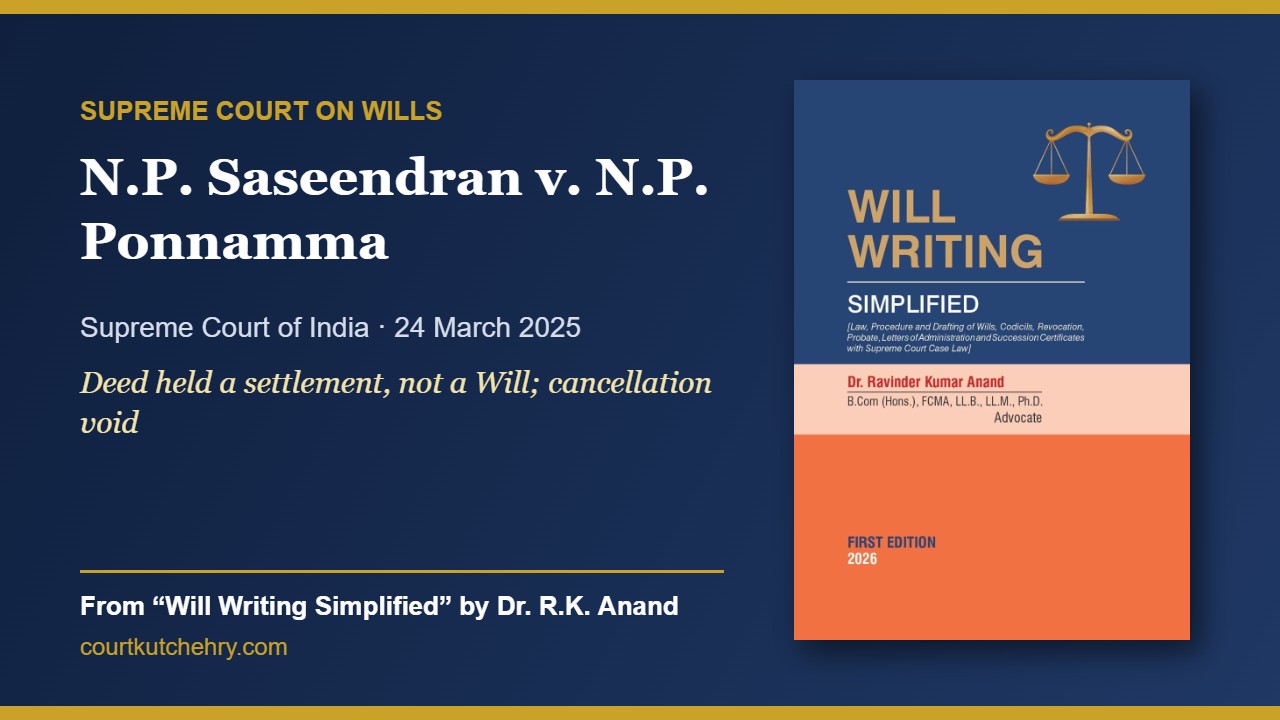
In 1985, a father in Kerala registers a document giving a property to his daughter “out of love and affection”, while keeping the income for himself and his wife for their lifetimes. Eight years later, he cancels it and sells the property to his son. Was the 1985 document a Will, which he could revoke at any time, or a gift, which he could not? The trial court and first appellate court called it a Will; the High Court called it a settlement. On 24 March 2025, the Supreme Court agreed with the High Court. This article explains N.P. Saseendran v. N.P. Ponnamma & Ors. and what it teaches about telling a Will from a gift or settlement deed.
Case at a Glance
| Case | N.P. Saseendran v. N.P. Ponnamma & Ors. |
|---|---|
| Court | Supreme Court of India |
| Citation | (2025) 03 SC CK 0237; Civil Appeal No. 4312 of 2025 |
| Decided on | 24 March 2025 |
| Bench | Justice J.B. Pardiwala and Justice R. Mahadevan (judgment by Justice R. Mahadevan) |
| Provisions | Sections 11, 122, 123 and 126, Transfer of Property Act, 1882; Sections 2(h) and 59-63, Indian Succession Act, 1925; Section 100, CPC; Article 142, Constitution of India |
| Result | Appeal dismissed; 1985 deed held a settlement (gift); cancellation and sale to son void |
The Facts
By a registered document dated 26 June 1985 (Ext. A1, Document No. 3148 of 1985), described in Malayalam as a dhananischayaadharam, a father conveyed a property to his daughter, out of love and affection, for her subsistence and residence. The document said:
- the father would keep possession and the income during his lifetime;
- after his death, the mother would have the income during her lifetime;
- the father could mortgage the property up to Rs. 2,000;
- the daughter could build a house, pay taxes and obtain a purchase certificate; and
- the daughter could enjoy and transfer the property after both parents’ lifetimes.
On 19 October 1993, the father executed a cancellation deed (Document No. 4233 of 1993) and, the same day, a sale deed in favour of his son (Document No. 4234 of 1993).
The daughter filed O.S. No. 27 of 1994 in the Sub Court, Cherthala, for a declaration of her title and a declaration that the 1993 cancellation and sale deeds were void. The father died on 6 January 1995 while the suit was pending, and his other heirs were brought on record.
What the Lower Courts Held
- The trial court (28 May 2001) held that Ext. A1 was a Will, not a gift, and dismissed the suit.
- The first appellate court (A.S. No. 109 of 2001, 20 December 2003) affirmed.
- The Kerala High Court (R.S.A. No. 1338 of 2004, 10 June 2019) reversed both. It held Ext. A1 to be a gift or settlement, not a Will, and declared that the 1993 cancellation and sale deeds did not bind the daughter.
The Question Before the Supreme Court
The Court framed two questions (para 10): was the 1985 document a gift, a settlement or a Will; and were the legal requirements satisfied so as to vest a right in the daughter?
The Law on Wills, Gifts and Settlements
Gift. Under Section 122 of the Transfer of Property Act, 1882, a gift is a voluntary transfer of existing property without consideration, accepted by the donee during the donor’s lifetime. A gift of immovable property must be by a registered instrument signed by the donor and attested by two witnesses (Section 123). Once made, it cannot be revoked at the donor’s will, except in the limited cases in Section 126.
Settlement. A settlement deed disposes of property, usually among family members, often out of love and affection, and may reserve a life interest for the settlor. It vests rights in praesenti, that is, immediately.
Will. A Will, defined in Section 2(h) of the Indian Succession Act, 1925, operates only after death and can be revoked at any time during the testator’s life (Section 62).
The test. The key question is whether the document transfers an interest now, or only on death. The name given to the document is not decisive. The Court relied on a long line of authority, including P.K. Mohan Ram v. B.N. Ananthachary, (2010) 4 SCC 161, K. Balakrishnan v. K. Kamalam, (2004) 1 SCC 581, Renikuntla Rajamma v. K. Sarwanamma, (2014) 07 SC CK 0039, and Mathai Samuel v. Eapen Eapen, (2012) 13 SCC 80.
The Supreme Court’s Reasoning
1. Deciding a substantial question of law
The son argued that the High Court could not have upset concurrent findings in second appeal. The Court held that concurrent findings can be disturbed only where a substantial question of law arises, and that the nature of a document is such a question; it also invoked Article 142 to do complete justice (para 8).
2. How gifts, settlements and Wills overlap
The Court explained that a gift and a settlement both need acceptance in the donor’s lifetime and both vest rights at once: “The vesting of the right also takes place in praesenti in both the cases” (para 11.3). “The element of voluntary disposition is common to all the three deeds” (para 11.5), but a Will postpones the gift until death. A composite document may even operate partly as a settlement and partly as a Will.
3. Labels do not decide
“The nomenclature given to the document is irrelevant” (para 14.1). The court reads the whole document to find whether the interest passes now or on death, and may also consider later conduct.
4. Ext. A1 conveyed the property in praesenti
Ext. A1 transferred the property to the daughter immediately, while the father kept a life interest and a limited right to mortgage. “The postponement of delivery by creation of life interest is not an anathema to absolute conveyance in praesenti” (para 15.1). A clause that seemed to conflict was read as qualifying, not repugnant; even if repugnant, the earlier absolute grant would prevail on the principle of Section 11 of the Transfer of Property Act.
5. Acceptance was proved, so the gift could not be cancelled
“Ascertainment of the nature of the document is different from validity” (para 16), so the Court went on to examine acceptance. Delivery of possession is not essential, and acceptance can be inferred from conduct, such as the donee holding the original deed. The Court found acceptance proved. “Once a gift has been acted upon, the same cannot be unilaterally cancelled” (para 18). The 1993 cancellation deed was therefore void, the sale deed to the son fell with it, and the Sub-Registrar should not have registered the cancellation.
The Final Decision
The Supreme Court dismissed the son’s appeal and confirmed the High Court’s judgment. The 1985 document was a settlement (a gift by way of settlement) vesting the property in the daughter, and the 1993 cancellation deed and sale deed were invalid. The parties were to bear their own costs (paras 20-21).
Key Takeaways
- Whether a document is a Will or a gift/settlement depends on when the interest passes: now (gift or settlement) or on death (Will).
- The title of the document does not decide its nature.
- Reserving a life interest or a limited power to mortgage does not turn a settlement into a Will.
- Acceptance of a gift can be inferred from conduct; possession need not be delivered.
- A completed gift or settlement cannot be cancelled unilaterally, and a sale based on such a cancellation is void.
Practical Lessons for Will Makers and Lawyers
- Decide what you want. If you want to keep the right to change your mind, make a Will. If you want to transfer now, make a gift or settlement, and understand that you cannot take it back.
- Use clear words. A Will should say it takes effect only after your death and that you may revoke it. A settlement should say the property vests in the beneficiary from today.
- Life interest is possible either way. You can settle property now and keep a life interest; that will not let you cancel it later.
- Do not “cancel” a gift deed and resell. Such a cancellation is void and exposes the new buyer to litigation.
- For lawyers: when drafting, avoid mixed clauses that can be read both ways. When litigating, read the whole document, not just its heading.
Frequently Asked Questions
How do I know if a document is a Will or a gift deed?
Ask when the property passes. If it passes immediately, even with a life interest reserved, it is a gift or settlement. If it passes only after death, it is a Will. The name of the document is not decisive.
Can a person cancel a registered gift or settlement deed?
Not unilaterally, once it is accepted and acted upon, except in the limited situations in Section 126 of the Transfer of Property Act. The Court held the father’s 1993 cancellation void.
Does the donee have to take possession for a gift to be valid?
No. The Court held delivery of possession is not essential. Acceptance can be shown by conduct, such as holding the original deed.
Can a Will be cancelled?
Yes. A Will can be revoked by the testator at any time before death. That is why the son argued the 1985 document was a Will; the Court rejected that.
What happened to the sale deed in favour of the son?
It fell with the cancellation deed. Since the father no longer owned the property after the 1985 settlement, he could not sell it to the son.
Conclusion
Saseendran is a valuable guide to one of the most common confusions in family property: whether a document is a Will or a gift. The answer lies in its substance. Where property passes now, even with a life interest kept back, the transfer is complete and the giver cannot change his mind later.
For anyone planning succession, the choice between a Will and a gift or settlement deed is a real one, with real consequences. Choose deliberately, draft clearly, and remember that only a Will can be revoked.
Read More in “Will Writing Simplified”

This judgment is one of 123 Supreme Court judgments on Wills summarised in Chapter 14 of Will Writing Simplified by Advocate Dr. Ravinder Kumar Anand. The book covers the law, procedure and drafting of Wills, codicils, revocation, probate, letters of administration and succession certificates, with Supreme Court case law.
Special limited-period offer: available at 50% off on Amazon.
Buy Will Writing Simplified on Amazon →
Research Judgments Like These on CourtKutchehry
Every judgment cited in this article, and lakhs more, can be searched and read on CourtKutchehry. Searching and reading judgments is free. A membership adds unlimited summaries, all related judgments, original court PDF downloads, bookmarks, notes and the CourtKutchehry AI assistant.
| Membership | Price | Works out to | AI credits |
|---|---|---|---|
| Monthly (1 month) | ₹599 | ₹599 / month | 1,000 / month |
| Quarterly (3 months) · Save 16% | ₹1,499 | ₹499.67 / month | 1,100 / month |
| Six-monthly (6 months) · Save 33% | ₹2,399 | ₹399.83 / month | 1,200 / month |
| Yearly (12 months) · Save 44% · Best value | ₹3,999 | ₹333.25 / month | 1,300 / month |
Every plan is a one-off purchase for a fixed period: nothing auto-renews and no card is kept on file. Prices are exclusive of applicable tax, which is added at checkout. Extra AI chat credits can be topped up from ₹99. A free verified account gets 5 summaries and 50 AI trial credits.
Prices are as displayed on courtkutchehry.com on 20 November 2026 and are subject to change without notice. Please check the pricing page for the current plans and offers.
For more judgments, legal opinions and case analysis, visit courtkutchehry.com
Visit CourtKutchehry →