
Watch the Video
In this 5-minute video, Vineet Kohli, Advocate explains Sections 6, 6A and 7 of the Recovery of Debts and Bankruptcy Act, 1993 in Episode 9 of “DRT Act Explained with Judgments”. He covers the Presiding Officer’s term of office, the shift to the Tribunals Reforms Act, 2021, and the staff of the Tribunal, especially the Recovery Officer, the executing arm of the DRT. This article explains each provision, the Supreme Court’s ruling in Allahabad Bank v. Canara Bank, and the worked example from the episode.
Two Officers, Two Jobs
Every DRT case passes through two sets of hands. The Presiding Officer hears the parties and decides how much is due. The Recovery Officer then turns that decision into money. Sections 6 and 6A deal with the first officer’s tenure and service; Section 7 provides the second officer and the rest of the staff.
Section 6: Term of Office
Section 6, as substituted in 2016, provides that the Presiding Officer holds office for a term of five years from the date on which he enters upon his office, and is eligible for reappointment. But no Presiding Officer can hold office after attaining the age of 65 years.
So the outer limit is whichever comes first: the end of the five-year term or the age of 65.
Section 6A: The Tribunals Reforms Act, 2021
In 2021, Parliament passed the Tribunals Reforms Act, 2021, which created a common framework for many tribunals. Section 6A of the DRT Act now provides that for Presiding Officers appointed after the notified date, the qualifications, appointment, term of office, salaries and allowances, resignation, removal and other conditions of service are governed by the Tribunals Reforms Act and the rules under it, rather than by the DRT Act alone.
The question of tribunal tenure has been the subject of several Supreme Court rulings in the Madras Bar Association line of cases, which examined the validity of tenure and service provisions for tribunal members. The law in this area has changed more than once, so the video’s advice is practical: always check the current position before relying on a figure for tenure or age.
Section 7: Staff of the Tribunal
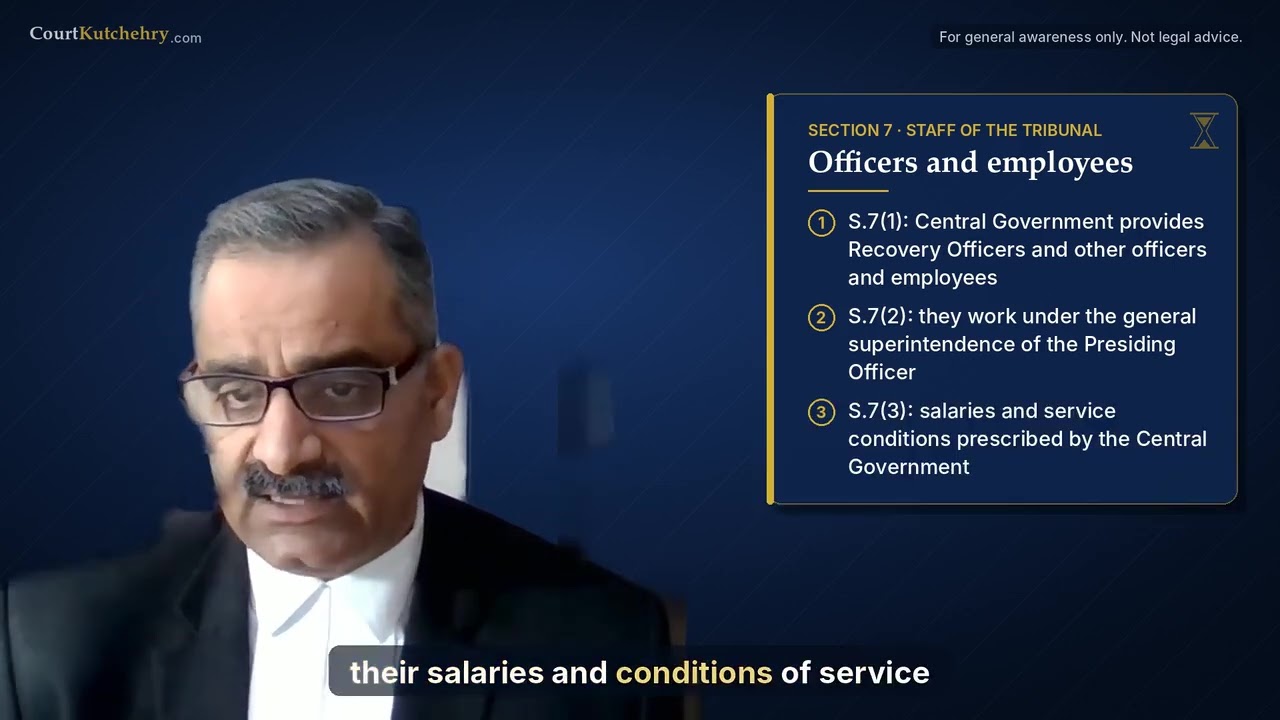
Under Section 7, the Central Government provides the Tribunal with Recovery Officers and other officers and employees as it thinks fit. They discharge their functions under the general superintendence of the Presiding Officer. Their salaries and service conditions are prescribed by the Central Government.
The Recovery Officer: The Executing Arm
Once the DRT decides an original application, the Presiding Officer issues a recovery certificate. The Recovery Officer then executes it under Sections 25 to 29: by attachment and sale of the debtor’s movable or immovable property, by arrest and detention, by appointment of a receiver, and by other modes. Section 29 applies the tax-recovery procedure in the Second and Third Schedules to the Income-tax Act, 1961, with necessary modifications. Since that Act has now been replaced by the Income-tax Act, 2025, practitioners should check the corresponding provisions of the new law.
Two safeguards complete the picture:
- Section 26: the Recovery Officer cannot go behind the recovery certificate. He cannot question its correctness or reopen the amount. That is for the Tribunal.
- Section 30: a person aggrieved by an order of the Recovery Officer can appeal to the Presiding Officer, and Section 30A requires a deposit before such an appeal by the debtor is entertained.
Allahabad Bank v. Canara Bank (2000)
The leading authority on the Recovery Officer’s role is Allahabad Bank vs Canara Bank and Another, (2000) 04 SC CK 0050, (2000) 4 SCC 406, decided on 4 April 2000 by N. Santosh Hegde and M. Jagannadha Rao, JJ. The Supreme Court held that the Tribunal alone adjudicates the debt, and the Recovery Officer alone executes the certificate. No civil court or company court can step into either function. Because of Section 34, the DRT Act overrides inconsistent provisions of the Companies Act, so leave of the company court is not needed to start or continue proceedings under the DRT Act, and questions of priority among creditors over money realised under the Act are for the Tribunal to decide.
Remember this line: the Presiding Officer decides; the Recovery Officer executes.
Practical Point: Dealing With Both Officers
For advocates, the distinction is not academic. Arguments about liability and the amount due belong before the Presiding Officer, at the stage of the original application. Once the recovery certificate is issued, the Recovery Officer will not reopen them. Before the Recovery Officer, the arguments are about execution: whether the property attached belongs to the debtor, whether the sale was properly conducted, whether the valuation was fair. And if the Recovery Officer goes wrong, the remedy is an appeal under Section 30, with the deposit under Section 30A.
Practical Illustration
A bank’s original application for ₹80 lakh is allowed by the DRT.
- The Presiding Officer, appointed for five years and within the age limit, signs the order and issues a recovery certificate.
- The certificate goes to the Recovery Officer, who attaches the borrower’s commercial property and proclaims it for sale.
- The borrower tells the Recovery Officer that the bank’s interest was wrongly calculated. The Recovery Officer cannot entertain this: under Section 26, he cannot go behind the certificate.
- A third party then objects that the attached property belongs to him, not to the borrower. That is an execution issue, which the Recovery Officer can decide. If either side is aggrieved by his order, it can appeal to the Presiding Officer under Section 30.
Key Takeaways
- A DRT Presiding Officer holds office for five years, is eligible for reappointment, and retires at 65 (Section 6).
- For Presiding Officers appointed after the notified date, service is governed by the Tribunals Reforms Act, 2021 (Section 6A); check the current position given the Madras Bar Association rulings.
- The Central Government provides Recovery Officers and staff, under the Presiding Officer’s superintendence (Section 7).
- The Recovery Officer executes the recovery certificate under Sections 25 to 29 and cannot go behind it (Section 26).
- An order of the Recovery Officer is appealable to the Presiding Officer under Section 30, with a deposit under Section 30A.
Frequently Asked Questions
What is the term of a DRT Presiding Officer?
Five years, with eligibility for reappointment, but not beyond the age of 65 (Section 6). For appointments after the notified date, the Tribunals Reforms Act, 2021 governs.
Who is the Recovery Officer of the DRT?
An officer provided by the Central Government under Section 7, who executes the Tribunal’s recovery certificates under Sections 25 to 29.
Can the Recovery Officer change the amount in the recovery certificate?
No. Under Section 26, the Recovery Officer cannot question the correctness of the certificate. Only the Tribunal can.
How do I challenge an order of the Recovery Officer?
By an appeal to the Presiding Officer of the DRT under Section 30, subject to the deposit required by Section 30A.
Can a company court stop DRT recovery proceedings?
No. In Allahabad Bank v. Canara Bank (2000), the Supreme Court held that the DRT and its Recovery Officer have exclusive jurisdiction, and the DRT Act prevails over inconsistent provisions of the Companies Act.
Where can I watch the full explanation?
Watch Vineet Kohli, Advocate explain it in 5 minutes: https://youtu.be/oL-8VmA2Hiw.
Conclusion
Sections 6 and 6A tell us how long the Presiding Officer holds office and which law governs his service today. Section 7 gives the Tribunal its staff, and above all its Recovery Officer.
The Supreme Court’s message in Allahabad Bank v. Canara Bank is the key to the whole scheme: adjudication belongs to the Tribunal, execution to the Recovery Officer, and no other court can take over either job.
▶ Watch the video: Sections 6, 6A & 7, DRT Act: Presiding Officer’s Term, Tribunals Reforms Act | Ep 9
📖 Read more: Supreme Court Clarifies DRT Powers Over Civil Procedure in Debt Recovery
Research Judgments Like These on CourtKutchehry
Every judgment cited in this article, and lakhs more, can be searched and read on CourtKutchehry. Searching and reading judgments is free. A membership adds unlimited summaries, all related judgments, original court PDF downloads, bookmarks, notes and the CourtKutchehry AI assistant.
| Membership | Price | Works out to | AI credits |
|---|---|---|---|
| Monthly (1 month) | ₹599 | ₹599 / month | 1,000 / month |
| Quarterly (3 months) · Save 16% | ₹1,499 | ₹499.67 / month | 1,100 / month |
| Six-monthly (6 months) · Save 33% | ₹2,399 | ₹399.83 / month | 1,200 / month |
| Yearly (12 months) · Save 44% · Best value | ₹3,999 | ₹333.25 / month | 1,300 / month |
Every plan is a one-off purchase for a fixed period: nothing auto-renews and no card is kept on file. Prices are exclusive of applicable tax, which is added at checkout. Extra AI chat credits can be topped up from ₹99. A free verified account gets 5 summaries and 50 AI trial credits.
Prices are as displayed on courtkutchehry.com on 20 November 2026 and are subject to change without notice. Please check the pricing page for the current plans and offers.
For more judgments, legal opinions and case analysis, visit courtkutchehry.com
Visit CourtKutchehry →