
Watch the Video
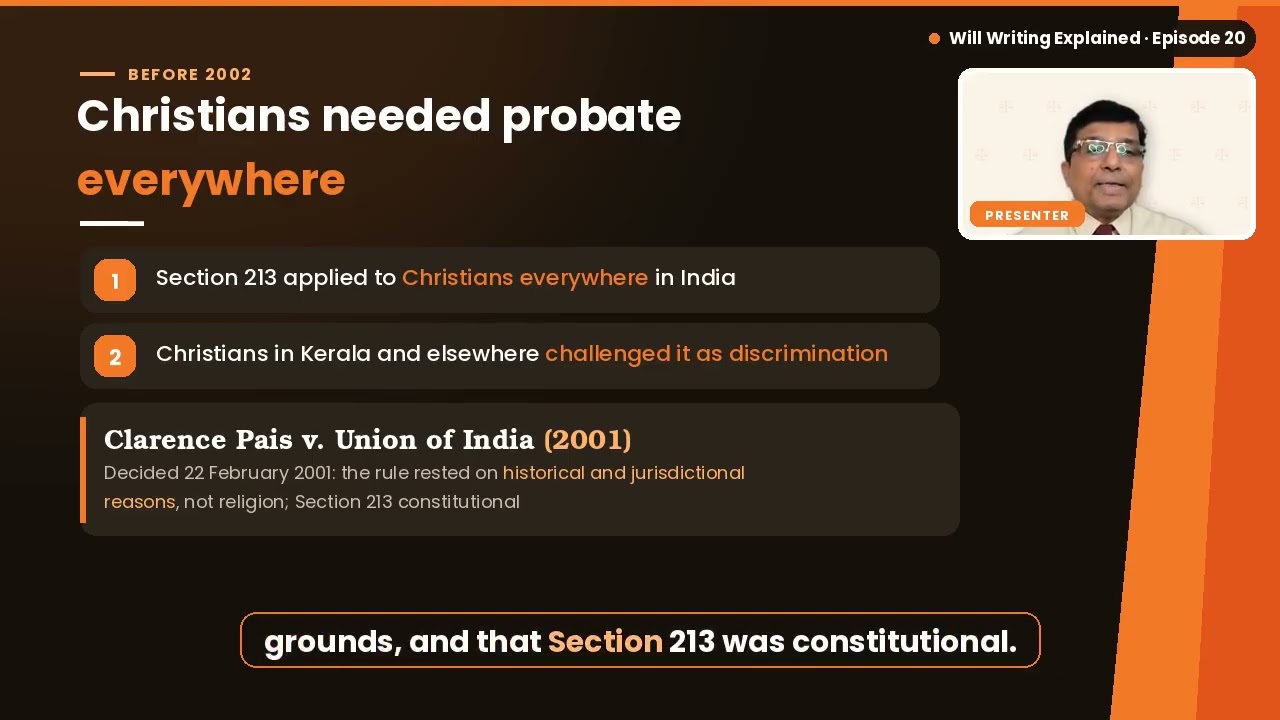
In this 10-minute video, CourtKutchehry presents Episode 20 of “Will Writing Explained” on Section 213 of the Indian Succession Act, 1925. A Hindu leaves a flat by will in Mumbai, and his daughter needs probate. The same will in Delhi needs none. Same law, same religion, different city. The episode explains the rule that made probate compulsory in Mumbai, Chennai and Kolkata until 20 December 2025: how it worked with Section 57, why Delhi was exempt (Kanta Yadav, 2019), how Christians were exempted after Clarence Pais (2001), and why the rule was criticised. This article explains the same history in writing.
▶ Watch on YouTube: Section 213: When Probate of a Will Was Compulsory | Will Writing Ep 20
The Puzzle: Same Will, Different Cities
Imagine two Hindu fathers. Each leaves his flat to his daughter by a properly signed and attested will. One flat is in Mumbai, the other in Delhi. Until 20 December 2025, the Mumbai daughter could not establish her right under the will in any court without first obtaining probate. The Delhi daughter could simply rely on the will and prove it in the ordinary way.
The reason was not anything in the Hindu Succession Act. It was Section 213 of the Indian Succession Act, read with Section 57, and a piece of colonial history.
What Section 213 Said
Section 213(1) provided that no right as executor or legatee could be established in any court of justice unless a competent court in India had granted probate of the will, or letters of administration with the will annexed.
Section 213(2) then limited who was caught. As it stood before 2025, the rule did not apply to wills made by Muslims or Indian Christians. For Hindus, Buddhists, Sikhs and Jains, it applied only to wills falling within clauses (a) and (b) of Section 57. For Parsis, it applied to wills made within the local limits of the ordinary original civil jurisdiction of the High Courts at Calcutta, Madras and Bombay, and to wills made elsewhere only so far as they related to immovable property within those limits.
Remember this line: Section 213 was a rule of evidence and procedure about how a right under a will could be established, not a rule about whether the will was valid.
Section 57: The Map Behind the Rule
Section 57 applies certain provisions of the Act to wills of Hindus, Buddhists, Sikhs and Jains. Its three clauses created the geography:
- Clause (a): wills made on or after 1 September 1870 within the territories then under the Lieutenant-Governor of Bengal, or within the local limits of the ordinary original civil jurisdiction of the High Courts at Madras and Bombay.
- Clause (b): wills made outside those territories, but only so far as they relate to immovable property situated within them.
- Clause (c): all other wills made by Hindus, Buddhists, Sikhs and Jains on or after 1 January 1927.
Section 213 picked up only clauses (a) and (b). So in practice, probate was compulsory for such wills made in the old presidency areas, broadly Kolkata, Chennai and Mumbai, or dealing with immovable property there. Everywhere else, clause (c) applied and no probate was required.
Why Delhi Was Exempt: Kanta Yadav (2019)
The question reached the Supreme Court in Kanta Yadav v. Om Prakash Yadav, (2019) 07 SC CK 0085. A Hindu had made a will in Delhi about property in Delhi. Was probate necessary before the legatee could rely on it?
A bench of Justices L. Nageswara Rao and Hemant Gupta held that it was not. Section 213 applied to Hindu wills only where they fell within Section 57(a) or (b). A will made in Delhi about Delhi property fell under neither clause, so Section 213 did not apply. The Court upheld the Delhi High Court’s Division Bench and dismissed the appeal.
The same reasoning applied across most of India. Outside the old presidency limits, Hindu, Sikh, Jain and Buddhist wills could be proved directly in a suit, and probate was optional.
Christians, Clarence Pais and the 2002 Amendment
Christians were in a different position. Their wills are governed by Part VI of the Act generally, and before 2002 Section 213(2) did not list Indian Christians among the exempted communities. Petitioners argued that this left Christian wills subject to the probate requirement while Muslim wills were free of it.
In Clarence Pais v. Union of India, (2001) 02 SC CK 0104, petitioners argued that Section 213 discriminated against Indian Christians and violated Article 14. The Supreme Court (Justices S. Rajendra Babu and R.C. Lahoti) rejected the challenge. It held that the requirement rested on historical and territorial reasons connected with the old presidency towns, not on religion, and that it also covered Parsis and certain Hindu wills. The petitions were dismissed.
Parliament then acted. The Indian Succession (Amendment) Act, 2002 inserted “Indian Christians” into Section 213(2), so wills of Indian Christians, like those of Muslims, no longer needed probate under Section 213.
Why the Rule Was Criticised
By the 2000s, Section 213 looked hard to defend:
- It made the same family’s rights depend on the city where the will was made or the property lay.
- After 2002, it bore on Hindus, Buddhists, Sikhs, Jains and Parsis in certain areas, but not on Muslims or Christians.
- Probate proceedings added cost and delay, including court fees on the value of the estate.
- Multi-city estates raised awkward questions about which property needed probate.
The Law Commission of India, in its 209th Report (2008), recommended that Section 213 be omitted. The notes to the Repealing and Amending Bill, 2025 described the provision as discriminatory and said its omission sought to attain uniformity.
What Changed on 20 December 2025
The Repealing and Amending Act, 2025 received the President’s assent on 20 December 2025. It omitted Section 213, removed the reference to it in Section 3(1), and made consequential changes to Section 370. From that date, probate is no longer compulsory anywhere in India. The next episode of the series explains the change in detail, including questions about older wills and pending cases.
Key Takeaways
- Section 213 barred establishing a right as executor or legatee in court without probate, but only for certain wills.
- For Hindus, Buddhists, Sikhs and Jains it applied only to wills under Section 57(a) and (b): the old presidency areas of Kolkata, Chennai and Mumbai.
- A Delhi will about Delhi property never needed probate (Kanta Yadav, 2019).
- The Supreme Court upheld Section 213 in Clarence Pais (2001); Parliament exempted Indian Christians in 2002.
- Section 213 was omitted from 20 December 2025 by the Repealing and Amending Act, 2025.
Frequently Asked Questions
Was probate ever compulsory in Delhi?
Not for Hindu wills made in Delhi about Delhi property. The Supreme Court confirmed this in Kanta Yadav v. Om Prakash Yadav (2019).
Which cities did Section 213 affect?
Broadly the old presidency areas: the territories under the former Lieutenant-Governor of Bengal and the original civil jurisdiction limits of the Madras and Bombay High Courts, that is, Kolkata, Chennai and Mumbai.
Did Section 213 apply to Muslims?
No. Section 213(2) always excluded wills made by Muslims.
What did Clarence Pais decide?
That Section 213 was not discriminatory against Christians, because it rested on territorial and historical grounds. Parliament exempted Indian Christians the next year.
Is Section 213 still in force?
No. It was omitted by the Repealing and Amending Act, 2025, which received assent on 20 December 2025.
Where can I watch the full explanation?
Watch the video explain Section 213 in 10 minutes: https://youtu.be/e9pyAzgsIyE.
Conclusion
For almost a century, a will’s path through the courts depended on geography. A daughter in Mumbai had to take probate; a daughter in Delhi did not. The rule survived a constitutional challenge, was softened for Christians in 2002, and was finally removed in December 2025.
Knowing this history still matters. Many pending disputes and old title chains in Mumbai, Chennai and Kolkata were shaped by Section 213, and lawyers will meet its effects for years to come.
▶ Watch the video: Section 213: When Probate of a Will Was Compulsory | Will Writing Ep 20
📖 Read more: Clarence Pais and Others v. Union of India — Supreme Court Upholds Probate Requirement for Indian Christians
Research Judgments Like These on CourtKutchehry
Every judgment cited in this article, and lakhs more, can be searched and read on CourtKutchehry. Searching and reading judgments is free. A membership adds unlimited summaries, all related judgments, original court PDF downloads, bookmarks, notes and the CourtKutchehry AI assistant.
| Membership | Price | Works out to | AI credits |
|---|---|---|---|
| Monthly (1 month) | ₹599 | ₹599 / month | 1,000 / month |
| Quarterly (3 months) · Save 16% | ₹1,499 | ₹499.67 / month | 1,100 / month |
| Six-monthly (6 months) · Save 33% | ₹2,399 | ₹399.83 / month | 1,200 / month |
| Yearly (12 months) · Save 44% · Best value | ₹3,999 | ₹333.25 / month | 1,300 / month |
Every plan is a one-off purchase for a fixed period: nothing auto-renews and no card is kept on file. Prices are exclusive of applicable tax, which is added at checkout. Extra AI chat credits can be topped up from ₹99. A free verified account gets 5 summaries and 50 AI trial credits.
Prices are as displayed on courtkutchehry.com on 20 November 2026 and are subject to change without notice. Please check the pricing page for the current plans and offers.
For more judgments, legal opinions and case analysis, visit courtkutchehry.com
Visit CourtKutchehry →