
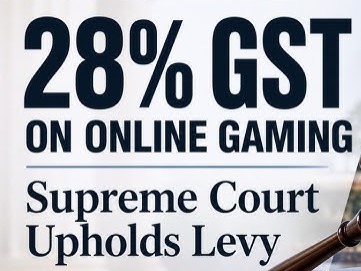
Supreme Court Declares GST on Online Gaming Constitutional: Betting & Gambling Redefined
Skill-based fantasy games fall under GST when money is staked
Court affirms actionable claims as taxable supplies under CGST Act
By Legal Reporter
New Delhi: May 27, 2026:
The Supreme Court of India has upheld the levy of Goods and Services Tax (GST) on online gaming and fantasy sports, ruling that such activities constitute “betting and gambling” when money is staked on uncertain outcomes. This judgment clarifies the constitutional validity of taxing actionable claims under the GST framework, reshaping the legal and commercial landscape for India’s booming online gaming industry.
The Supreme Court ruling in Navas Mulanavas vs State is a significant criminal law judgment focusing on procedural fairness, evidentiary appreciation, and constitutional safeguards available to accused persons during investigation and trial. The case discusses the standards required for criminal conviction, the importance of reliable evidence, and the duty of courts to ensure that prosecutions comply with principles of natural justice and due process. The Supreme Court emphasized that criminal liability cannot rest on doubtful or incomplete evidence, making this judgment highly relevant for criminal jurisprudence, trial procedure, and constitutional law research in India.
Background
On May 27, 2026, the Supreme Court delivered a landmark ruling in Directorate General of GST Intelligence vs Gameskraft Technologies Pvt Ltd. The case centered on whether online gaming platforms, particularly fantasy sports, could be taxed under GST. Petitioners argued that skill-based games should not be equated with gambling, while the government maintained that once money is staked on uncertain outcomes, the activity falls within the ambit of “betting and gambling.”
Key Legal Provisions Discussed
- Articles 366(12) & 366(12A) of the Constitution
- Define “goods” and “services” for taxation purposes.
- The Court held that actionable claims arising from betting and gambling are taxable supplies under GST and do not violate constitutional definitions.
- Article 265 of the Constitution
- States that no tax shall be levied or collected except by authority of law.
- The Court confirmed that GST on online gaming is backed by statutory authority under the CGST Act.
- Central Goods and Services Tax (CGST) Act, 2017
- Section 7: Defines “supply” to include actionable claims.
- Section 9: Provides for levy and collection of GST.
- Section 15: Determines valuation of taxable supply.
- The Court emphasized that pooled stakes and contingent prize structures in online gaming constitute “taxable supplies.”
- Transfer of Property Act, 1882 (Section 3)
- Defines “actionable claim” as a claim to any debt or beneficial interest in movable property not in possession.
- The Court ruled that participants in online games acquire contingent beneficial interests, qualifying as actionable claims.
Court’s Observations
- Skill vs Chance: Even skill-based games become taxable once money is staked on uncertain outcomes.
- Nature of Supply: Online gaming platforms are not mere intermediaries; they are suppliers of actionable claims.
- Commercial Hardship: Increased tax burden or reduced profitability does not make a fiscal measure unconstitutional.
- Legislative Competence: Parliament has the authority to impose GST on actionable claims arising from betting and gambling.
Implications
- Industry Impact: Online gaming operators face higher tax liabilities, potentially altering business models and profitability.
- Consumer Costs: Players may see increased entry fees or reduced prize pools as companies adjust to GST compliance.
- Legal Clarity: The ruling settles long-standing disputes over whether fantasy sports are games of skill or gambling for taxation purposes.
- Regulatory Precedent: This judgment may influence future legislation on digital gaming, betting, and emerging fintech-linked entertainment platforms.
Critical Analysis
The Court’s decision underscores a pragmatic approach: taxation hinges not on the skill-versus-chance debate but on the presence of monetary stakes and uncertain outcomes. While this ensures fiscal consistency, it raises concerns about stifling innovation in India’s gaming sector. Policymakers may need to balance revenue interests with fostering a regulated yet thriving digital entertainment ecosystem.
Detailed FAQ on Key Legal Points
Q1: Why did the Supreme Court uphold GST on online gaming?
A: Because online gaming involving monetary stakes creates actionable claims, which are taxable supplies under the CGST Act.
Q2: Does this apply to skill-based fantasy sports?
A: Yes. Once money is staked on uncertain outcomes, even skill-based games are treated as betting and gambling for GST purposes.
Q3: Which constitutional provisions were examined?
A: Articles 366(12), 366(12A), and 265 of the Constitution, which define goods, services, and taxation authority.
Q4: What sections of the CGST Act are relevant?
A: Sections 7 (supply), 9 (levy of GST), 15 (valuation), and 2(31) (definition of consideration).
Q5: What is an actionable claim in this context?
A: A contingent beneficial interest in pooled stakes or prize structures, as defined under Section 3 of the Transfer of Property Act.
Q6: Are gaming operators considered intermediaries?
A: No. The Court held they are suppliers of actionable claims, not mere facilitators.
Q7: How does this affect players?
A: Players may face higher costs as operators pass on GST liabilities through increased fees or reduced rewards.
In summary, the Supreme Court has firmly placed online gaming and fantasy sports within India’s GST framework, treating them as taxable betting and gambling activities when money is staked. This ruling reshapes the industry’s fiscal landscape while reinforcing constitutional principles of taxation.