
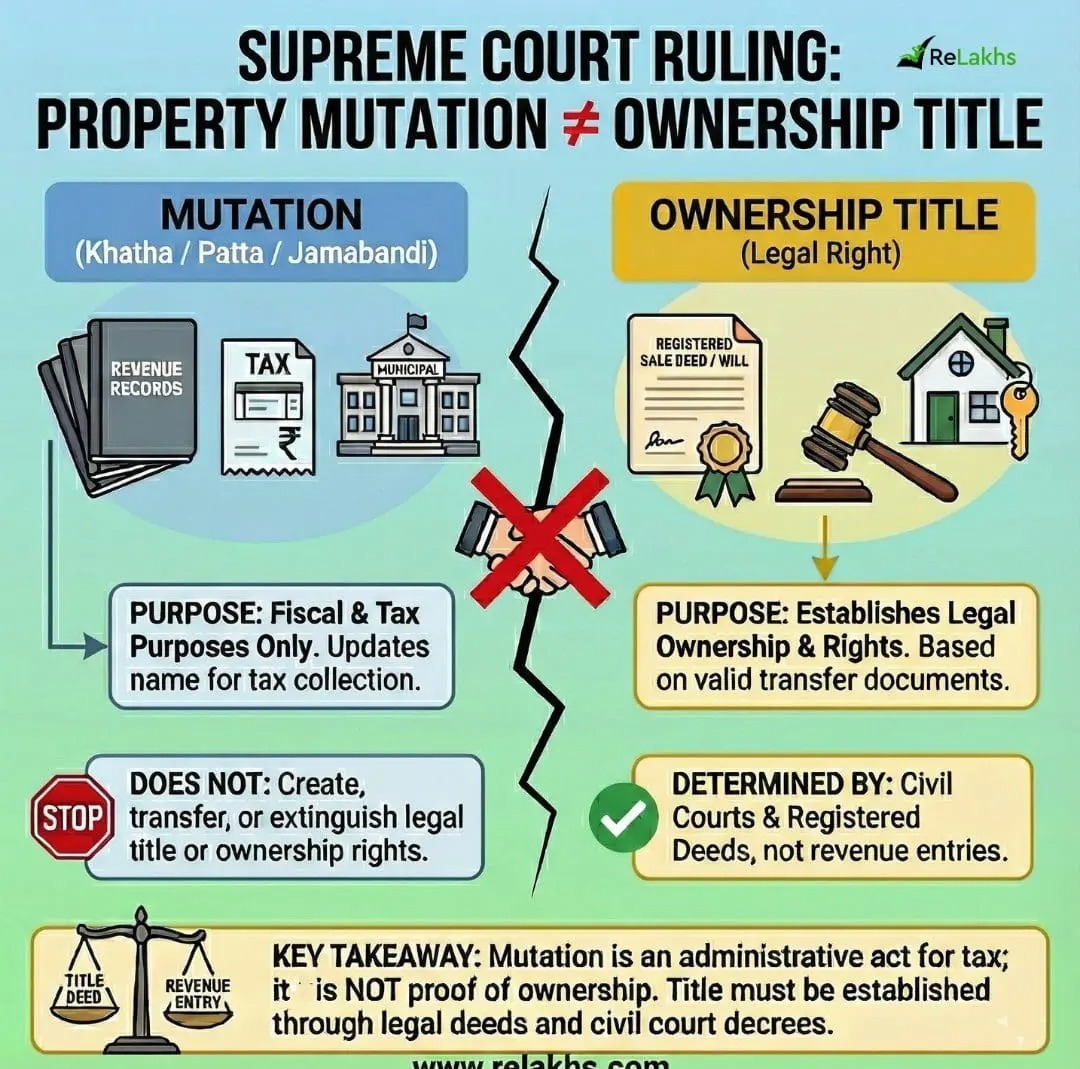
Mutation Updates Records, Not Ownership: Supreme Court Defines Boundaries
Revenue entries serve fiscal purposes only
Civil courts alone decide title disputes
By Vishwas Kumar
New Delhi: May 02, 2026:
Mutation is the process by which revenue authorities update land records to reflect changes in ownership after sale, inheritance, or transfer. The Supreme Court has clarified that mutation is purely administrative and does not confer ownership rights.
Readers exploring succession disputes, proof of wills, and the judicial approach to contested testamentary documents should also examine the Supreme Court judgment in Adivekka and Others vs Hanamavva Kom Venkatesh (D) by LRs and Another, where the Court discussed inheritance rights, attestation of wills, and the evidentiary burden involved in establishing valid testamentary succession under Indian law.
Process of Mutation
- Application: Buyer or heir applies to the local revenue office (Tehsildar/Patwari) for mutation.
- Required Records:
- Registered sale deed or succession certificate
- Death certificate (in case of inheritance)
- Will or partition deed (if applicable)
- Encumbrance certificate (to show property is free of disputes)
- Verification: Revenue officers check documents against existing records. However, Supreme Court has held they do not independently verify title validity — they only update records for tax purposes.
- Entry in Records: Mutation entry is made in the Record of Rights (RoR) or revenue register.
- Notice Requirement: Before cancelling or altering an existing entry, authorities must issue notice to the recorded owner.
Supreme Court Judgments on Mutation
- Balwant Singh v. Daulat Singh (1997)
- Clarification: Mutation entries are for fiscal purposes only. They do not confer or extinguish ownership rights.
- Suraj Bhan v. Financial Commissioner (2007)
- Clarification: Revenue records are not proof of title, only evidence of possession.
- Jitendra Singh v. State of Madhya Pradesh (2021)
- Clarification: Mutation neither creates nor extinguishes rights in property. It is only an administrative act.
- Yerikala Sunkalamma v. State of Andhra Pradesh (2025)
- Clarification: Cancelling mutation without notice violates constitutional rights under Article 300A (right to property).
Powers and Limitations
- Powers:
- Update records for tax collection.
- Record succession, inheritance, or sale.
- Issue pattadar passbooks and RoR extracts.
- Limitations:
- Cannot decide ownership disputes.
- Cannot cancel entries without notice to the recorded owner.
- Cannot override civil court judgments.
When to Seek Remedies
- Revenue Department: For mutation, administrative corrections, and fiscal records.
- Civil Courts: For ownership disputes, forged deeds, partition, succession conflicts, or injunctions.
FAQ on Mutation
Q1: What is mutation?
It is the process of updating revenue records after sale, inheritance, or transfer.
Q2: Does mutation confer ownership?
No. Supreme Court has held mutation is administrative, not proof of title.
Q3: What documents are required for mutation?
Registered sale deed, succession certificate, death certificate, Will/partition deed, and encumbrance certificate.
Q4: Are documents independently verified before mutation?
No. Revenue officers check them against records but do not adjudicate ownership validity.
Q5: Can revenue cancel mutation entries without notice?
No. Supreme Court has ruled cancellation without notice violates the right to property under Article 300A.
Q6: Who decides ownership disputes?
Only civil courts have jurisdiction to conclusively decide title disputes.
In summary: Mutation is essential for fiscal records but does not confer ownership. Supreme Court judgments make it clear that revenue authorities cannot decide title disputes, and cancellation of entries must follow due process with notice to owners.