
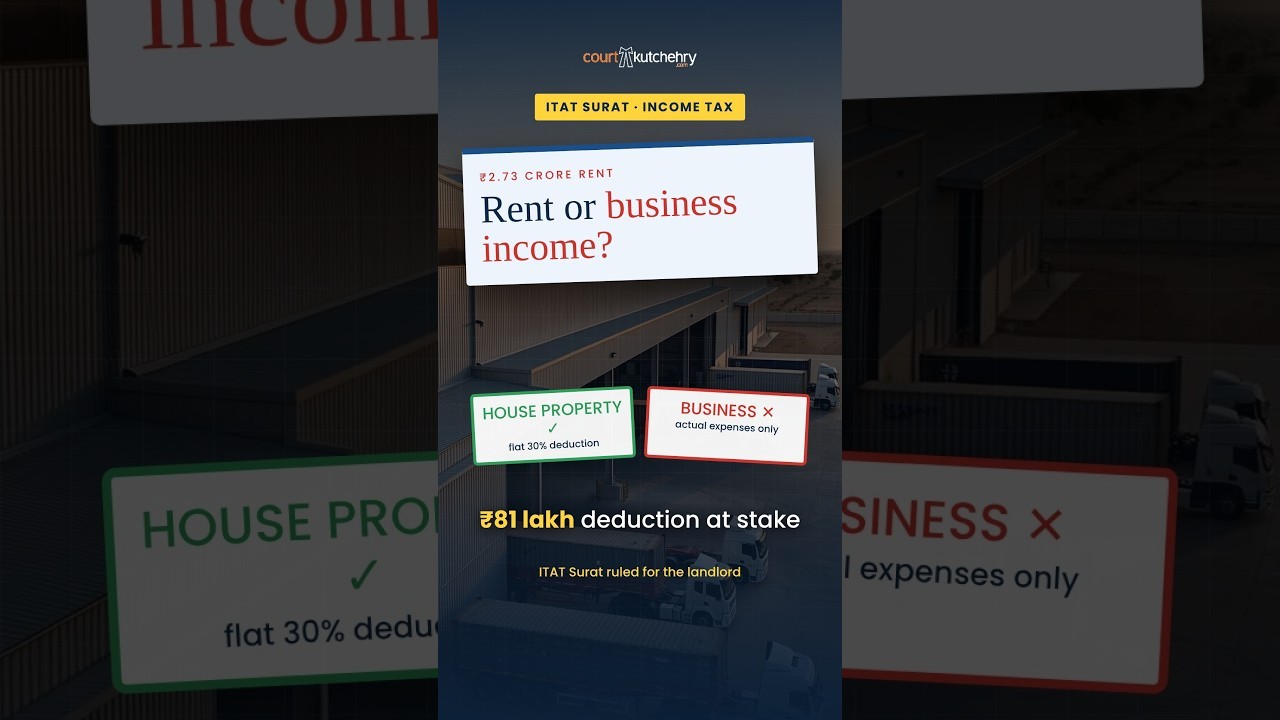
Watch the Video
In this 2-minute video, CourtKutchehry explains a ruling of the Income Tax Appellate Tribunal, Surat, on when rent is taxed as “Income from House Property” and when it is “business income”. This article explains the facts, why the label matters and what the Tribunal held.
▶ Watch on YouTube: ₹2.73 Crore Rent Called "Business Income" – ITAT Surat Says It's House Property!
The Facts
In Fatehsinh Mohansinh Chauhan v. ACIT (ITAT Surat, AY 2016-17, order dated 4 November 2026, as reported by TaxGuru and Business Standard), the taxpayer is an individual whose business is buying land and constructing buildings. He had let out industrial buildings that he held as stock-in-trade and received about ₹2.73 crore in rent.
He showed the rent as “Income from House Property” and claimed the flat 30% standard deduction of about ₹81.5 lakh, along with municipal taxes paid. His return declared total income of about ₹24.07 lakh. The Assessing Officer, in a scrutiny assessment under Section 143(3), treated the rent as business income, and the assessed income rose to about ₹1.07 crore. The Commissioner of Income Tax (Appeals) agreed with the officer.
Why the Label Matters: Sections 22–24 vs Section 28
The Income-tax Act, 1961 taxes income under separate heads, and each head has its own rules for deductions. The 1961 Act governs this case because it concerns AY 2016-17. (The Income-tax Act, 2025 has applied only from 1 April 2026.)
- House property (Sections 22 to 24): Section 22 taxes the annual value of buildings or land appurtenant to them that the taxpayer owns, except the parts he uses for his own business. Section 24(a) allows a flat deduction of 30% of that value, whatever the owner actually spends on repairs or upkeep.
- Business income (Section 28): Profits of a business are computed by deducting the expenses actually incurred for the business. There is no flat 30% allowance.
So for a landlord with low actual expenses, the house property head can mean a much smaller tax bill. Here, the 30% deduction alone was worth about ₹81.5 lakh.
What the Tribunal Held
The Tribunal sided with the taxpayer (as reported). Its reasoning:
- Stock-in-trade is not decisive. Holding a building as stock-in-trade is relevant, but it does not, by itself, turn the rent from that building into business income.
- Look at the activity. What matters is the nature of the activity that produces the income, not just how the property is shown in the books.
- His business was building and dealing in property, not letting it out. The rent was therefore income from house property.
The Tribunal directed the Assessing Officer to recompute the rent under the house property head, allow the admissible deductions, and give consequential relief.
Remember this line: it is not what the property is, it is how you use it.
Not a Free Pass: When Rent Is Business Income
The ruling does not mean rent is always house property income. In Chennai Properties & Investments Ltd. v. CIT, (2015) 04 SC CK 0057, the Supreme Court held that where letting out properties is the company’s actual business, the rent is taxable as business income. Its entire income came from letting.
Two years later, in Raj Dadarkar & Associates v. ACIT, (2017) 05 SC CK 0059, the Supreme Court explained that an object clause or a partnership deed is not conclusive. There, rent from sub-letting market shops was held to be house property income, as no organised commercial activity was shown. A mall, serviced offices or business centres, where letting comes with organised services, may well produce business income.
Three Lessons
- It is not what the property is, it is how you use it. The head of income follows the activity.
- Keep your books and returns consistent, year after year.
- If leasing is only incidental to your main business, document it.
Key Takeaways
- ITAT Surat held that rent of about ₹2.73 crore from industrial buildings held as stock-in-trade was income from house property (as reported).
- Stock-in-trade status alone does not make rent business income; the nature of the activity decides.
- House property income gets a flat 30% deduction under Section 24(a); business income allows only actual expenses.
- Where letting is the real business, rent can be business income, as in Chennai Properties (SC, 2015).
Frequently Asked Questions
Is rent from stock-in-trade property always business income?
No. In this case the Tribunal held that holding a building as stock-in-trade does not by itself make the rent business income. The activity that generates the income decides.
What is the 30% standard deduction?
Under Section 24(a) of the Income-tax Act, 1961, an owner taxed under house property can deduct 30% of the annual value, whatever the actual repair or maintenance cost.
When is rent taxed as business income?
When letting out property is the taxpayer’s actual business, for example through an organised commercial activity. The Supreme Court so held in Chennai Properties & Investments Ltd. v. CIT.
Does the Income-tax Act, 2025 apply to this case?
No. The case concerns AY 2016-17, so the Income-tax Act, 1961 applies. The 2025 Act has applied from 1 April 2026.
Where can I watch the video?
Watch the short explainer on the CourtKutchehry YouTube channel: https://youtu.be/SU94dtCsMXk.
Conclusion
The Surat Tribunal’s ruling, as reported, puts substance over labels: a builder who rents out buildings from his stock does not automatically earn business income from that rent. What matters is whether letting is his business or only incidental to it.
For taxpayers: keep your treatment consistent and keep records of how the property is actually used.
Research Judgments Like These on CourtKutchehry
Every judgment cited in this article, and lakhs more, can be searched and read on CourtKutchehry. Searching and reading judgments is free. A membership adds unlimited summaries, all related judgments, original court PDF downloads, bookmarks, notes and the CourtKutchehry AI assistant.
| Membership | Price | Works out to | AI credits |
|---|---|---|---|
| Monthly (1 month) | ₹599 | ₹599 / month | 1,000 / month |
| Quarterly (3 months) · Save 16% | ₹1,499 | ₹499.67 / month | 1,100 / month |
| Six-monthly (6 months) · Save 33% | ₹2,399 | ₹399.83 / month | 1,200 / month |
| Yearly (12 months) · Save 44% · Best value | ₹3,999 | ₹333.25 / month | 1,300 / month |
Every plan is a one-off purchase for a fixed period: nothing auto-renews and no card is kept on file. Prices are exclusive of applicable tax, which is added at checkout. Extra AI chat credits can be topped up from ₹99. A free verified account gets 5 summaries and 50 AI trial credits.
Prices are as displayed on courtkutchehry.com on 20 November 2026 and are subject to change without notice. Please check the pricing page for the current plans and offers.
For more judgments, legal opinions and case analysis, visit courtkutchehry.com
Visit CourtKutchehry →