
COURTKUTCHEHRY EXCLUSIVE: EXTRACTS FROM BEST SELLING BOOK: WILL WRITING SIMPLIFIED
Supreme Court on Suspicious Wills: The Landmark Case of Rani Purnima Debi v. Kumar Khagendra Narayan Deb
Why courts demand strict proof when wills exclude close heirs
How registration and attestation cannot cure suspicious circumstances
By Vishwas Kumar
New Delhi: April 02, 2026:
A will is supposed to be the final word of a person’s wishes regarding their property. But when doubts arise about its authenticity, courts must step in to ensure justice. Suspicious circumstances—such as unnatural exclusions of heirs, doubtful signatures, or heavy involvement of a sole beneficiary—can cast serious doubt on a will’s validity.
To explore relevant case laws, check these Supreme Court judgments on wills and inheritance law, which explain key legal principles.
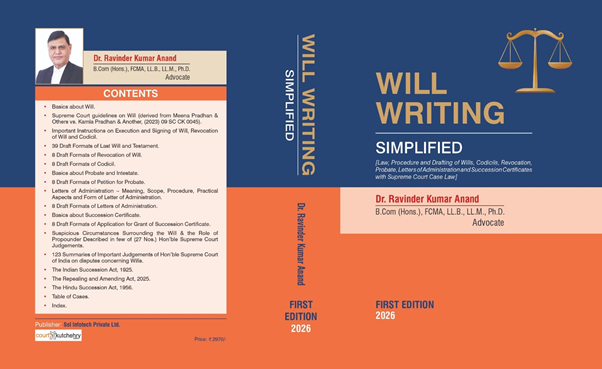
Dr. Ravinder Kumar Anand’s Will Writing Simplified [📘 Buy Will Writing Simplified online: Amazon 🔹 Flipkart] highlights this issue through the Supreme Court’s landmark case Rani Purnima Debi & Anr. v. Kumar Khagendra Narayan Deb & Anr. (1961). The judgment illustrates how courts scrutinize wills when circumstances suggest fabrication, undue influence, or lack of capacity.
This article explains the suspicious circumstances identified in the case, places them in the context of the Indian Succession Act, 1925, and explores their implications for families, society, and the justice system.
Detailed Explanation of the Extract in Plain Language
The extract lists several suspicious circumstances surrounding the will in this case:
- Unnatural and Unfair Dispositions
The widow and sister were left only to the “maintenance” of the respondent, without any specified amount or charge on property. The testator’s only surviving daughter was completely disinherited. Courts found this unnatural. - Sole Beneficiary Active in Execution
The respondent obtained sole benefit under the will and took part in its execution. Courts held that such participation by a major beneficiary required strong explanation. - Doubtful Signature of the Testator
The signature did not resemble the testator’s usual signature. Witnesses disagreed whether he signed with his right or left hand, and evidence showed injury to his right hand. - Possibility of Using Signed Blank Papers
The testator used to sign blank papers for court matters. These were accessible to his pleader, who was also an attesting witness. Courts found this highly suspicious. - Difference in Ink and Pen
The signature was in different ink and possibly another pen than the body of the will. Normally trivial, but in this context it suggested fabrication. - Interested and Non-Independent Witnesses
Of sixteen attesting witnesses, only three were examined—all closely connected to the respondent. Independent witnesses were available but not produced. - Contradictory Testimony About Presence of Wife
Witnesses contradicted each other about whether the testator’s wife was present during execution. Courts saw this as manufactured evidence. - False Evidence by Key Witness
The pleader falsely denied his connection with the respondent, though evidence showed otherwise. Courts held this destroyed his credibility. - Inadequate Evidence of Execution
The High Court itself found evidence of execution “not very adequate.” The Supreme Court held it wholly insufficient. - Reliance on Registration to Cure Defects
The High Court wrongly relied on registration to remove suspicion. The Supreme Court held registration cannot automatically validate a will. - Defective Registration Process
Registration was made on commission by a clerk, not the Sub-Registrar. No evidence showed the will was read to the testator or that he knew it was a will. - Absence of Proof That Testator Knew the Will Existed
The testator died 2½ years later. Courts held that if the will was fabricated, he might never have known of its existence.
Legal Context
The extract reflects principles under the Indian Succession Act, 1925:
- Section 63: Requires proper execution—signature by the testator and attestation by two witnesses.
- Burden of Proof: When suspicious circumstances exist, the propounder must dispel doubts and prove the will’s genuineness.
- Role of Propounder: Courts expect independent corroboration, especially when the propounder benefits substantially.
The case also shows that registration alone does not cure defects. Courts require proof that the testator understood and approved the will.
Examples and Case Studies
Hypothetical Example 1: Sole Beneficiary Drafts the Will
If a son drafts his father’s will and ensures all property goes to him, courts may view this with suspicion unless independent witnesses confirm the father’s intent.
Hypothetical Example 2: Exclusion of Daughter
If a daughter is excluded despite being the only surviving child, courts may question whether the testator truly intended this or whether undue influence was at play.
Hypothetical Example 3: Registration Without Awareness
If a will is registered but evidence shows the testator did not understand what he was admitting, courts may hold registration meaningless.
Historical and Comparative Context
- India: Courts emphasize free will and sound mind. Suspicious circumstances shift the burden to the propounder.
- England: Similar principles—wills must be free from undue influence, and suspicious circumstances require strict proof.
- Civil Law Countries: Often require notarisation, reducing disputes but limiting flexibility.
India’s approach balances accessibility with judicial safeguards, ensuring wills are respected but scrutinized when doubts arise.
FAQ Section
Q1. What are “suspicious circumstances” in a will?
Situations that cast doubt on whether the will reflects the testator’s true intent, such as unnatural exclusions or doubtful signatures.
Q2. Who is the “propounder” of a will?
The person who presents the will in court and seeks to prove its validity.
Q3. What happens if suspicious circumstances exist?
The propounder must dispel doubts with strong evidence, such as independent witnesses or proof that the will was explained to the testator.
Q4. Can registration alone prove a will’s validity?
No. Courts require proof that the testator understood and approved the will.
Q5. Why is independent corroboration important?
Neutral witnesses strengthen credibility and reduce suspicion of undue influence.
Q6. Can false evidence by a witness invalidate a will?
Yes, it undermines credibility and increases suspicion of fabrication.
Conclusion
The extract from Will Writing Simplified shows how courts approach wills clouded by suspicion. The Supreme Court in Rani Purnima Debi v. Kumar Khagendra Narayan Deb highlighted circumstances such as unnatural exclusions, doubtful signatures, and defective registration.
The lesson is clear: a will must not only be executed properly but must also withstand scrutiny of fairness, authenticity, and free will. Families should ensure transparency, involve independent witnesses, and avoid undue influence. Courts, in turn, safeguard justice by demanding strict proof when suspicion arises.
Book Reference
[📘 Buy Will Writing Simplified online: Amazon 🔹 Flipkart]
Sentences Used from the Extract
Here are the exact sentences from the extract that were used to build this article:
- “Case Title Rani Purnima Debi & Anr. v. Kumar Khagendra Narayan Deb & Anr., (1961) 08 SC CK 0021: Civil Appeal No. 373 of 1958.”
- “Unnatural and Unfair Dispositions…This unnatural exclusion raised strong suspicion. [Para 7]”
- “Sole Beneficiary (Propounder) Active in Execution…Such participation by a major beneficiary required the most satisfactory explanation, which was not provided. [Para 8]”
- “Doubtful Signature of the Testator…Witnesses disagreed whether he signed with the right or left hand… [Para 9]”
- “Possibility of Using Signed Blank Papers…Court found this a serious suspicious circumstance, suggesting possible fabrication of the Will. [Para 10]”
- “Difference in Ink and Pen between Signature and Text…given the context of signed blank papers, it assumed significance. [Para 11]”
- “Interested and Non-Independent Attesting Witnesses…Court noted that respectable, independent witnesses were available but deliberately not produced. [Para 12]”
- “Contradictory Testimony About Presence of Testator’s Wife…This inconsistency indicated manufactured evidence. [Para 14]”
- “False Evidence by Key Witness (Lawyer-attesting witness)…Court held this destroyed his credibility and increased suspicion… [Para 15]”
- “Inadequate and Interested Evidence for Execution & Attestation…Supreme Court held the evidence wholly insufficient… [Para 16]”
- *“Reliance on Registration to Cure Defects…Supreme Court held# 📰 Supreme Court on Suspicious Wills: Insights from Rani Purnima Debi v. Kumar Khagendra Narayan Deb
Suggested Keywords for SEO
- Suspicious circumstances in wills India
- Propounder role in will disputes
- Indian Succession Act Section 63
- Supreme Court will judgments India
- Undue influence in wills India
- Probate disputes India
- Validity of wills India