

WhatsApp Group Messages Are Public Utterances: Punjab & Haryana High Court Warns in Obscenity Case
Court rules that group chats can be treated as public speech under IPC provisions.
Legal experts caution users to be careful with online comments to avoid criminal liability.
By Our Legal Correspondent
New Delhi: February 28, 2026:
The Punjab and Haryana High Court have ruled that messages posted in a WhatsApp group amount to public utterances, making them subject to laws governing obscenity and harassment. The decision came in a case where a man was prosecuted for posting a comment on a woman’s photo in a residential society’s WhatsApp group. The Court’s interpretation has far-reaching implications for how digital communication is treated under Indian law, especially in the context of Sections 294, 354-A, and 509 of the Indian Penal Code (IPC).
Also Read: Calcutta High Court: GST Assessment Order Without Hearing Is Unsustainable
[Resource Note]
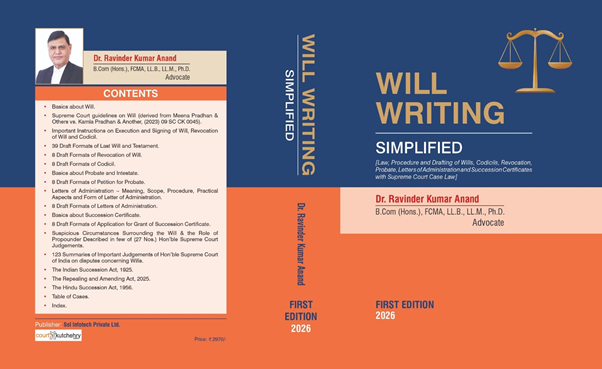
If you want practical guidance on drafting wills, codicils, and probate procedures, Will Writing Simplified is an invaluable resource. BUY HERE: Amazon 🔹 Flipkart
Background of the Case
Also Read: ITAT Rules Assessee Not Required to Prove “Source of Source” When Loan Repaid via Bank
- The case involved a Gurugram resident, Dheeraj Gupta, who responded to a woman’s photo in a WhatsApp group with the comment: “Jaane kitne dinon ke baad society me abb chand nikla” (loosely translated: “After ages, the moon has finally shown up in the society”).
- An FIR was registered against him under:
- Section 294 IPC (obscene acts and songs),
- Section 354-A IPC (sexual harassment),
- Section 509 IPC (insulting the modesty of a woman).
- Gupta sought quashing of the FIR, arguing that WhatsApp group messages are private communications.
- Justice Shalini Singh Nagpal rejected this argument, ruling that group messages are accessible to multiple members and therefore constitute public utterances.
High Court’s Observations
- Messages in a WhatsApp group are not private but public utterances, as they are visible to all members.
- The Court emphasized that obscenity laws apply to digital platforms just as they do to physical spaces.
- It clarified that the context and accessibility of the message determine its legal status.
Why Users Should Be Careful in Group Chats
- Legal Liability: Comments perceived as obscene, harassing, or insulting can lead to criminal charges.
- Digital Evidence: Courts increasingly accept WhatsApp chats as admissible evidence in criminal and family law cases.
- Public Nature of Groups: Even if a group is limited to residents or colleagues, messages are treated as public utterances.
- Permanent Record: Digital messages can be screenshotted, forwarded, and preserved, making them difficult to deny later.
Broader Legal Context
- Section 294 IPC: Punishes obscene acts or songs in public places.
- Section 354-A IPC: Covers sexual harassment, including unwelcome remarks.
- Section 509 IPC: Criminalizes words or gestures intended to insult a woman’s modesty.
- Digital Expansion: Courts are adapting these provisions to cover online platforms, including WhatsApp, Facebook, and other social media.
Expert Opinions
- Legal Scholars: Applaud the ruling for recognizing the public nature of group chats.
- Cyber Law Experts: Warn that users must treat WhatsApp groups like public forums.
- Critics: Argue that the ruling could blur the line between private and public communication, requiring careful judicial balancing.
Conclusion
The Punjab and Haryana High Court’s ruling that WhatsApp group messages amount to public utterances is a landmark in India’s digital jurisprudence. It serves as a reminder that online comments, even in seemingly private groups, can have serious legal consequences. Citizens must exercise caution, respect, and responsibility in digital communication to avoid criminal liability and protect social harmony.
Also Read: Supreme Court Rejects Plea Against Film Yadav Ji Ki Love Story, Says Title Does Not Defame Community
Keywords for Faster Searches
- Punjab Haryana High Court WhatsApp group ruling
- WhatsApp group messages public utterance India
- Obscenity case WhatsApp chat IPC
- Section 294 IPC WhatsApp group case
- Section 354-A IPC WhatsApp harassment case
- Section 509 IPC WhatsApp obscenity ruling
- Digital evidence WhatsApp group India
Also Read: Supreme Court Clarifies: High Courts Cannot Disturb Finality of Apex Court Orders