
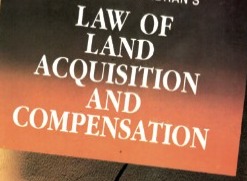
Punjab & Haryana High Court Frees Compensation from Section 26 Formula
Judicial discretion allowed in land valuation disputes
Ruling clarifies balance between statutory formula and fairness
By Our Legal Reporter
New Delhi: June 20, 2026:
The Punjab and Haryana High Court has ruled that authorities adjudicating compensation disputes under the Right to Fair Compensation and Transparency in Land Acquisition Act, 2013 are not strictly bound by Section 26’s market value formula. Instead, courts can exercise judicial discretion to ensure fair compensation, marking a significant shift in land acquisition jurisprudence.
The judgment in Moturu Nalini Kanth Appellant vs Gainedi Kaliprasad (Dead Through LRs) Respondent discusses important legal principles, judicial interpretation, and case-specific arguments considered by the court before arriving at its final decision. This case serves as a valuable reference for legal professionals, litigants, and researchers studying precedent-based judgments.
Introduction
Land acquisition in India has long been a contentious issue, balancing the state’s need for infrastructure with landowners’ rights to fair compensation. The Right to Fair Compensation and Transparency in Land Acquisition, Rehabilitation and Resettlement Act, 2013 (RFCTLARR Act) was enacted to address inequities under the colonial-era Land Acquisition Act of 1894. Section 26 of the 2013 Act prescribes a formula for determining market value, but recent rulings of the Punjab and Haryana High Court have clarified that courts are not rigidly bound by this formula when adjudicating disputes.
Background of the Case
The dispute arose from land acquired in Village Barara, District Ambala, for construction of a Mini Secretariat. The Land Acquisition Collector applied Section 26’s parameters to fix compensation. Landowners challenged this, arguing that the formula undervalued their property compared to prevailing sale exemplars. The matter reached the High Court, where Justice Harkesh Manuja delivered a landmark ruling.
Key Legal Provisions
Section 26 RFCTLARR Act, 2013: Provides a formula for determining market value based on average sale prices, stamp duty values, and other criteria.
Section 64 RFCTLARR Act, 2013: Allows landowners to seek reference to an Authority or Court if dissatisfied with the Collector’s award.
Explanation 4 to Section 26: Permits deductions in valuation only if the Collector records specific reasons.
Court’s Reasoning
The High Court distinguished between the executive role of the Collector and the judicial role of the Authority:
Collector: Bound by Section 26 formula to prevent undervaluation.
Authority/Court: Not shackled by Section 26; can adopt a realistic “guesstimate” to ensure fairness.
Deduction Theory: The court rejected arbitrary deductions (like 40%) unless specifically justified by the Collector.
Implications of the Judgment
For Landowners: Greater scope to argue for compensation based on sale exemplars and market realities.
For Authorities: Judicial discretion ensures fairness but requires careful reasoning to avoid arbitrariness.
For Policy: Reinforces the principle that statutory formulas are guides, not rigid constraints.
Comparative Perspective
Old Law (1894 Act): Allowed wide discretion, often leading to undervaluation.
2013 Act: Introduced formula-based valuation to ensure transparency.
High Court Ruling: Strikes a balance—formula for executive, discretion for judiciary.
Critical Analysis
The ruling is progressive, but challenges remain:
Risk of Inconsistency: Judicial discretion may lead to varied outcomes across cases.
Proof Burden: Landowners must provide credible sale exemplars.
Policy Gap: Need for clearer guidelines on when courts may depart from Section 26.
Conclusion
The Punjab and Haryana High Court’s ruling liberates compensation adjudication from rigid formulas, ensuring fairness while retaining transparency. It marks a significant evolution in land acquisition law, aligning statutory provisions with constitutional principles of justice.
FAQ Section (Searchable Index Format)
1. What is Section 26 of the 2013 Act?
It prescribes a formula for determining market value of acquired land based on average sale prices, stamp duty values, and other factors.
2. Are courts bound by Section 26?
No. The High Court ruled that courts are not strictly bound by Section 26 when adjudicating compensation disputes.
3. What is Section 64 of the Act?
It allows landowners dissatisfied with the Collector’s award to seek reference to an Authority or Court.
4. Can deductions be applied to sale exemplars?
Only if the Collector records specific reasons under Explanation 4 to Section 26. Courts cannot impose arbitrary deductions.
5. How does this ruling benefit landowners?
It gives them a stronger chance to argue for higher compensation based on actual market conditions.
6. What happens if the Collector undervalues land?
Landowners can challenge the award under Section 64, and courts can reassess compensation beyond Section 26’s formula.
7. How does this differ from the old 1894 Act?
The old law allowed wide discretion, often leading to undervaluation. The 2013 Act introduced transparency, but the High Court clarified that fairness must prevail over rigid formulas.