
Watch the Video
In this 14-minute video, the Hindi episode of Episode 21 of the CourtKutchehry series “AIBE Explained”, two concept-based subjects are explained in Hindi: Public International Law (लोक अंतरराष्ट्रीय विधि) and Administrative Law (प्रशासनिक विधि). This English article turns the episode’s seven questions into revision notes for Hindi-medium aspirants, with a table of the Hindi terms used and their English equivalents.
Seven Marks, Repeated Questions
As the episode explains, Public International Law carries 4 marks in the AIBE and Administrative Law 3 marks. Both are concept subjects in which the same questions keep coming back. The next episode moves to Professional Ethics and the Bar Council of India Rules.
Q1–Q2. Sources of International Law and Treaties
The sources are listed in Article 38(1) of the Statute of the International Court of Justice: treaties, international custom (State practice plus opinio juris), general principles of law, and, as subsidiary means, judicial decisions and the writings of jurists. Jus cogens is a peremptory norm from which no treaty may derogate.
On monism and dualism, India follows the dualist approach: a treaty needs legislation to become domestic law, and Parliament has power to implement treaties under Article 253. Courts may still read international conventions into domestic law where there is no conflict, as the Supreme Court did in Vishaka v. State of Rajasthan (1997).
The Vienna Convention on the Law of Treaties, 1969 gives the exam articles:
- Article 26: pacta sunt servanda, treaties must be performed in good faith;
- Article 27: internal law is no excuse for non-performance;
- Article 53: a treaty conflicting with jus cogens is void;
- Article 62: fundamental change of circumstances (rebus sic stantibus).
Q3. States and Recognition
The Montevideo Convention, 1933 lists four qualifications of a State: a permanent population, a defined territory, a government, and the capacity to enter into relations with other States. Recognition may be de facto or de jure, and two theories explain it: declaratory (recognition only acknowledges an existing State) and constitutive (recognition creates the State’s legal personality).
Q4. The United Nations, the ICJ and Other Instruments
| Point | Remember |
|---|---|
| UN Charter | Signed at San Francisco on 26 June 1945; in force 24 October 1945; six principal organs |
| Security Council | 15 members: 5 permanent with veto, 10 non-permanent for two years |
| Use of force | Article 2(4) prohibits it; Article 51 self-defence; Chapter VII enforcement |
| ICJ | The Hague; 15 judges for 9 years; only States may be parties (Statute, Article 34); optional clause Article 36(2) |
| ICC | Rome Statute, 1998; India is not a party |
| Human rights | UDHR 1948; two Covenants of 1966; Geneva Conventions 1949 |
| UNCLOS 1982 | Territorial sea 12, contiguous zone 24, EEZ 200 nautical miles |
| Diplomats and extradition | Vienna Convention on Diplomatic Relations, 1961; Extradition Act, 1962 (no extradition for political offences) |
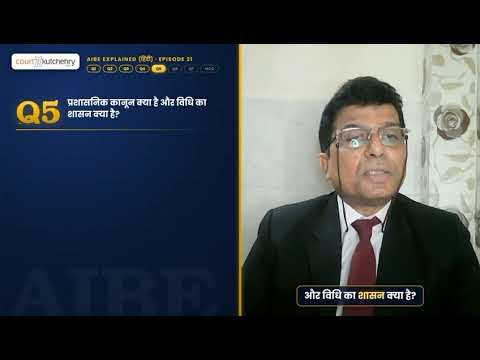
Q5. Administrative Law, Rule of Law and Delegated Legislation
Dicey’s rule of law is the starting point. India has no rigid separation of powers, but the Supreme Court has treated separation of powers and the rule of law as part of the basic structure, in Kesavananda Bharati and in Indira Nehru Gandhi v. Raj Narain, (1975) 11 SC CK 0007.
On delegated legislation, In re Delhi Laws Act, 1912 (1951) held that the legislature cannot delegate its essential legislative function. Delegated legislation is controlled by laying before the legislature, by the courts through the doctrine of ultra vires, and by procedural requirements such as publication and consultation.
Q6. Natural Justice
- Nemo judex in causa sua, the rule against bias. In A.K. Kraipak v. Union of India, (1969) 04 SC CK 0045, a selection was set aside because a candidate sat on the selection board.
- Audi alteram partem, hear the other side: notice, hearing, disclosure of evidence and, where needed, cross-examination. Maneka Gandhi v. Union of India, (1978) 01 SC CK 0026, accepted a post-decisional hearing in urgent cases.
- Reasoned decisions, often called the third principle: S.N. Mukherjee v. Union of India (1990).
Remember this line: no one judges his own cause, no one is condemned unheard, and every decision gives reasons.
Q7. How Courts Control Administrative Action
The three classic grounds of judicial review are illegality, irrationality and procedural impropriety (the GCHQ case, 1985). Irrationality draws on Wednesbury unreasonableness (1948). Indian courts also apply proportionality, as in Modern Dental College (2016), and the doctrine of legitimate expectation.
The Government can be held to its promise through promissory estoppel: Motilal Padampat Sugar Mills Co. Ltd. v. State of Uttar Pradesh, (1978) 12 SC CK 0016.
Remedies include writs under Articles 32 and 226. Tribunals under Articles 323A and 323B remain subject to High Court review: in L. Chandra Kumar v. Union of India, (1997) 03 SC CK 0098, a seven-judge Bench held that the power of judicial review under Articles 226 and 32 is part of the basic structure. The episode also covers the Lokpal and Lokayuktas Act, 2013 and the Right to Information Act, 2005 (exemptions in Section 8, and a second appeal to the Information Commission).
Key Legal Terms: Hindi ↔ English
| Hindi | English |
|---|---|
| लोक अंतरराष्ट्रीय विधि | Public international law |
| संधि | Treaty |
| अंतरराष्ट्रीय रूढ़ि | International custom |
| आरक्षण | Reservation (to a treaty) |
| मान्यता | Recognition |
| प्रादेशिक समुद्र | Territorial sea |
| अनन्य आर्थिक क्षेत्र | Exclusive economic zone |
| प्रत्यर्पण | Extradition |
| प्रत्यायोजित विधान | Delegated legislation |
| नैसर्गिक न्याय | Natural justice |
| न्यायिक पुनर्विलोकन | Judicial review |
| वचन-विबंध | Promissory estoppel |
Key Takeaways
- Sources of international law: Article 38(1), ICJ Statute; India is dualist and implements treaties under Article 253.
- Vienna Convention, 1969: Articles 26, 27, 53 and 62.
- Security Council: 15 members; ICJ: 15 judges for 9 years, States only; UNCLOS: 12, 24, 200 nautical miles.
- Natural justice: rule against bias (Kraipak), hearing (Maneka Gandhi), reasoned decisions (S.N. Mukherjee).
- Judicial review: illegality, irrationality, procedural impropriety, plus proportionality and legitimate expectation; promissory estoppel binds the Government (Motilal Padampat).
Frequently Asked Questions
Is this episode in Hindi?
Yes. The video is in Hindi and this article is in English. The English version of Episode 21 is linked above.
Can an individual bring a case before the ICJ?
No. Under Article 34 of the ICJ Statute, only States may be parties in contentious cases.
What is वचन-विबंध?
Promissory estoppel. Where the Government makes a promise on which a person acts to his detriment, the Government can be held to it, as in Motilal Padampat Sugar Mills.
Which case held that essential legislative functions cannot be delegated?
In re Delhi Laws Act, 1912, decided by the Supreme Court in 1951.
Where can I watch the video?
Watch the 14-minute Hindi episode here: https://youtu.be/-TVJFFYHtsc.
Conclusion
International law in the AIBE is a matter of articles and numbers: Article 38(1), Articles 26, 27, 53 and 62 of the Vienna Convention, the Security Council’s 15 members, the ICJ’s 15 judges and the UNCLOS zones. Administrative law turns on three principles of natural justice and three grounds of review.
Revise from the notes above and keep the term table handy.
▶ Watch the video: लोक अंतरराष्ट्रीय विधि और प्रशासनिक विधि: संधियाँ, ICJ, नैसर्गिक न्याय और न्यायिक पुनर्विलोकन Ep 21
▶ Watch in English: Public International Law & Administrative Law for AIBE: ICJ, Treaties, UNCLOS, Natural Justice Ep 21
📖 Read the full article: AIBE Public International Law and Administrative Law: ICJ, Treaties, UNCLOS, Natural Justice and Judicial Review
Research Judgments Like These on CourtKutchehry
Every judgment cited in this article, and lakhs more, can be searched and read on CourtKutchehry. Searching and reading judgments is free. A membership adds unlimited summaries, all related judgments, original court PDF downloads, bookmarks, notes and the CourtKutchehry AI assistant.
| Membership | Price | Works out to | AI credits |
|---|---|---|---|
| Monthly (1 month) | ₹599 | ₹599 / month | 1,000 / month |
| Quarterly (3 months) · Save 16% | ₹1,499 | ₹499.67 / month | 1,100 / month |
| Six-monthly (6 months) · Save 33% | ₹2,399 | ₹399.83 / month | 1,200 / month |
| Yearly (12 months) · Save 44% · Best value | ₹3,999 | ₹333.25 / month | 1,300 / month |
Every plan is a one-off purchase for a fixed period: nothing auto-renews and no card is kept on file. Prices are exclusive of applicable tax, which is added at checkout. Extra AI chat credits can be topped up from ₹99. A free verified account gets 5 summaries and 50 AI trial credits.
Prices are as displayed on courtkutchehry.com on 20 November 2026 and are subject to change without notice. Please check the pricing page for the current plans and offers.
For more judgments, legal opinions and case analysis, visit courtkutchehry.com
Visit CourtKutchehry →