
Watch the Video
In this 12-minute video, Episode 21 of the “AIBE Explained” series, the episode covers two concept-based subjects in seven questions: Public International Law (sources, treaties, statehood and recognition, the United Nations and the ICJ) and Administrative Law (the rule of law, delegated legislation, natural justice and judicial control of administrative action). He then solves five practice questions in the style of past AIBE papers. This article sets out the same points in writing, with the leading cases.
Two Subjects, Seven Marks
Public International Law carries 4 marks in the AIBE and Administrative Law carries 3. Both are concept-based, and the same questions keep coming back: the sources of international law, the key articles of the Vienna Convention, the composition of the Security Council and the ICJ, the maritime zones, and the principles of natural justice and judicial review.
Q1. Sources of International Law
Article 38(1) of the Statute of the International Court of Justice lists the sources the Court applies:
- international conventions (treaties);
- international custom, as evidence of a general practice accepted as law;
- the general principles of law recognised by civilised nations;
- judicial decisions and the teachings of the most highly qualified publicists, as subsidiary means.
Custom has two elements: consistent State practice and opinio juris, the belief that the practice is legally required. Jus cogens norms (for example, the prohibition of genocide, slavery and torture) are peremptory and cannot be set aside by treaty.
India follows the dualist approach: a treaty does not by itself become part of domestic law, and Parliament may legislate to implement it under Article 253 of the Constitution. But where there is no domestic law, the courts may read international conventions consistent with fundamental rights into domestic law, as the Supreme Court did in Vishaka v. State of Rajasthan (1997) when it framed guidelines against sexual harassment at the workplace, later replaced by the 2013 Act.
Q2. The Law of Treaties (Vienna Convention, 1969)
- Pacta sunt servanda (Article 26): every treaty in force binds the parties and must be performed in good faith.
- Jus cogens (Article 53): a treaty that conflicts with a peremptory norm of general international law is void.
- Rebus sic stantibus (Article 62): a fundamental change of circumstances may, in narrow conditions, be invoked to terminate or withdraw from a treaty.
Q3. Statehood and Recognition
The Montevideo Convention, 1933 lists the criteria of statehood: a permanent population, a defined territory, a government, and the capacity to enter into relations with other States.
On recognition, the constitutive theory says a State exists only when recognised by others; the declaratory theory says recognition merely acknowledges a State that already exists. Recognition may be de jure (full and permanent) or de facto (provisional).
Q4. The United Nations, the ICJ and Other Instruments
- The UN Charter was signed on 26 June 1945 and came into force on 24 October 1945.
- The UN has six principal organs: the General Assembly, the Security Council, the Economic and Social Council, the Trusteeship Council, the International Court of Justice and the Secretariat.
- The Security Council has 15 members, of which 5 are permanent (China, France, Russia, the United Kingdom and the United States).
- The ICJ sits at The Hague. It has 15 judges elected for 9 years, and only States may be parties in contentious cases.
- The International Criminal Court was set up under the Rome Statute, 1998. India is not a party.
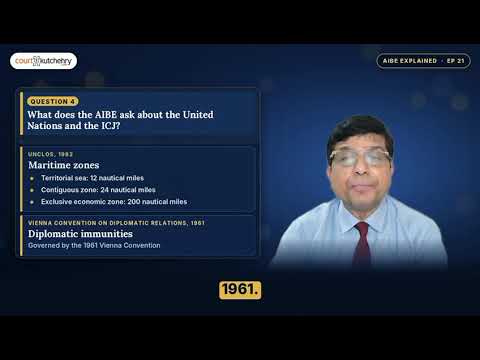
- UNCLOS, 1982 fixes the maritime zones from the baseline: territorial sea 12 nautical miles, contiguous zone 24 nautical miles, and exclusive economic zone 200 nautical miles.
Remember this line: 12, 24, 200 at sea; 15 judges for 9 years at The Hague.
Q5. Administrative Law, the Rule of Law and Delegated Legislation
A.V. Dicey’s rule of law has three meanings: the supremacy of regular law over arbitrary power, equality before the law, and the constitution as the result of the ordinary law of the land. In India, the rule of law is part of the basic structure; in Indira Nehru Gandhi v. Raj Narain, (1975) 11 SC CK 0007, the Supreme Court struck down a constitutional amendment that sought to put an election dispute beyond judicial scrutiny.
Delegated legislation is law made by the executive under power conferred by a statute. Parliament may delegate, but it cannot delegate its essential legislative functions: it must lay down the policy and the guidelines. That was settled in In re Delhi Laws Act, 1912.
Q6. The Principles of Natural Justice
- Nemo judex in causa sua: no one should be a judge in his own cause (the rule against bias). In A.K. Kraipak v. Union of India, (1969) 04 SC CK 0045, the selection was set aside because a candidate sat on the selection board; the Court also held that the line between administrative and quasi-judicial powers is thin, and natural justice applies to administrative action too.
- Audi alteram partem: hear the other side. In Maneka Gandhi v. Union of India, (1978) 01 SC CK 0026, the Court held that the procedure under Article 21 must be fair, just and reasonable, and that a person whose passport is impounded must be given a hearing.
- The duty to give reasons: in S.N. Mukherjee v. Union of India (1990), a Constitution Bench held that administrative authorities exercising quasi-judicial functions must record reasons, unless the requirement is expressly or impliedly excluded.
Q7. How Courts Control Administrative Action
In the GCHQ case (Council of Civil Service Unions v. Minister for the Civil Service, 1985), Lord Diplock classified the grounds of judicial review as illegality, irrationality and procedural impropriety.
- Wednesbury unreasonableness: from Associated Provincial Picture Houses v. Wednesbury Corporation (1948), a decision so unreasonable that no reasonable authority could have taken it.
- Proportionality: the measure must pursue a legitimate aim, be suitable and necessary, and strike a proper balance. Indian courts apply it particularly where fundamental rights are restricted, as a Constitution Bench explained in Modern Dental College v. State of Madhya Pradesh (2016).
- Legitimate expectation and promissory estoppel: in Motilal Padampat Sugar Mills Co. Ltd. v. State of Uttar Pradesh, (1978) 12 SC CK 0016, the Supreme Court held that the Government can be bound by a promise on which a party has acted to its detriment, and cannot plead executive necessity to escape it.
- Tribunals: in L. Chandra Kumar v. Union of India, (1997) 03 SC CK 0098, a seven-judge bench held that the power of judicial review of the High Courts and the Supreme Court is part of the basic structure, so tribunal decisions remain subject to the High Court’s writ jurisdiction.
The Right to Information Act, 2005 is a common question here: information must be supplied within 30 days of the request, and the exemptions are listed in Section 8.
Key Takeaways
- Article 38(1) of the ICJ Statute lists the sources; custom needs State practice and opinio juris; India is dualist (Article 253).
- Vienna Convention: Article 26 pacta sunt servanda, Article 53 jus cogens, Article 62 rebus sic stantibus.
- Security Council 15 members (5 permanent); ICJ 15 judges for 9 years; India is not a party to the Rome Statute; UNCLOS 12/24/200.
- Essential legislative functions cannot be delegated (In re Delhi Laws Act, 1951).
- Natural justice: no bias (Kraipak), fair hearing (Maneka Gandhi), reasons (S.N. Mukherjee).
- Judicial review: illegality, irrationality, procedural impropriety; Wednesbury; proportionality; promissory estoppel (Motilal Padampat); judicial review is basic structure (L. Chandra Kumar).
Frequently Asked Questions
Does a treaty signed by India automatically become domestic law?
No. India follows dualism, and Parliament implements treaties by legislation under Article 253, though courts may read conventions into domestic law where there is a gap.
How many judges does the ICJ have, and for how long?
Fifteen judges, each elected for nine years.
What is the width of the territorial sea under UNCLOS?
Twelve nautical miles from the baseline; the contiguous zone extends to 24 and the exclusive economic zone to 200 nautical miles.
Can Parliament delegate all its law-making power to the executive?
No. It cannot delegate essential legislative functions, as held in In re Delhi Laws Act (1951).
Can promissory estoppel be pleaded against the Government?
Yes. Motilal Padampat Sugar Mills held that the Government may be bound by its promise, subject to overriding public interest.
Where can I watch the full explanation?
Watch the full explanation in 12 minutes: https://youtu.be/W17O9vpT9H8.
Conclusion
Public International Law and Administrative Law are seven marks that reward a clear list of facts and principles: the sources and treaty rules, the numbers for the UN and the sea, and the principles of natural justice and judicial review with their leading cases.
Revise the numbers and the case names together, and these two subjects become dependable. The next episode covers Professional Ethics and the Bar Council of India Rules.
▶ Watch the video: Public International Law & Administrative Law for AIBE: ICJ, Treaties, UNCLOS, Natural Justice Ep 21
📖 Read more: Supreme Court Upholds Natural Justice in Criminal Proceedings
Research Judgments Like These on CourtKutchehry
Every judgment cited in this article, and lakhs more, can be searched and read on CourtKutchehry. Searching and reading judgments is free. A membership adds unlimited summaries, all related judgments, original court PDF downloads, bookmarks, notes and the CourtKutchehry AI assistant.
| Membership | Price | Works out to | AI credits |
|---|---|---|---|
| Monthly (1 month) | ₹599 | ₹599 / month | 1,000 / month |
| Quarterly (3 months) · Save 16% | ₹1,499 | ₹499.67 / month | 1,100 / month |
| Six-monthly (6 months) · Save 33% | ₹2,399 | ₹399.83 / month | 1,200 / month |
| Yearly (12 months) · Save 44% · Best value | ₹3,999 | ₹333.25 / month | 1,300 / month |
Every plan is a one-off purchase for a fixed period: nothing auto-renews and no card is kept on file. Prices are exclusive of applicable tax, which is added at checkout. Extra AI chat credits can be topped up from ₹99. A free verified account gets 5 summaries and 50 AI trial credits.
Prices are as displayed on courtkutchehry.com on 20 November 2026 and are subject to change without notice. Please check the pricing page for the current plans and offers.
For more judgments, legal opinions and case analysis, visit courtkutchehry.com
Visit CourtKutchehry →