
Watch the Video
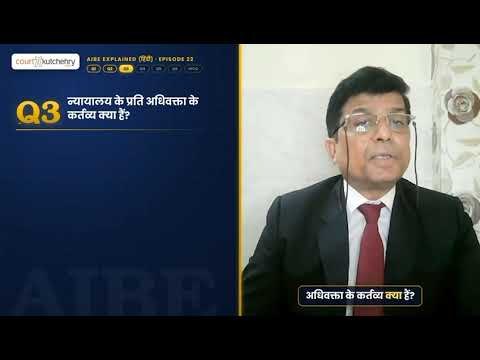
In this 14-minute video in Hindi, Episode 22 of “AIBE Explained” (Hindi) covers Professional Ethics, the most dependable 4-mark subject in the AIBE. The episode takes up the key sections of the Advocates Act, 1961, the advocate’s duties towards the court, the client and the opposite party under the Bar Council of India Rules (Part VI, Chapter II), professional misconduct, Rule 36 on advertising, important judgments such as Harish Uppal, and practice questions on the AIBE pattern. This English article, for Hindi-medium aspirants, is a quick-recall sheet: the numbers, the duties grouped by person, and a Hindi–English glossary.
▶ Watch on YouTube: व्यावसायिक आचार और BCI नियम | AIBE Explained (हिंदी) Episode 22
▶ Watch in English: Professional Ethics for AIBE: Advocates Act 1961, Misconduct & BCI Rules Ep 22
Why Ethics Is the Easiest Four Marks
Professional Ethics (व्यावसायिक आचार) is a small, closed syllabus: one Act and one chapter of rules. Unlike criminal or civil law, there are few conflicting judgments and only a handful of amendments to track (the most recent, the Advocates (Amendment) Act, 2023, added Section 45A on lists of touts). Questions are mostly direct: a section number, a time limit, or whether a given act is permitted. That makes it ideal for last-week revision, and the Hindi episode treats it that way.
The Advocates Act, 1961: Sections in One Table
| Section | What it provides |
|---|---|
| 3 and 4 | State Bar Councils and the Bar Council of India |
| 6 and 7 | Functions of State Bar Councils and of the BCI |
| 16 | Two classes: senior advocates and other advocates |
| 24 | Qualifications for enrolment: citizen of India, at least 21 years, recognised law degree |
| 29 | Only advocates are entitled to practise law |
| 30 | Right of an enrolled advocate to practise throughout India, in all courts and tribunals |
| 35 | Punishment of advocates for misconduct |
| 36B | State Bar Council’s committee to decide within one year, failing which the case goes to the BCI |
| 37 and 38 | Appeals: to the BCI, and then to the Supreme Court, each within 60 days |
| 45 | Penalty for practising in courts without being entitled to |
Professional Misconduct (व्यावसायिक कदाचार)
The Act does not define “misconduct”; it covers conduct, in or out of court, that makes an advocate unfit to practise. The AIBE asks about the process:
- A complaint reaches the State Bar Council, which refers it to its disciplinary committee (अनुशासन समिति) if it has reason to believe there is misconduct.
- After hearing the advocate, the committee may dismiss the complaint, reprimand the advocate, suspend him for a period, or remove his name from the roll (Section 35(3)).
- If the State committee does not decide within one year, the proceedings are transferred to the BCI (Section 36B).
- Appeal lies to the BCI within 60 days (Section 37), and from the BCI to the Supreme Court within 60 days (Section 38).
Remember this line: four punishments, one year to decide, sixty days for each appeal.
Duties Towards the Court (न्यायालय के प्रति कर्तव्य)
- Conduct yourself with dignity and self-respect, while remaining free to complain about a judicial officer to the proper authority.
- Do not try to influence a decision by illegal or improper means.
- Appear only in the prescribed dress, and do not wear bands or gowns in public places other than courts.
- Do not appear before a court where a close relative is the judge or a member of the bench.
- Do not stand as surety for a client.
Duties Towards the Client (मुवक्किल के प्रति कर्तव्य)
- Accept briefs: an advocate is ordinarily bound to accept a brief in the courts where he practises, at a fee consistent with his standing (Rule 11), subject to special circumstances.
- Do not abandon the client: withdraw only for sufficient cause and with reasonable notice.
- Defend regardless of personal opinion: an advocate for an accused must present every defence the law allows, whatever his personal view of guilt.
- No contingency fee: an advocate shall not stipulate for a fee contingent on the result, or agree to share the proceeds of litigation (Rule 20).
- Confidence and accounts: keep the client’s confidences and account properly for the client’s money.
On fees, in B. Sunitha v. State of Telangana, (2017) 12 SC CK 0065, the Supreme Court held that an advocate’s claim to a percentage of the amount decreed is against public policy and amounts to professional misconduct.
Duties Towards the Opposite Party (विरोधी पक्ष) and Colleagues
- Do not negotiate directly with an opposite party who is represented by an advocate; deal through that advocate.
- Carry out legitimate promises made to the opposite side.
- Do not appear in a case where another advocate has filed a vakalatnama (वकालतनामा) without that advocate’s consent or the court’s leave.
Rule 36: no soliciting, no advertising
An advocate shall not solicit work or advertise (विज्ञापन), directly or indirectly, whether by circulars, personal communication, interviews or press reports. Since the 2008 amendment, an advocate may have a website giving basic information such as name, address, contact details, enrolment number, qualifications and areas of practice. Anything beyond that, such as claims of success or comparisons, is still prohibited.
The Judgments to Know
- Ex-Captain Harish Uppal v. Union of India, (2002) 12 SC CK 0112: a Constitution Bench held that advocates have no right to go on strike or call for a boycott of courts; at most they may register protest in ways that do not stop court work.
- B. Sunitha (above): a fee calculated as a share of the decretal amount is misconduct.
- Indira Jaising v. Supreme Court of India, (2017) 10 SC CK 0018: the leading case on the process for designating senior advocates under Section 16.
Practice Questions on the AIBE Pattern
- Within how many days can a BCI order be appealed to the Supreme Court? (60 days, Section 38)
- Which Rule prohibits advertising? (Rule 36)
- Can an advocate charge 20% of the amount recovered as fee? (No; contingency fees are prohibited)
- Minimum age for enrolment as an advocate? (21 years, Section 24)
- Do advocates have a right to strike? (No, Harish Uppal)
Key Legal Terms: Hindi ↔ English
| Hindi | English |
|---|---|
| व्यावसायिक आचार | Professional ethics |
| अधिवक्ता | Advocate |
| वरिष्ठ अधिवक्ता | Senior advocate |
| नामांकन | Enrolment |
| व्यावसायिक कदाचार | Professional misconduct |
| अनुशासन समिति | Disciplinary committee |
| मुवक्किल | Client |
| विरोधी पक्ष | Opposite party |
| न्यायालय | Court |
| विज्ञापन | Advertisement |
| वकालतनामा | Vakalatnama |
Key Takeaways
- Professional Ethics is a 4-mark subject drawn from the Advocates Act, 1961 and Part VI, Chapter II of the BCI Rules.
- Section 35 gives four outcomes: dismissal, reprimand, suspension, removal from the roll.
- One year for the State committee (Section 36B); 60 days for each appeal (Sections 37 and 38).
- Contingency fees and advertising are prohibited (Rules 20 and 36); a basic website is allowed.
- Advocates have no right to strike (Harish Uppal).
Frequently Asked Questions
Is this episode in Hindi?
Yes. The episode is in Hindi; the English version of Episode 22 is linked above.
Where are an advocate’s duties set out?
In Part VI, Chapter II of the Bar Council of India Rules, made under the Advocates Act, 1961. It is arranged by the person to whom the duty is owed: the court, the client, the opponent and colleagues.
Can an advocate have a website?
Yes, with basic information only, as permitted since the 2008 amendment to Rule 36. Soliciting work or advertising is otherwise prohibited.
What happens if the State Bar Council does not decide a misconduct complaint in time?
Under Section 36B, if it is not decided within one year, the proceedings are transferred to the Bar Council of India.
Is a fee as a percentage of the decree allowed?
No. It is a contingency fee, prohibited by Rule 20, and the Supreme Court in B. Sunitha held it to be misconduct.
Where can I watch the Hindi episode?
Watch it here: https://youtu.be/D5q0Be-zz_k.
Conclusion
Ethics rewards precise memory more than argument. Learn the ten sections in the table, the four punishments, the one-year and sixty-day limits, and the two prohibited practices, and the four marks are almost certain.
These are also the rules every new advocate practises under from day one.
▶ Watch in English: Professional Ethics for AIBE: Advocates Act 1961, Misconduct & BCI Rules Ep 22
📖 Read the full article: AIBE Professional Ethics: Advocates Act, 1961, Professional Misconduct and the Bar Council of India Rules
Research Judgments Like These on CourtKutchehry
Every judgment cited in this article, and lakhs more, can be searched and read on CourtKutchehry. Searching and reading judgments is free. A membership adds unlimited summaries, all related judgments, original court PDF downloads, bookmarks, notes and the CourtKutchehry AI assistant.
| Membership | Price | Works out to | AI credits |
|---|---|---|---|
| Monthly (1 month) | ₹599 | ₹599 / month | 1,000 / month |
| Quarterly (3 months) · Save 16% | ₹1,499 | ₹499.67 / month | 1,100 / month |
| Six-monthly (6 months) · Save 33% | ₹2,399 | ₹399.83 / month | 1,200 / month |
| Yearly (12 months) · Save 44% · Best value | ₹3,999 | ₹333.25 / month | 1,300 / month |
Every plan is a one-off purchase for a fixed period: nothing auto-renews and no card is kept on file. Prices are exclusive of applicable tax, which is added at checkout. Extra AI chat credits can be topped up from ₹99. A free verified account gets 5 summaries and 50 AI trial credits.
Prices are as displayed on courtkutchehry.com on 20 November 2026 and are subject to change without notice. Please check the pricing page for the current plans and offers.
For more judgments, legal opinions and case analysis, visit courtkutchehry.com
Visit CourtKutchehry →