
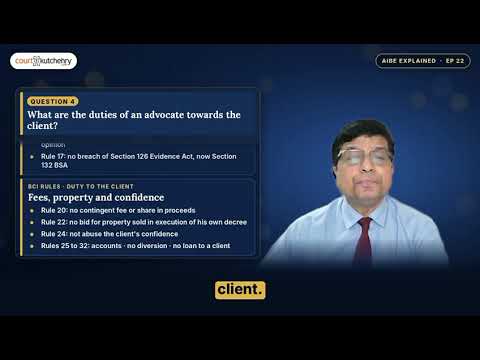
Watch the Video
In this 12-minute video, Episode 22 of the “AIBE Explained” series, the episode covers Professional Ethics in six questions: the structure of the Advocates Act, 1961; professional misconduct and its punishment; and the advocate’s duties towards the court, the client, the opponent and colleagues under the Bar Council of India Rules. He then solves five practice questions in the style of past AIBE papers. This article sets out the same provisions in writing.
▶ Watch on YouTube: Professional Ethics for AIBE: Advocates Act 1961, Misconduct & BCI Rules Ep 22
▶ हिंदी में देखें (Watch in Hindi): व्यावसायिक आचार और BCI नियम | AIBE Explained (हिंदी) Episode 22
The Most Predictable Four Marks
Professional Ethics carries 4 marks in the AIBE, and it is the most predictable subject in the paper. The questions come from the Advocates Act, 1961 and Chapter II of Part VI of the Bar Council of India Rules, on standards of professional conduct and etiquette. A few hours with these provisions can fetch all four marks.
Q1. Structure of the Advocates Act, 1961
- State Bar Councils are constituted under Section 3, and the Bar Council of India under Section 4.
- Their functions are in Section 6 (State Bar Councils: admission, the roll, misconduct cases, welfare) and Section 7 (BCI: standards of conduct, legal education, supervision of State Bar Councils).
- Section 16: there are two classes of advocates, senior advocates and other advocates. A senior advocate is designated by the Supreme Court or a High Court on the basis of ability, standing at the Bar or special knowledge or experience in law.
- Section 24: to be enrolled, a person must be an Indian citizen, at least 21 years old, and hold a law degree recognised by the BCI, besides the other conditions in the Act and the rules.
- Section 29: only advocates are entitled to practise the profession of law.
- Section 30: every advocate on the State roll has the right to practise in all courts, before any tribunal and before any person authorised to take evidence, throughout India.
On senior designation, Indira Jaising v. Supreme Court of India, (2017) 10 SC CK 0018 laid down guidelines, including a Permanent Committee and a points-based assessment. That system was later revisited: in 2025, in Jitender @ Kalla v. State (Govt. of NCT of Delhi), the Supreme Court disapproved of the points system, and fresh guidelines without points or interviews have since been notified.
Q2. Professional Misconduct and Its Punishment (Sections 35 to 38)
- Complaint: if the State Bar Council has reason to believe that an advocate is guilty of professional or other misconduct, it refers the case to its disciplinary committee (Section 35).
- Punishment: after hearing the advocate, the committee may dismiss the complaint, reprimand the advocate, suspend him for a period, or remove his name from the roll (Section 35(3)).
- Time limit: the State Bar Council’s committee must dispose of the complaint within one year, failing which it stands transferred to the Bar Council of India (Section 36B).
- Appeal to the BCI: within 60 days of the order (Section 37).
- Appeal to the Supreme Court: from the BCI’s order, within 60 days (Section 38).
Remember this line: State Bar Council, one year; BCI appeal, 60 days; Supreme Court appeal, 60 days.
In Ex-Captain Harish Uppal v. Union of India, (2002) 12 SC CK 0112, a Constitution Bench held that advocates have no right to go on strike or to call for a boycott of courts.
Q3. Duties Towards the Court (Rules 1 to 10)
- Act in a dignified manner and maintain respect towards the court, while remaining free to make complaints against judicial officers to the proper authority.
- Do not influence the decision of a court by any illegal or improper means.
- Appear in court only in the prescribed dress.
- Rule 6: do not appear before a court, tribunal or authority where a close relative is a member of the bench.
- Rule 10: do not stand as surety, or certify the soundness of a surety, for a client in any legal proceeding.
Q4. Duties Towards the Client (Rules 11 to 32)
- Rule 11: an advocate is bound to accept any brief in the courts or tribunals in which he practises, at a fee consistent with his standing and the nature of the case, subject to special circumstances.
- Do not withdraw from a case without sufficient cause and reasonable notice to the client.
- Rule 15: fearlessly uphold the client’s interests by all fair and honourable means.
- Rule 16: an advocate appearing for the accused must defend him regardless of personal opinion about the accused’s guilt.
- Rule 20: do not stipulate for a fee contingent on the result, or agree to share the proceeds of litigation. Contingency fees are prohibited.
- Keep the client’s confidences and account for the client’s money.
In B. Sunitha v. State of Telangana, (2017) 12 SC CK 0065, the Supreme Court held that an advocate’s claim to a fee calculated as a percentage of the decretal amount is against public policy and amounts to professional misconduct, and quashed the cheque-bounce proceedings founded on such a claim.
Q5. Duties Towards the Opponent and Colleagues (Rules 34 onwards)
- Do not negotiate or communicate on the subject of the case directly with the opposing party who is represented by an advocate; deal only through that advocate.
- Carry out all legitimate promises made to the opposite party.
- Rule 36: do not solicit work or advertise, directly or indirectly. Since the 2008 amendment, an advocate may have a website giving basic details such as name, address, contact information, enrolment, qualifications and areas of practice.
- Do not appear in a case where another advocate has filed a vakalatnama, except with that advocate’s consent or the court’s leave.
- Rules 47 to 52: an advocate shall not personally engage in any business or be a full-time salaried employee while practising.
Q6. Other Frequently Tested Provisions
- Certificate of practice: under the BCI Certificate and Place of Practice (Verification) Rules, 2015, the certificate is to be verified and renewed every five years.
- Touts: the Advocates (Amendment) Act, 2023 inserted Section 45A, empowering High Courts and judges to frame and publish lists of touts, and repealed the Legal Practitioners Act, 1879.
- Practising without enrolment: a person who practises in a court without being entitled to under the Act is punishable under Section 45.
Key Takeaways
- Sections 3, 4, 6, 7 set up the Bar Councils; Section 16 creates senior and other advocates; Section 24 lays down citizenship, 21 years and a law degree for enrolment.
- Misconduct goes to the State Bar Council’s disciplinary committee (Section 35), to be decided within one year (Section 36B); appeals lie to the BCI and then the Supreme Court, each within 60 days.
- Advocates have no right to strike or boycott courts (Harish Uppal).
- Rule 6 (relative on the bench), Rule 10 (no surety), Rule 11 (bound to accept a brief), Rule 16 (defend the accused), Rule 20 (no contingency fees), Rule 36 (no advertising).
- A fee as a share of the decree is misconduct (B. Sunitha); touts are now dealt with under Section 45A.
Frequently Asked Questions
What is the minimum age for enrolment as an advocate?
Twenty-one years, under Section 24 of the Advocates Act, along with Indian citizenship and a recognised law degree.
Within how many days can an advocate appeal against a State Bar Council order?
Within 60 days to the Bar Council of India under Section 37, and then within 60 days to the Supreme Court under Section 38.
Can an advocate refuse a brief?
Ordinarily no. Rule 11 binds an advocate to accept a brief at a proper fee, subject to special circumstances.
Can an advocate charge a percentage of what the client recovers?
No. Rule 20 prohibits contingency fees, and B. Sunitha held such a claim to be professional misconduct.
Can an advocate have a website?
Yes, since 2008, limited to basic information such as name, contact details, enrolment, qualifications and areas of practice.
Where can I watch the full explanation?
Watch the full explanation in 12 minutes: https://youtu.be/Y5zzIoUyRwQ.
Conclusion
Professional Ethics is the one AIBE subject where the questions come from a closed set of provisions: the Advocates Act and the BCI Rules on conduct and etiquette. Learn the section numbers for the Bar Councils, enrolment, misconduct and appeals, and the rule numbers for the main duties.
These rules are also the rules every advocate practises by, so the time spent here pays off beyond the exam. The next episode covers Tax Laws and Company Law.
▶ Watch the video: Professional Ethics for AIBE: Advocates Act 1961, Misconduct & BCI Rules Ep 22
📖 Read more: Supreme Court Overhauls Senior Advocate Designation: Points System and Interviews Scrapped
Research Judgments Like These on CourtKutchehry
Every judgment cited in this article, and lakhs more, can be searched and read on CourtKutchehry. Searching and reading judgments is free. A membership adds unlimited summaries, all related judgments, original court PDF downloads, bookmarks, notes and the CourtKutchehry AI assistant.
| Membership | Price | Works out to | AI credits |
|---|---|---|---|
| Monthly (1 month) | ₹599 | ₹599 / month | 1,000 / month |
| Quarterly (3 months) · Save 16% | ₹1,499 | ₹499.67 / month | 1,100 / month |
| Six-monthly (6 months) · Save 33% | ₹2,399 | ₹399.83 / month | 1,200 / month |
| Yearly (12 months) · Save 44% · Best value | ₹3,999 | ₹333.25 / month | 1,300 / month |
Every plan is a one-off purchase for a fixed period: nothing auto-renews and no card is kept on file. Prices are exclusive of applicable tax, which is added at checkout. Extra AI chat credits can be topped up from ₹99. A free verified account gets 5 summaries and 50 AI trial credits.
Prices are as displayed on courtkutchehry.com on 20 November 2026 and are subject to change without notice. Please check the pricing page for the current plans and offers.
For more judgments, legal opinions and case analysis, visit courtkutchehry.com
Visit CourtKutchehry →