COURTKUTCHEHRY EXCLUSIVE: EXTRACTS FROM BEST SELLING BOOK: WILL WRITING SIMPLIFIED
V. Prabhakara v. Basavaraj K. (Dead) by LRs & Another (2021): Supreme Court on Suspicion, Proof of Wills, and Appellate Limits
Suspicion Must Rest on Pleadings, Not Conjecture
Testamentary Courts Are Courts of Conscience
By Vishwas Kumar
New Delhi: April 07, 2026:
The Supreme Court’s ruling in V. Prabhakara v. Basavaraj K. (Dead) by Legal Representatives & Another, (2021) 10 SC CK 0031: Civil Appeals Nos. 1376–77 of 2010 is a landmark in Indian succession law. It clarified the boundaries of appellate review in testamentary matters, the role of suspicion in evaluating wills, and the evidentiary requirements under the Succession Act and Evidence Act. Lawyers continue to cite this case because it firmly establishes that courts must rely on legal proof and pleadings, not moral conjecture, when assessing the validity of wills.
For case law references, explore this collection of probate and will law rulings in India. Supreme Court probate and will judgments in India , including the important case of Smt. Sushila Devi vs Pandit Krishna Kumar Missir and Others, which discusses key principles of probate, will validity, and succession law.
Exclusion of Heirs Not Suspicious Per Se
The High Court had doubted the exclusion of the sister and brother of the propounder. The Supreme Court rejected this reasoning, holding that mere exclusion of heirs does not by itself create suspicion. The testatrix was accompanied by her sister during registration, and the will was attested by her brother, neither of whom raised objections. Their presence and silence confirmed genuineness rather than suspicion (Paras 24–26). This principle is vital: unequal distribution or exclusion of heirs is not inherently suspicious unless supported by tangible evidence of improbability or undue influence.
Suspicion Must Be Pleaded and Proved
The Court emphasized that suspicion must arise from pleadings and evidence. The High Court had “virtually reached a conclusion without recording reasons,” relying on moral notions rather than legal proof. A testamentary court is a court of conscience, not suspicion. Once statutory requirements under Section 63 of the Succession Act and Section 68 of the Evidence Act are satisfied, the burden shifts to challengers to prove suspicious circumstances. Without pleadings or evidence, appellate courts cannot invent suspicion (Paras 21, 23, 24, 27, 37).
Forged Alternate Will Strengthens Genuine Will
The case involved two wills: Ex.P-4 (propounded) and Ex.D-1 (challenged). Both lower courts found Ex.D-1 to be forged and fabricated. The thumb impression was smudged, the scribe was not examined, and the stamp bore the date of Independence Day (15 August 1986) while the will was dated 16 August 1986. The testatrix died just days later, on 22 August 1986. These anomalies proved fabrication. The Supreme Court held that the existence of a forged alternate will does not weaken a genuine, duly proved will; rather, it strengthens the propounder’s case (Paras 7, 27).
Registration and Statutory Proof
The Court reiterated that registration of a will is not mandatory but creates a rebuttable presumption under Section 114(e) of the Evidence Act of proper execution. In this case, Ex.P-4 was registered, duly attested by two witnesses, and proved in conformity with statutory requirements. Once these conditions are met, there is no legal room for suspicion (Paras 19, 25). Registration, coupled with attestation, provided strong evidence of voluntariness.
Limits of Appellate Review
The Supreme Court criticized the High Court for disregarding trial court findings based on oral evidence and witness demeanour. Under appellate principles, the first appellate court must provide cogent reasons for differing from trial court findings. The High Court’s reliance on moral reasoning was legally unsustainable. The Court reaffirmed that appellate courts cannot replace well-reasoned trial court findings with conjecture (Paras 21, 36–37).
Court of Conscience, Not Morality
The judgment underscored that testamentary courts must rely on material evidence, not moral or ethical notions. Suspicion must be based on proved facts, not subjective perceptions of fairness. The Court clarified that unequal distribution or exclusion of heirs is not suspicious unless accompanied by evidence of coercion, incapacity, or improbability (Paras 24–26).
Why Lawyers Still Cite This Case
- Suspicion Doctrine Clarified: Establishes that suspicion must be pleaded and proved, not inferred by courts.
- Exclusion of Heirs: Reinforces that unequal distribution is not inherently suspicious.
- Forgery Strengthens Genuine Will: Clarifies that fabricated alternate wills bolster the authenticity of genuine wills.
- Registration as Presumption: Affirms that registration creates a rebuttable presumption of genuineness.
- Appellate Discipline: Limits appellate courts from reappreciating evidence without cogent reasons.
- Practical Utility: Provides a strong precedent against speculative challenges to wills.
RESEARCH RESOURCES:
Access will dispute rulings here. Click the link here: https://www.courtkutchehry.com/pages/blog/123-supreme-court-judgments-on-wills/
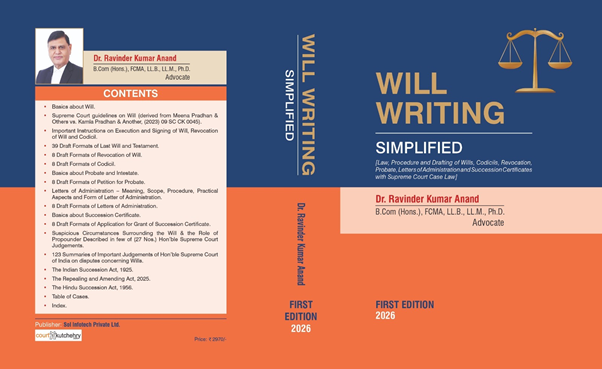
EXTRACTS FROM BOOK, WILL WRITING SIMPLIFIED, By Dr Ravinder Kumar Anand. [📘 Buy Will Writing Simplified online: Amazon | Flipkart ]
Case Title V. Prabhakara v. Basavaraj K. (Dead) by Legal Representatives & Another, (2021) 10 SC CK 0031: Civil Appeals Nos. 1376-77 of 2010.
[https://www.courtkutchehry.com/judgements/1103871/v-prabhakara-vs-basavaraj-k-dead-by-lr-anr/]
| Suspicious Circumstance | Court’s Observation & Para Reference in the Judgement |
|---|---|
| High Court doubted exclusion of sister and brother of propounder (Appellant) | Supreme Court held that mere exclusion of a brother or sister does not by itself create suspicion unless other surrounding factors show unnatural disposition. The testatrix was accompanied by the sister (Kantha Lakshmi) and the Will was attested by the brother (PW-2); neither raised any objection. Hence, no suspicious circumstance exists. [Paras 24–26] |
| Appellate Court’s “suspicion” without pleadings or reasons | The High Court “virtually reached a conclusion without recording reasons.” A testamentary court is a court of conscience, not suspicion. When the trial court found due execution and absence of suspicious circumstances, the appellate court cannot create suspicion by moral reasoning or conjecture. [Paras 21, 23, 24, 37] |
| Existence of a second Will (Ex.D-1) | Both Courts found Ex.D-1 to be forged and fabricated. Thumb impression smudged, scribe not examined, stamp dated 15 Aug 1986, Will dated 16 Aug 1986, and testatrix died 22 Aug 1986. Hence rejected. [Paras 7, 27] |
| Presence of sister at registration | Presence adds strength, not suspicion. It confirms genuineness and acceptance. [Para 26] |
| Absence of pleadings | Suspicion must arise from pleadings and issues framed, not speculation. [Para 27] |
| Moral reasoning by High Court | Courts must rely on legal evidence, not moral views. [Para 24] |
| Statutory compliance | Will proved under Section 63 (Succession Act) and Section 68 (Evidence Act). No room for suspicion. [Para 25] |
| Trial Court findings ignored | Appellate court failed to justify reversal. Hence legally unsustainable. [Paras 21, 36–37] |
| Testamentary court principle | A court of conscience, not suspicion. [Para 24] |
| Exclusion of heirs | Does not automatically create suspicion. [Paras 24–26] |
| Burden of proof | Once proved, burden shifts to challenger. [Para 25] |
| Appellate court limits | Cannot override trial findings without reasoning. [Paras 21, 36–37] |
| Forgery of alternate Will | Strengthens genuine Will. [Paras 7, 27] |
| Registration of Will | Not mandatory but creates rebuttable presumption. [Paras 19, 25] |
FAQs
Q1: Does exclusion of heirs make a will suspicious?
No. Mere exclusion or unequal distribution does not raise suspicion unless supported by evidence of coercion or improbability.
Q2: Must suspicion be pleaded in court?
Yes. Suspicion must arise from pleadings and evidence. Courts cannot invent suspicion without foundation.
Q3: What if there are two conflicting wills?
If one will is proved genuine and the other is shown to be forged, the genuine will stands strengthened.
Q4: Is registration of a will mandatory?
No. Registration is not mandatory but creates a rebuttable presumption of proper execution under Section 114(e) of the Evidence Act.
Q5: Can appellate courts overturn trial court findings on suspicion?
Only with cogent reasons based on evidence. They cannot rely on moral or ethical notions to replace trial court findings.
Q6: What is the role of a testamentary court?
It is a court of conscience, relying on material evidence and statutory compliance, not moral conjecture.
BOOK REFERENCE:
[📘 Buy Will Writing Simplified online: Amazon | Flipkart ]