

COURTKUTCHEHRY SPECIAL SERIES ON LANDMARKS JUDGEMENTS ON WILLS, CODICIL & PROBATE
Palanivelayutham Pillai v. Ramachandran and Others — Supreme Court Upholds Valid Will and Trustee’s Right to Appoint Successor
Temple Property Management Lawfully Passed Through Testamentary Authority
Court Rejects Hereditary Limitation, Confirms Successor’s Appointment Valid
By Vishwas Kumar
New Delhi: March 26, 2026:
In Palanivelayutham Pillai v. Ramachandran and Others (Civil Appeal No. 2002 of 1987, decided on 9 May 2000), the Supreme Court of India delivered a significant ruling on the management of temple Kattalai properties, and the scope of testamentary authority vested in trustees. The Division Bench comprising Hon’ble Justice S.B. Majmudar and Hon’ble Justice U.C. Banerjee examined whether a testator-trustee could validly bequeath the right of management to a non-lineal relative.
major Supreme Court precedents on wills of Palanivelayutham Pillai Case
The dispute arose from the Will of Sivasankaran Pillai, who had inherited full managerial authority from the original settlor’s second wife. The appellants argued that such authority was limited to hereditary succession and could not be passed to a non-lineal relative. The Court, however, rejected this contention, holding that the original settlor had vested unfettered managerial rights in his second wife without imposing hereditary restrictions. Consequently, Sivasankaran Pillai lawfully possessed the right to appoint his own successor trustee.
The Will was found to be duly proved, with no suspicious circumstances surrounding its execution. The Court emphasized that testamentary freedom, when lawfully exercised, must be respected. Accordingly, the management of the temple properties was validly transferred to Defendant 9 and thereafter to his widow, Defendant 10, under the supervision of the temple authority.
This judgment reinforces the principle that trustees with absolute managerial authority can designate successors beyond hereditary lines, provided the original settlement permits such discretion. It safeguards the continuity of temple property management while ensuring that testamentary dispositions are honoured when properly executed and proved.
For More, Read Here the Summary of the Judgement from the Book: WILL WRITING SIMPLIFIED, read below or open page no 436, Chapter 14.1 in the book. (Online book purchase link available here on: Buy online: Amazon | Flipkart
|
|
Case Summary |
: |
Palanivelayutham Pillai v. Ramachandran and Others. |
|
|
Court |
: |
Supreme Court of India |
|
|
Citations |
: |
(2000) 05 SC CK 0096: Civil Appeal No. 2002 of 1987. |
|
|
Link |
: |
|
|
|
Decided on |
: |
9 May 2000 |
|
|
Coram |
: |
Hon’ble Mr. Justice S.B. Majmudar and Hon’ble Mr. Justice U.C. Banerjee. (Division Bench) |
|
|
Relevant Paragraphs |
: |
Para Nos.1–20 |
1. Facts of the Case:
The plaintiffs (respondent nos. 2 & 3) sought partition and separate possession of ancestral properties of late Sivasankaran Pillai. Among these, Schedule “C” properties gifted by Palanivelayutham Pillai in 1907 to Madurai Devasthanam Tirupparankundram Andavar Subramaniaswamy were claimed to be temple endowments (Kattalai properties). The contesting defendants (sons through the first wife) resisted, asserting these were trust properties managed by Sivasankaran Pillai under authority of the settlor’s widow Pitchammal, and that her Will (1924) had appointed him successor trustee. By his Will dated 1 July 1955 (Ex.B-487) he bequeathed management to his son-in-law (Defendant 9), while another Will (Ex.B-488) on the same day covered his personal properties in favour of his sons.
2. Law Points Involved:
(i). Proof and validity of a Will under the Indian Succession Act, 1925 — Section 68 Evidence Act, attestation and testamentary capacity.
(ii). Authority of a trustee under a Kattalai endowment to appoint successor manager by Will.
(iii). Nature of rights in Kattalai properties — whether proprietary or mere right of management.
(iv). Applicability of Madras Hindu Religious Endowments Act, 1926 —Section 57 (scheme of administration).
(v). Scope of interference under Article 136, Constitution of India.
3. Acts / Provisions / Articles Referred:
(i). Constitution of India — Article 136
(ii). Madras Hindu Religious Endowments Act, 1926 — Section 57
(iii). Principles under the Indian Succession Act 1925 & Evidence Act 1872 (Sections 68 & 71 implied)
4. Judgments Referred:
(i). Bhagwan Kaur v. Kartar Kaur, (1994) 04 SC CK 0079
https://www.courtkutchehry.com/judgements/691485/bhagwan-kaur-vs-kartar-kaur-and-others/]
(ii). H. Venkatachala Iyengar v. B.N. Thimmajamma (1958) 11 SC CK 0008;
(iii). Ramchandra Rambux v. Champabai, (1964) 02 SC CK 0018.
(iv). Kalipada Chakraborti v. Palani Bala Devi, (1953) 01 SC CK 0002.
(v). Ram Gopal v. Nand Lal, (1950) 11 SC CK 0008.
https://www.courtkutchehry.com/judgements/650673/ram-gopal-vs-nand-lal-and-others]
5. Obiter Dicta:
The Court emphasized that Kattalai grants are special endowments for specified religious or charitable services; the trustee holds no proprietary interest but only a duty of management. The settlor’s intention governs, and when management is vested absolutely in one person, that person may validly nominate a successor of choice, irrespective of lineal descent.
6. Ratio Decidendi:
(i). Proof of Will: The Will (Ex.B-487) was validly executed; the scribe, also an attesting witness, was examined fulfilling Section 68 Evidence Act.
(ii). Absence of Suspicious Circumstances: Concurrent findings that the testator was of sound mind; simultaneous execution of another Will in favour of his sons negated suspicion.
(iii). Authority to Appoint Successor: The 1907 Gift Deed vested absolute managerial right in the settlor’s widow, not limited to heirs. She could bequeath that right; thus Sivasankaran Pillai validly willed management to his son-in-law.
(iv). Nature of Right: The office carried only fiduciary management, not ownership; succession by Will was legally permissible.
(v). Effect of 1945 Scheme: The trustee’s management remains subject to the statutory scheme under Section 57 of the 1926 Act and supervision of the temple’s Executive Officer.
7. Final Ruling:
Appeal dismissed. The Supreme Court upheld both lower-court judgments confirming validity of Sivasankaran Pillai’s Will (Ex.B-487) and legality of entrusting management to Defendant 9. Directions of the High Court for continued performance of charities under supervision of the Executive Officer were affirmed. No order as to costs.
8. Gist / Dispute & Final Decision:
Dispute concerned whether a testator-trustee could validly bequeath the right of management of temple Kattalai properties to a non-lineal relative. The Court held that since the original settlor vested full managerial authority in his second wife without hereditary limitation, her successor (Sivasankaran Pillai) also possessed an unfettered right to appoint his own successor trustee. Will duly proved; no suspicious circumstances; management lawfully passed to Defendant 9 and thereafter to his widow (Defendant 10) under supervision of the temple authority.
Read full Judgement Here:
Palanivelayutham Pillai v. Ramachandran and Others.
Supreme Court of India
(2000) 05 SC CK 0096: Civil Appeal No. 2002 of 1987.
You Can Also Purchase the Book from here on: Buy online: Amazon | Flipkart
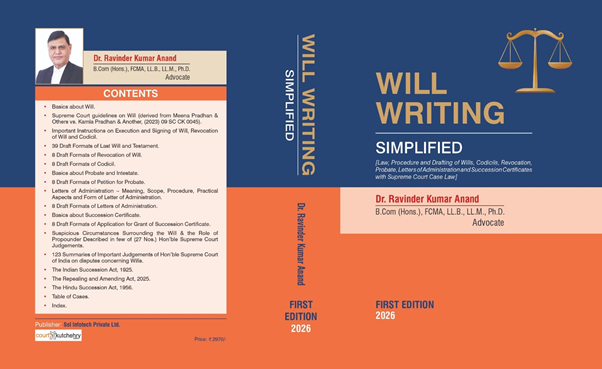
OUR RECOMMENDATION: Check out 123 Key Judgements, as highlighted in the book, WILL WRITING SIMPLIFIED, for the quick research and reference purposes. Click the link here: https://www.courtkutchehry.com/pages/blog/123-supreme-court-judgments-on-wills/
Keywords for SEO & Faster Searches
- Palanivelayutham Pillai case 2000
- Ramachandran Supreme Court judgment
- Temple Kattalai property management India
- Trustee succession rights Supreme Court
- Will validity in temple property disputes
- Justice S.B. Majmudar U.C. Banerjee ruling
- Civil Appeal No. 2002 of 1987 inheritance law