
COURTKUTCHEHRY SPECIAL SERIES ON LANDMARKS JUDGEMENTS ON WILLS, CODICIL & PROBATE
Niranjan Umeshchandra Joshi v. Mrudula Jyoti Rao and Others: Supreme Court Denies Probate of ICU Will
Hospital Execution and Exclusion of Family Raised Doubts
Propounder Failed to Remove Suspicious Circumstances
By Vishwas Kumar
New Delhi: March 24, 2026:
In Niranjan Umeshchandra Joshi v. Mrudula Jyoti Rao and Others (Civil Appeal No. 5060 of 2005, decided on 15 December 2006), the Supreme Court of India addressed the validity of a Will executed under extraordinary circumstances. The Division Bench comprising Hon’ble Mr. Justice S.B. Sinha and Hon’ble Mr. Justice Markandey Katju examined whether a Will made in the Intensive Care Unit (ICU) by a seriously ill testator, favouring only one son, could be accepted as genuine.
The appellant argued that the Will was validly executed and that the testator was of sound mind at the time. The respondents, however, alleged manipulation, pointing to the exclusion of other family members and the unusual hospital setting. Both the Single Judge and Division Bench of the Bombay High Court had earlier found the Will surrounded by suspicious circumstances: the unexplained execution in the ICU, absence of medical testimony confirming the testator’s capacity, exclusion of natural heirs, and the dominant role played by the propounder.
The Supreme Court affirmed these findings, holding that the propounder failed to dispel the suspicions and did not prove due execution and attestation as required by law. The Court reiterated that in probate matters, the burden lies heavily on the propounder to establish authenticity beyond doubt. Since this burden was not met, probate was rightly denied.
This ruling underscores the judiciary’s cautious approach to Wills executed under unusual or suspicious conditions. It highlights that testamentary freedom must be balanced against safeguards ensuring fairness and preventing undue influence, especially when natural heirs are excluded without clear justification.
For More, Read Here the Summary of the Judgement from the Book: WILL WRITING SIMPLIFIED, read below or open page no 436, Chapter 14.1 in the book. (Online book purchase link available here on: Buy online: Amazon | Flipkart
|
|
Case Summary |
: |
Niranjan Umeshchandra Joshi v. Mrudula Jyoti Rao and Others. |
|
|
Court |
: |
Supreme Court of India |
|
|
Citations |
: |
(2006) 12 SC CK 0022: Civil Appeal No.5060 of 2005. |
|
|
Link |
: |
|
|
|
Decided on |
: |
15 December 2006 |
|
|
Coram |
: |
Hon’ble Mr. Justice S.B. Sinha and Hon’ble Mr. Justice Markandey Katju. |
|
|
Relevant Paragraphs |
: |
Para Nos.11–23 |
1. Facts of the Case:
Late Umeshchandra Madhav Joshi owned considerable properties including a house, “Umesh Dham,” and ran a yoga and hair-oil business. He executed a Will and Power of Attorney while admitted to Breach Candy Hospital’s ICU in November 1983, bequeathing his entire estate to his son, the appellant Dr. Niranjan Joshi, excluding his wife and other children. The Will was drafted by Advocate M.K. Mahimkar and attested by Mahimkar and Dr. Bhupendra Gandhi. Other heirs initially consented but later revoked consent alleging fraud and suspicious circumstances. The Bombay High Court (Single Judge and Division Bench) dismissed the probate petition. The propounder appealed to the Supreme Court.
2. Law Points Involved:
(i). Proof of execution of Wills – Section 63, Indian Succession Act, 1925; Section 68, Indian Evidence Act, 1872.
(ii). Requirement that propounder must prove the Will’s due execution, sound mind of testator, and free will.
(iii). Duty of court to be satisfied that the Will represents the true intention of the testator, particularly when suspicious circumstances exist.
(iv). Scope of interference by appellate courts with concurrent factual findings in probate cases.
3. Acts / Provisions / Articles Referred:
(i). Indian Succession Act, 1925 – Section 63.
(ii). Indian Evidence Act, 1872 – Section 68.
4. Judgments Referred:
(i). H. Venkatachala Iyengar v. B.N. Thimmajamma (1958) 11 SC CK 0008;
(ii). Sridevi v. Jayaraja Shetty, (2005) 01 SC CK 0034.
(iii). Madhukar D. Shende v. Tarabai Aba Shedage, (2002) 01 SC CK 0024.
https://www.courtkutchehry.com/judgements/653626/madhukar-d-shende-vs-tarabai-aba-shedage/]
(iv). B. Venkatamuni v. C.J. Ayodhya Ram Singh, (2006) 10 SC CK 0054.
(v). T.K. Ghosh’s Academy v. T.C. Palit, (1970) 01 SC CK 0001.
5. Obiter Dicta:
The Court emphasized that a signature on a Will by itself is not sufficient proof of due execution if the testator’s mental or physical condition is doubtful. Courts must satisfy their conscience as to genuineness and fairness. Suspicion must not be fanciful but well-founded, and the court must look for credible removal of such suspicion by the propounder.
6. Ratio Decidendi:
The propounder bears the burden to prove the Will’s genuineness and remove any suspicious circumstances by clear, cogent evidence. When the propounder himself plays an active role in preparing or executing the Will that benefits him exclusively, and where dispositions are unnatural or exclude close family members without reason, the court must view such a Will with grave suspicion. Concurrent findings of fact on suspicious circumstances cannot be interfered with unless perverse.
7. Final Ruling:
(i). Appeal dismissed.
(ii). The Supreme Court upheld the concurrent findings of the High Court that the Will was surrounded by grave suspicious circumstances and that the appellant failed to dispel them. The Will was held not proved in accordance with law. Costs of ₹25,000 imposed on the appellant.
8. Gist Highlighting Dispute with Final Decision:
The dispute centered on whether a Will executed in the ICU by a seriously ill testator, benefiting solely one son, was genuine. The appellant claimed valid execution and sound mind; respondents alleged manipulation. Both the Single Judge and Division Bench of the Bombay High Court found the Will surrounded by suspicious circumstances—unexplained hospital execution, exclusion of family, lack of medical testimony, and the propounder’s dominant role. The Supreme Court affirmed, holding that the propounder failed to remove suspicions and thus probate was rightly denied.
Read full Judgement Here:
Niranjan Umeshchandra Joshi v. Mrudula Jyoti Rao and Others.
Supreme Court of India
(2006) 12 SC CK 0022: Civil Appeal No.5060 of 2005.
You Can Also Purchase the Book from here on: Buy online: Amazon | Flipkart
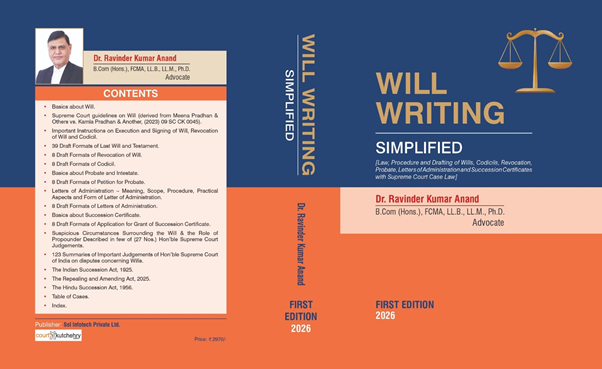
OUR RECOMMENDATION: Check out 123 Key Judgements, as highlighted in the book, WILL WRITING SIMPLIFIED, for the quick research and reference purposes. Click the link here: https://www.courtkutchehry.com/pages/blog/123-supreme-court-judgments-on-wills/
Keywords: Niranjan Umeshchandra Joshi v. Mrudula Jyoti Rao, Supreme Court of India 2006, Civil Appeal No. 5060 of 2005, Justice S.B. Sinha, Justice Markandey Katju, ICU Will dispute, suspicious circumstances in Will, exclusion of family heirs, proof of attestation, probate denied, Indian succession law.