COURTKUTCHEHRY EXCLUSIVE: EXTRACTS FROM BEST SELLING BOOK: WILL WRITING SIMPLIFIED
Murthy and Others v. C. Saradambal and Others (2021): Supreme Court on Suspicious Circumstances and Burden of Proof in Wills
Suspicious Circumstances Must Be Removed by Propounder
Appellate Courts Must Give Cogent Reasons
By Vishwas Kumar
New Delhi: April 07, 2026:
The Supreme Court’s judgment in Murthy and Others v. C. Saradambal and Others, (2021) 12 SC CK 0037: Civil Appeal No. 4270 of 2010 is a landmark in Indian succession law. It reaffirmed the principle that the propounder of a will must not only prove due execution and attestation but also dispel all suspicious circumstances to the satisfaction of the court’s conscience. This case continues to be cited by lawyers because it provides a comprehensive framework for evaluating wills where illness, delay, and unnatural dispositions raise doubts.
A detailed explanation is available in these Supreme Court rulings on will validity. Supreme Court judgments on will validity in India , including the key case of Moonga Devi and Others vs Radha Ballabh, which explains important principles of will execution, proof, and succession law.
Testator’s Condition and Soundness of Mind
The testator executed the will on 4 January 1978 and died just 15 days later, on 19 January 1978. Evidence showed he was bedridden for ten months, paralysed, and unable to move or write. No medical testimony was produced to prove his mental fitness. The Court held it highly doubtful that he was in a sound and disposing state of mind at the time of execution. This reinforced the principle that where illness or incapacity is alleged, medical or credible evidence must prove mental soundness; absence of such evidence is fatal (Paras 25(v), 33(a)–(c)).
Unregistered Will and Signature Discrepancies
The will was unregistered, despite the testator’s son being a practising advocate. The attesting witness admitted the testator could not be taken to the Sub-Registrar due to illness. The Court found this omission suspicious. Further, the signatures on the will did not tally with admitted signatures on other documents, with even the letter “E” distinctly different. Such discrepancies cast grave doubt on authenticity (Paras 25(ii), 25(xvi), 33(e), 33(g)).
Delay in Producing the Will
The will was not disclosed for 15 years after the testator’s death and surfaced only when the daughters filed a partition suit. The Court held that unexplained delay in producing a will gives rise to presumption of fabrication unless convincingly explained. Custody of the will was also unexplained: though PW-1 claimed it was in the testator’s custody, it was later found in her husband’s almirah. This inconsistency added to suspicion (Paras 25(xi), 33(h)(i)–(ii)).
Attesting Witnesses and Scribe
The credibility of attesting witnesses was undermined. PW-2 was a friend of the propounder, not of the testator, and admitted filing an affidavit at counsel’s request. The scribe was not identified or examined, and the will did not mention who drafted it. The Court held that attesting witnesses must be credible and known to the testator; otherwise, the will collapses. The absence of a scribe’s testimony was fatal to proving intention and genuineness (Paras 25(xiii), 33(d)–(f)).
Unnatural Bequest
The will excluded the daughters entirely, giving all property to the son. The Court found this unnatural and unfair, warranting heightened scrutiny. In testamentary law, exclusion of natural heirs without explanation is a suspicious circumstance requiring closer examination (Paras 25(xviii), 30(f), 33(a)).
Appellate Court’s Duty
The High Court reversed the trial court’s findings without detailed reasoning. The Supreme Court reiterated that an appellate court must record specific reasons when differing from a trial court’s factual findings, especially when oral evidence and witness demeanour are involved. Failure to do so renders its decision unsustainable. The Court cited Santosh Hazari v. Purushottam Tiwari and B.V. Nagesh v. H.V. Sreenivasa Murthy to reinforce this principle (Paras 36–42).
Testamentary Court as Court of Conscience
The Court reaffirmed the rule in H. Venkatachala Iyengar v. B.N. Thimmajamma (1958): mere formal proof of signatures is insufficient. A testamentary court must be satisfied that the will truly represents the free and sound volition of the testator. Suspicious circumstances such as shaky signatures, serious illness, unnatural exclusion of heirs, or non-production of the will for years justify closer scrutiny. If suspicion remains unexplained, the will must be rejected (Paras 30, 33–35).
Why Lawyers Still Cite This Case
- Suspicious Circumstances Doctrine: Clarifies that illness, delay, and unnatural exclusion of heirs require heightened scrutiny.
- Burden on Propounder: Reinforces that propounder must remove suspicion, not just prove attestation.
- Medical Evidence Requirement: Establishes that proof of sound mind is essential when illness is alleged.
- Appellate Discipline: Limits appellate courts from reversing trial court findings without cogent reasons.
- Practical Utility: Provides a checklist of suspicious circumstances for courts and lawyers in will disputes.
RESEARCH RESOURCES:
Browse testamentary law judgments here. Click the link here: https://www.courtkutchehry.com/pages/blog/123-supreme-court-judgments-on-wills/
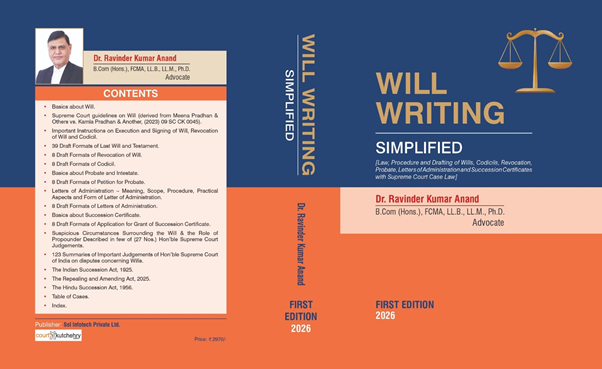
EXTRACTS FROM BOOK, WILL WRITING SIMPLIFIED, By Dr Ravinder Kumar Anand. [📘 Buy Will Writing Simplified online: Amazon | Flipkart ]
Case Title Murthy and Others v. C. Saradambal and Others, (2021) 12 SC CK 0037: Civil Appeal No. 4270 of 2010.
https://www.courtkutchehry.com/judgements/1110414/murthy-ors-vs-c-saradambal-ors/]
| Suspicious Circumstance | Court’s Observation & Para Reference in the Judgement |
|---|---|
| Testator died within 15 days of execution of the Will | Will dated 04.01.1978; death on 19.01.1978. Court doubted mental fitness due to paralysis and weakness. [Paras 33(a), 33(c)] |
| Testator was bedridden and paralysed | No medical evidence to prove sound mental state. [Paras 25(v), 33(a)-(c)] |
| Unregistered Will despite illness | Not taken to Sub-Registrar; increased suspicion. [Paras 25(ii), 25(xvi), 33(e)] |
| Signature discrepancy | Signatures didn’t match admitted records. [Para 33(g)] |
| 15-year delay in producing Will | Raised serious suspicion. [Paras 25(xi), 33(h)(i)] |
| Contradictory evidence | Witness statements inconsistent. [Paras 25(xii), 33(h)(v)] |
| Attesting witness unreliable | Witness not known to testator. [Paras 25(xiii), 33(e)(ii)] |
| Scribe not examined | No clarity on drafting. [Paras 25(x), 33(d)] |
| No date in heading | Created doubt on execution timing. [Para 33(h)(iv)] |
| Custody unexplained | Will found in unexpected place. [Para 33(h)] |
| Unnatural bequest | Daughters excluded; required scrutiny. [Paras 25(xviii), 33(a)] |
| Appellate Court error | No proper reasoning for reversal. [Paras 36–42] |
| Burden of proof | Must prove execution + remove suspicion. [Para 30] |
| Court of conscience | Must rely on evidence, not suspicion. [Paras 30, 33] |
| Suspicious circumstances examples | Includes illness, delay, exclusion of heirs. [Para 30(c)] |
| Sound mind requirement | Medical proof needed. [Para 33(b)] |
| Delay in disclosure | Suggests fabrication. [Para 33(h)] |
| Witness credibility | Must be reliable. [Para 33(e)] |
| Appellate duty | Must give reasoning before reversing. [Paras 36–42] |
| Failure to remove suspicion | Leads to rejection of Will. [Paras 34–35] |
FAQs
Q1: Does serious illness of a testator affect validity of a will?
Yes. If illness or incapacity is alleged, medical or credible evidence must prove mental soundness.
Q2: Is registration of a will mandatory?
No, but non-registration in suspicious circumstances (e.g., serious illness) can raise doubts.
Q3: Does delay in producing a will matter?
Yes. Unexplained delay in producing a will after death raises presumption of fabrication.
Q4: Can exclusion of daughters or heirs invalidate a will?
Not automatically, but total exclusion without explanation is a suspicious circumstance requiring closer scrutiny.
Q5: What is the role of attesting witnesses?
They must be credible and known to the testator. If linked only to the propounder, credibility collapses.
Q6: What is the appellate court’s duty in will disputes?
It must record specific reasons when differing from trial court findings. Failure to do so makes reversal unsustainable.
BOOK REFERENCE:
[📘 Buy Will Writing Simplified online: Amazon | Flipkart ]