
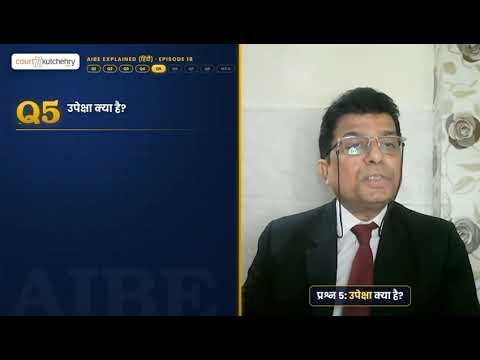
Watch the Video
In this 12-minute video, Episode 18 of the CourtKutchehry series “AIBE Explained” (Hindi), the episode explains अपकृत्य विधि (the Law of Torts) in Hindi, together with motor accident claims under the Motor Vehicles Act, 1988 and the Consumer Protection Act, 2019, in eight questions. This English article for Hindi-medium aspirants arranges it as revision notes, with one numbers table and a Hindi–English glossary.
▶ Watch in English: Law of Torts, Motor Vehicles Act & Consumer Protection Act 2019 for AIBE: Ep 18
A 5-Mark Subject Built on Principles and Cases
The Law of Torts, with motor accident law and consumer protection, is a 5-mark subject in the AIBE. Tort law in India is uncodified (असंहिताबद्ध), so questions test maxims and leading cases, plus a few statutory numbers. Learn each maxim with its case, and the statutory numbers as a table.
Notes on Q1 and Q2: What Is a Tort, and the General Defences
A tort (अपकृत्य) is a civil wrong, other than a breach of contract, for which the remedy is an action for unliquidated damages (अपरिनिर्धारित हर्जाना). Unlike a crime it is not punished by the State, and unlike contract the duty is not from agreement.
Two maxims that always come together
- Injuria sine damno – legal injury without actual loss – is actionable: Ashby v. White (1703).
- Damnum sine injuria – loss without legal injury – is not actionable: the Gloucester Grammar School case (1410).
The general defences listed in the episode
Volenti non fit injuria (consent), act of God (दैवी कृत्य), inevitable accident, private defence, necessity, statutory authority, contributory negligence (अंशदायी उपेक्षा) and ex turpi causa (no action arises from one’s own wrongful act).
Notes on Q3: Vicarious Liability and the State
Under vicarious liability (प्रतिनिधिक दायित्व), a master is liable for the tort of his servant committed in the course of employment, but generally not for that of an independent contractor. State liability (Article 300) runs through three cases:
- State of Rajasthan v. Vidhyawati, (1962) 02 SC CK 0015 – liable for a Government jeep driven negligently.
- Kasturilal Ralia Ram Jain v. State of Uttar Pradesh, (1964) 09 SC CK 0028 (usually cited as 1965) – not liable: sovereign function.
- N. Nagendra Rao and Co. v. State of Andhra Pradesh, (1994) 09 SC CK 0089 – sovereign immunity (संप्रभु उन्मुक्ति) narrowed.
Notes on Q4 and Q5: Strict Liability, Absolute Liability and Negligence
Strict liability (कठोर दायित्व) comes from Rylands v. Fletcher (1868) and has exceptions. Absolute liability (पूर्ण दायित्व) was laid down in M.C. Mehta v. Union of India (the oleum gas leak case, 1987) for hazardous enterprises and has no exceptions. The Public Liability Insurance Act, 1991 followed.
Remember this line: Rylands allows exceptions; M.C. Mehta allows none.
Negligence (उपेक्षा) needs a duty of care (सावधानी का कर्तव्य), breach of that duty and consequent damage. The “neighbour principle” (पड़ोसी सिद्धांत) is from Donoghue v. Stevenson (1932). For res ipsa loquitur, the Indian case is Municipal Corporation of Delhi v. Subhagwanti, (1966) 02 SC CK 0029 (the Chandni Chowk clock tower collapse). For doctors, the Bolam test; in Jacob Mathew v. State of Punjab, (2005) 08 SC CK 0074, gross negligence for criminal liability.
Notes on Q6: The Other Torts and Remoteness
The episode lists the torts most often asked: defamation (मानहानि), nuisance, assault, battery, false imprisonment (मिथ्या कारावास), malicious prosecution (द्वेषपूर्ण अभियोजन) and conversion. On remoteness of damage (क्षति की दूरी), the test is reasonable foreseeability, from The Wagon Mound (1961).
Notes on Q7 and Q8: The Numbers Table
| Point | Provision | What to write |
|---|---|---|
| Claims Tribunal | MV Act s. 165 | Constituted by the State |
| Fault-based claim | MV Act s. 166 | Claim petition; 6-month limit under s. 166(3) |
| No-fault liability | MV Act s. 164 | ₹5 lakh death; ₹2.5 lakh grievous hurt |
| Hit-and-run | MV Act s. 161 | ₹2 lakh death; ₹50,000 grievous hurt |
| Compulsory third-party insurance | MV Act s. 146 | Mandatory in a public place |
| Insurer’s defences | MV Act s. 149 (s. 150 after the 2019 amendment’s insurance provisions took effect) | Only the statutory defences |
| Definition of consumer | CPA 2019 s. 2(7) | Includes online transactions |
| Central Consumer Protection Authority | CPA 2019 s. 10 | Regulator |
| Product liability | CPA 2019 Chapter VI | Manufacturer, service provider, seller |
| Limitation for a complaint | CPA 2019 s. 69 | 2 years |
Compensation cases: the multiplier method from Sarla Verma v. Delhi Transport Corporation, (2009) 04 SC CK 0222, and future prospects from the Constitution Bench in National Insurance Company Ltd. v. Pranay Sethi, (2017) 10 SC CK 0044.
Consumer Commissions (2021 rules, by consideration paid): District up to ₹50 lakh; State above ₹50 lakh up to ₹2 crore; National above ₹2 crore. Medical services for a fee are covered: Indian Medical Association v. V.P. Shantha, (1995) 11 SC CK 0090.
Key Legal Terms: Hindi ↔ English
| Hindi (as used in the episode) | English |
|---|---|
| अपकृत्य | Tort |
| अपरिनिर्धारित हर्जाना | Unliquidated damages |
| दैवी कृत्य | Act of God |
| प्रतिनिधिक दायित्व | Vicarious liability |
| संप्रभु उन्मुक्ति | Sovereign immunity |
| कठोर दायित्व / पूर्ण दायित्व | Strict liability / absolute liability |
| उपेक्षा / अंशदायी उपेक्षा | Negligence / contributory negligence |
| सावधानी का कर्तव्य | Duty of care |
| मानहानि | Defamation |
| द्वेषपूर्ण अभियोजन | Malicious prosecution |
| घोर उपहति | Grievous hurt |
Key Takeaways
- Torts is uncodified: learn maxim + case pairs.
- State liability: Vidhyawati, Kasturilal, Nagendra Rao.
- Strict liability has exceptions; absolute liability has none.
- MV Act numbers: s. 164 ₹5 lakh / ₹2.5 lakh; s. 161 ₹2 lakh / ₹50,000; s. 146 compulsory insurance; 6 months under s. 166(3).
- CPA 2019: consumer s. 2(7), CCPA s. 10, product liability Chapter VI, limitation 2 years (s. 69); Commissions ₹50 lakh / ₹2 crore.
Frequently Asked Questions
What is the Hindi term for vicarious liability used in the episode?
प्रतिनिधिक दायित्व: a master’s liability for a servant’s tort in the course of employment.
What is the no-fault compensation for a death in a motor accident?
₹5 lakh under Section 164 of the Motor Vehicles Act, and ₹2.5 lakh for grievous hurt.
Within what time must a motor accident claim be filed?
Within six months of the accident, under Section 166(3).
Which case brought medical services under consumer law?
Indian Medical Association v. V.P. Shantha (1995).
Where can I watch the full explanation?
Watch it here: https://youtu.be/45DGmEHAo6w.
Conclusion
The Hindi Episode 18 links three areas – tort, motor accident compensation and consumer protection – by one thread: compensation for a wrong.
Learn the maxims with their cases and the numbers table. The next episode covers Arbitration, Conciliation and ADR.
▶ Watch the video: अपकृत्य विधि, मोटर दुर्घटना दावे और उपभोक्ता संरक्षण अधिनियम, 2019 | AIBE Explained Ep 18
▶ Watch in English: Law of Torts, Motor Vehicles Act & Consumer Protection Act 2019 for AIBE: Ep 18
📖 Read the full article: AIBE Law of Torts, Motor Vehicles Act and Consumer Protection Act, 2019: Principles and Leading Cases
Research Judgments Like These on CourtKutchehry
Every judgment cited in this article, and lakhs more, can be searched and read on CourtKutchehry. Searching and reading judgments is free. A membership adds unlimited summaries, all related judgments, original court PDF downloads, bookmarks, notes and the CourtKutchehry AI assistant.
| Membership | Price | Works out to | AI credits |
|---|---|---|---|
| Monthly (1 month) | ₹599 | ₹599 / month | 1,000 / month |
| Quarterly (3 months) · Save 16% | ₹1,499 | ₹499.67 / month | 1,100 / month |
| Six-monthly (6 months) · Save 33% | ₹2,399 | ₹399.83 / month | 1,200 / month |
| Yearly (12 months) · Save 44% · Best value | ₹3,999 | ₹333.25 / month | 1,300 / month |
Every plan is a one-off purchase for a fixed period: nothing auto-renews and no card is kept on file. Prices are exclusive of applicable tax, which is added at checkout. Extra AI chat credits can be topped up from ₹99. A free verified account gets 5 summaries and 50 AI trial credits.
Prices are as displayed on courtkutchehry.com on 20 November 2026 and are subject to change without notice. Please check the pricing page for the current plans and offers.
For more judgments, legal opinions and case analysis, visit courtkutchehry.com
Visit CourtKutchehry →