
Watch the Video
In this 11-minute video, Episode 18 of the “AIBE Explained” series, the episode covers the Law of Torts in eight questions: the essentials of a tort, the general defences, vicarious and State liability, strict and absolute liability, negligence, the other key torts, motor accident claims under the Motor Vehicles Act, 1988 and the Consumer Protection Act, 2019. He then solves five practice questions in the style of past AIBE papers. This article sets out the same material in writing.
▶ Watch on YouTube: Law of Torts, Motor Vehicles Act & Consumer Protection Act 2019 for AIBE: Ep 18
Q1. What Is a Tort?
A tort is a civil wrong, other than breach of contract, remedied by an action for unliquidated damages. Torts are largely uncodified, so questions test principles and leading cases.
- Injuria sine damno: violation of a legal right without actual loss is actionable. In Ashby v. White (1703), a voter wrongly prevented from voting succeeded even though his candidate won.
- Damnum sine injuria: loss without violation of a legal right is not actionable. In the Gloucester Grammar School case (1410), a rival school that drew away pupils and reduced fees committed no tort.
Q2. The General Defences
- Volenti non fit injuria: one who consents to a risk cannot complain of the harm.
- Act of God and inevitable accident: harm that could not be foreseen or avoided with reasonable care.
- Private defence and necessity: reasonable force to protect person or property, or harm caused to prevent a greater harm.
- Statutory authority: an act authorised by statute, done without negligence.
Q3. Vicarious Liability and the Liability of the State
Under vicarious liability, one person is liable for the tort of another: qui facit per alium facit per se. A master is liable for a tort committed by his servant in the course of employment, but generally not for an independent contractor.
The liability of the State moved in three steps:
- In State of Rajasthan v. Vidhyawati, (1962) 02 SC CK 0015, the State was held liable for the rash and negligent driving of a Government jeep by its employee, which caused a death.
- In Kasturilal Ralia Ram Jain v. State of Uttar Pradesh, (1964) 09 SC CK 0028, the State was held not liable for the loss of gold seized by the police, because the police acted in exercise of a sovereign function.
- In N. Nagendra Rao and Co. v. State of Andhra Pradesh, (1994) 09 SC CK 0089, the Supreme Court considerably narrowed sovereign immunity, holding that the State is liable for the negligence of its officers in discharging statutory functions that are not primary and inalienable sovereign functions.
Q4. Strict and Absolute Liability
Under the rule in Rylands v. Fletcher (1868), a person who brings on his land something likely to do mischief if it escapes is liable for the damage caused by its escape, even without negligence. This is strict liability, and it has exceptions: act of God, the plaintiff’s own default, consent, act of a stranger and statutory authority.
In M.C. Mehta v. Union of India (the oleum gas leak case, 1987), the Supreme Court went further and laid down absolute liability: an enterprise engaged in a hazardous or inherently dangerous activity is absolutely liable for harm caused by it, with no exceptions, and the compensation should be correlated to the magnitude and capacity of the enterprise.
Remember this line: strict liability has exceptions; absolute liability has none.
Q5. Negligence and Res Ipsa Loquitur
Negligence has three elements: a duty of care owed to the plaintiff, breach of that duty, and damage caused by the breach. Donoghue v. Stevenson (1932), the snail-in-the-bottle case, established the “neighbour principle”: a manufacturer owes a duty of care to the ultimate consumer.
Res ipsa loquitur (the thing speaks for itself) applies where the accident would not ordinarily happen without negligence and the thing was under the defendant’s control. It shifts the burden to the defendant. In Municipal Corporation of Delhi v. Subhagwanti, (1966) 02 SC CK 0029, the collapse of a clock tower in Chandni Chowk was held to speak for itself, and the Corporation was held liable.
For medical negligence, Indian courts follow the Bolam test: a doctor is not negligent if he acted in accordance with a practice accepted as proper by a responsible body of medical opinion. In Jacob Mathew v. State of Punjab, (2005) 08 SC CK 0074, the Supreme Court held that criminal liability of a doctor requires gross negligence. The offence of causing death by negligence, formerly Section 304A IPC, is now Section 106 of the Bharatiya Nyaya Sanhita, 2023.
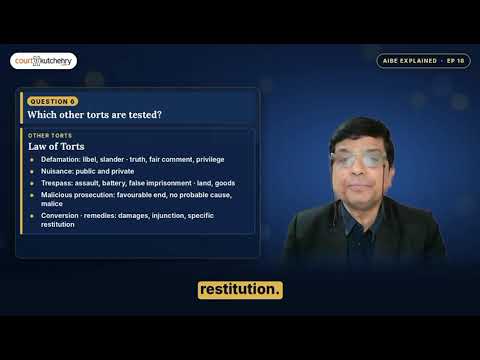
Q6. Defamation, Nuisance, Trespass, Malicious Prosecution and Remoteness
- Defamation: a false statement lowering a person’s reputation; libel is permanent, slander is spoken; truth, fair comment and privilege are defences.
- Nuisance: unlawful interference with the use or enjoyment of land (private) or with the public at large (public).
- Trespass: direct, unjustified interference with land, goods or the person; it is actionable per se.
- Malicious prosecution: a prosecution by the defendant, without reasonable and probable cause, with malice, ending in the plaintiff’s favour and causing damage.
- Remoteness of damage: the defendant is liable only for damage of a kind that was reasonably foreseeable. That is the test in The Wagon Mound (1961).
Q7. Motor Accident Claims Under the Motor Vehicles Act, 1988
- Claims Tribunals are constituted under Section 165.
- Fault-based claims are filed under Section 166. The 2019 amendment introduced a six-month limit for filing a claim petition from the date of the accident.
- No-fault compensation (Section 164): ₹5 lakh for death and ₹2.5 lakh for grievous hurt, without the claimant having to prove wrongful act or negligence.
- Hit-and-run (Section 161): ₹2 lakh for death and ₹50,000 for grievous hurt.
- Compulsory third-party insurance: Section 146.
- Insurer’s duty and limited defences: these were in Section 149 and, after the 2019 amendment took effect, are in Section 150. The insurer can avoid liability only on the defences the statute allows.
For death cases, Sarla Verma v. Delhi Transport Corporation, (2009) 04 SC CK 0222 fixed the multiplier table by age and the deduction for personal expenses. A Constitution Bench in National Insurance Company Ltd. v. Pranay Sethi, (2017) 10 SC CK 0044 added future prospects for both salaried and self-employed victims and standardised the conventional heads: loss of estate, loss of consortium and funeral expenses.
Q8. The Consumer Protection Act, 2019
- Pecuniary jurisdiction (based on the value of goods or services paid as consideration): District Commission up to ₹50 lakh; State Commission above ₹50 lakh and up to ₹2 crore; National Commission above ₹2 crore.
- A complaint may be filed where the complainant resides or personally works for gain, in addition to where the opposite party is located or the cause of action arose.
- Limitation: two years from the date the cause of action arose (Section 69).
- The Central Consumer Protection Authority (Section 10) acts against unfair trade practices and misleading advertisements.
In Indian Medical Association v. V.P. Shantha, (1995) 11 SC CK 0090, the Supreme Court held that services rendered by medical practitioners for a fee are “services” under the consumer law, so patients can approach consumer forums for medical negligence.
Key Takeaways
- The State is liable for non-sovereign functions (Vidhyawati, Nagendra Rao); Kasturilal applied sovereign immunity.
- Rylands v. Fletcher strict liability has exceptions; M.C. Mehta absolute liability has none.
- Negligence needs duty, breach and damage; res ipsa loquitur shifts the burden; doctors are judged by the Bolam test (Jacob Mathew).
- MV Act: no-fault ₹5 lakh / ₹2.5 lakh (Section 164); hit-and-run ₹2 lakh / ₹50,000 (Section 161); compensation under Sarla Verma and Pranay Sethi.
- Consumer Commissions: up to ₹50 lakh, up to ₹2 crore, above ₹2 crore; limitation two years.
Frequently Asked Questions
What is the difference between strict and absolute liability?
Strict liability under Rylands v. Fletcher admits exceptions such as act of God; absolute liability under M.C. Mehta admits none for hazardous enterprises.
Is the State liable for the torts of its employees?
Yes, for acts in non-sovereign functions. Sovereign immunity, applied in Kasturilal, has been considerably narrowed since N. Nagendra Rao.
How much no-fault compensation is payable for a death in a motor accident?
₹5 lakh under Section 164 of the Motor Vehicles Act, and ₹2.5 lakh for grievous hurt.
Can a patient file a consumer complaint against a doctor?
Yes, for paid medical services, following Indian Medical Association v. V.P. Shantha.
Where can I watch the full explanation?
Watch the full explanation in 11 minutes: https://youtu.be/zbukCd--TU0.
Conclusion
Torts is a subject of principles and cases. Learn each maxim with its case, the steps of State liability, strict and absolute liability, and the elements of negligence.
Add the numbers from the Motor Vehicles Act and the Consumer Protection Act, and these 5 marks are within reach. The next episode covers Arbitration and ADR.
Research Judgments Like These on CourtKutchehry
Every judgment cited in this article, and lakhs more, can be searched and read on CourtKutchehry. Searching and reading judgments is free. A membership adds unlimited summaries, all related judgments, original court PDF downloads, bookmarks, notes and the CourtKutchehry AI assistant.
| Membership | Price | Works out to | AI credits |
|---|---|---|---|
| Monthly (1 month) | ₹599 | ₹599 / month | 1,000 / month |
| Quarterly (3 months) · Save 16% | ₹1,499 | ₹499.67 / month | 1,100 / month |
| Six-monthly (6 months) · Save 33% | ₹2,399 | ₹399.83 / month | 1,200 / month |
| Yearly (12 months) · Save 44% · Best value | ₹3,999 | ₹333.25 / month | 1,300 / month |
Every plan is a one-off purchase for a fixed period: nothing auto-renews and no card is kept on file. Prices are exclusive of applicable tax, which is added at checkout. Extra AI chat credits can be topped up from ₹99. A free verified account gets 5 summaries and 50 AI trial credits.
Prices are as displayed on courtkutchehry.com on 20 November 2026 and are subject to change without notice. Please check the pricing page for the current plans and offers.
For more judgments, legal opinions and case analysis, visit courtkutchehry.com
Visit CourtKutchehry →