

COURTKUTCHEHRY SPECIAL SERIES ON LANDMARKS JUDGEMENTS ON WILLS, CODICIL & PROBATE
Lakshmi Amma & Anr. v. Talengalanarayana Bhatta & Anr.: Supreme Court Declares Settlement Deed Void for Undue Influence
1955 Settlement Found Executed Under Infirmity of Mind
Trial Court’s Decree Restored, Beneficiary Failed to Dispel Suspicion
By Vishwas Kumar
New Delhi: March 30, 2026:
On 10 March 1970, the Supreme Court of India delivered a decisive judgment in Lakshmi Amma & Anr. v. Talengalanarayana Bhatta & Anr. (Civil Appeal No. 156 of 1967; (1970) 03 SC CK 0022), addressing the validity of a 1955 settlement deed that had deprived the testator’s wife and daughters of their rightful share. The case revolved around whether the deed was executed voluntarily or under undue influence.
The Trial Court had initially declared the deed void, finding that the executant was of infirm mind and that the transaction was unnatural, favouring one beneficiary while excluding close family members. However, the High Court reversed this decision, upholding the deed. The matter then reached the Supreme Court, where a Bench comprising Hon’ble Chief Justice J.C. Shah, Hon’ble Mr. Justice K.S. Hegde, and Hon’ble Mr. Justice A.N. Grover examined the circumstances in detail.
The apex court held that the settlement deed was indeed executed under undue influence, noting that the beneficiary had failed to discharge the heavy burden of suspicion surrounding the transaction. The Court emphasized that when a document appears unnatural—particularly when it deprives immediate family members—the beneficiary must provide convincing evidence to prove its fairness and voluntariness. In this case, such proof was lacking.
Consequently, the Supreme Court allowed the appeal, restoring the Trial Court’s decree and declaring the deed void. This ruling reinforced the principle that courts must scrutinize transactions that exclude natural heirs, especially when executed by persons of advanced age or infirmity, to prevent exploitation under the guise of legal instruments.
The judgment remains a significant precedent in Indian succession and property law, underscoring judicial vigilance against undue influence and protecting vulnerable individuals from unfair dispossession.
For More, Read Here the Summary of the Judgement from the Book: WILL WRITING SIMPLIFIED, read below or open page no 436, Chapter 14.1 in the book. (Online book purchase link available here on: Buy online: Amazon | Flipkart
|
|
Case Summary |
: |
Lakshmi Amma & Anr. v. Talengalanarayana Bhatta & Anr. |
|
|
Court |
: |
Supreme Court of India |
|
|
Citations |
: |
(1970) 03 SC CK 0022: Civil Appeal No. 156 of 1967. |
|
|
Link |
: |
|
|
|
Decided on |
: |
10 March 1970 |
|
|
Coram |
: |
Hon’ble Mr. Chef Justice J.C. Shah, Hon’ble Mr. Justice K.S. Hegde and Hon’ble Mr. Justice A.N. Grover. |
|
|
Relevant Paragraphs |
: |
Para Nos.2–12 |
1. Facts of the Case:
Narasimha Bhatta, an aged man of weak intellect suffering from diabetes, was taken by his grandson (respondent no.1) to Mangalore and induced to execute a deed of settlement (Ext. B-3) on 13 December 1955, transferring his entire property to the respondent, reserving only life interest and minor maintenance for his wife Lakshmi Amma. The plaintiff (through next friend) sought a declaration that the will (1955) and the settlement deed were invalid, having been obtained under undue influence when Narasimha Bhatta was mentally infirm. The trial court decreed the suit; the High Court reversed it; the widow and daughters appealed to the Supreme Court.
2. Law Points Involved:
Whether the deed of settlement was executed voluntarily by a person of sound disposing mind; burden of proof when the transaction appears unnatural or unconscionable; presumption of undue influence and requirement to dispel suspicion in gifts executed by aged or infirm persons in favour of beneficiaries who stood in a position of dominance or confidence.
3. Acts / Provisions / Articles Referred:
(i). Indian Evidence Act, 1872 – Sections 101-103 (burden of proof);
(ii). Indian Contract Act, 1872 – Section 16 (undue influence);
(iii). General principles relating to proof of voluntariness and free will in execution of deeds by persons of feeble mind.
4. Judgments Referred:
(i). Trial Court decree dated 31 March 1959 (held will and settlement invalid).
(ii). Kerala High Court judgment (reversing decree, holding deed spontaneous).
(iii). Supreme Court restored Trial Court’s decree.
5. Obiter Dicta:
Unnatural or unconscionable dispositions made by an aged and infirm person raise grave suspicion; when surrounding circumstances suggest want of free will, the onus lies on the beneficiary to prove voluntary and conscious execution. Mere attestation by doctors without proper examination of mental capacity cannot remove such suspicion.
6. Ratio Decidendi:
Where a transaction is unnatural, excludes natural heirs, and benefits the dominant party who arranged the execution, the burden shifts to the beneficiary to prove that the executant understood and voluntarily executed it. Failure to produce the draft, hospital records, or reliable evidence of mental soundness sustains the inference of undue influence and invalidity.
7. Final Ruling:
Appeal allowed; High Court judgment set aside; Trial Court decree restored. The deed of settlement (Ext. B-3) held invalid, being obtained under undue influence from an aged, infirm, and mentally weak person.
8. Gist / Dispute & Final Decision:
The dispute centered on whether the 1955 settlement deed was voluntary. The Supreme Court found that the document was executed under undue influence while the executant was of infirm mind; the transaction was unnatural, depriving wife and daughters. The beneficiary failed to dispel the heavy burden of suspicion. The appeal was accordingly allowed, restoring the trial court’s decree declaring the deed void.
Read full Judgement Here:
Lakshmi Amma & Anr. v. Talengalanarayana Bhatta & Anr.
Supreme Court of India
(1970) 03 SC CK 0022: Civil Appeal No. 156 of 1967.
You Can Also Purchase the Book from here on: Buy online: Amazon | Flipkart
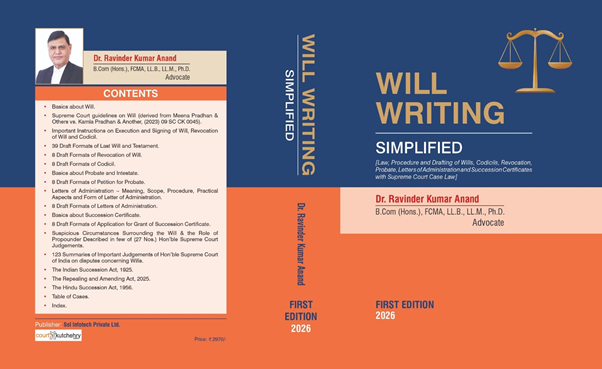
OUR RECOMMENDATION: Check out 123 Key Judgements, as highlighted in the book, WILL WRITING SIMPLIFIED, for the quick research and reference purposes. Click the link here: https://www.courtkutchehry.com/pages/blog/123-supreme-court-judgments-on-wills/
Keywords for Search Optimization
Lakshmi Amma v. Talengalanarayana Bhatta case, Supreme Court of India 1970 judgment, Civil Appeal No. 156 of 1967, Chief Justice J.C. Shah, Justice K.S. Hegde, Justice A.N. Grover, undue influence settlement deed, infirm mind property dispute, succession law India, void settlement deed Supreme Court.