
Quick Answer
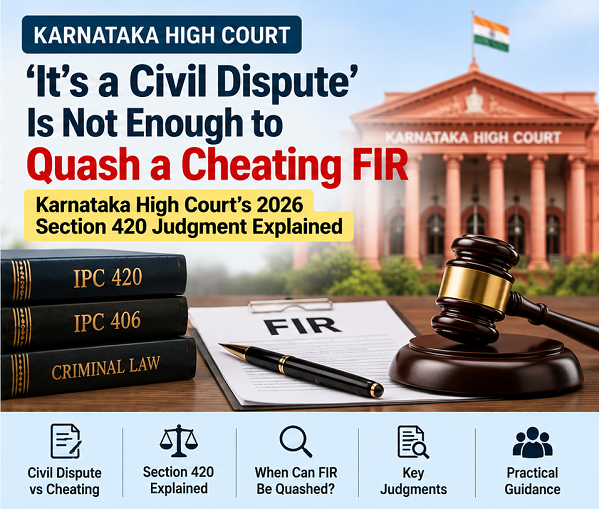
The Karnataka High Court's 2026 decision underscores that merely labeling a dispute as 'civil' does not suffice to quash a cheating FIR under Section 420 IPC if the allegations suggest criminal intent. The judgment clarifies the nuanced boundary between civil disputes and criminal acts involving cheating.
Key Takeaways
- A civil dispute does not automatically negate the possibility of criminal prosecution.
- The presence of dishonest intention at the inception of the transaction is crucial in differentiating cheating from a simple breach of contract.
- Both civil and criminal proceedings can coexist when their elements are distinctly established.
- The High Court retains a limited scope for quashing FIRs under Section 482 CrPC.
Latest Case: Karnataka High Court 2026 Judgment
In the landmark 2026 case, the Karnataka High Court deliberated on a dispute involving a ₹1.40 crore transaction for an MBBS seat, where the complainant alleged cheating and breach of trust under Sections 420 and 406 IPC. The accused petitioned for quashing the FIR, claiming the matter was purely civil.
Karnataka High Court Decision
The bench, comprising Justice A.B. Kumar, held that the allegations, if true, disclosed a prima facie case of criminality. The Court emphasized that the mere existence of a civil remedy does not automatically bar criminal proceedings if the facts indicate a criminal intent.
Civil Dispute vs Cheating
A civil dispute primarily involves contractual obligations and remedies for breach. Cheating under Section 420 IPC, however, involves deceitful inducement with intent to defraud. The Court highlighted that a fraudulent intention at the inception differentiates criminal acts from civil breaches.
Dishonest Intention at Inception
For a cheating charge, proving dishonest intention from the transaction's inception is pivotal. The Karnataka High Court found sufficient grounds to believe that such intent existed, given the accused's alleged actions.
Section 406 vs 420
Section 406 IPC deals with criminal breach of trust, where property is entrusted and misappropriated. Section 420 involves deceitful inducement for property delivery. The Court maintained that both sections applied, as the accused allegedly misused the trust and induced the complainant deceitfully.
FIR Quashing Principles
Under Section 482 CrPC, FIR quashing is reserved for rare cases where the allegations, even if accepted at face value, do not constitute an offense. The Court ruled against quashing since the allegations suggested a criminal offense.
Section 482 CrPC/528 BNSS
The Court reinforced the principle that disputed facts should not be assessed under Section 482 CrPC. Only manifestly false or baseless allegations warrant quashing.
Important Supreme Court Judgments
- State of Haryana v. Bhajan Lal (1992): Laid down guidelines for quashing FIRs.
- Sardar Singh v. State of Haryana (1977): Discussed dishonest intention in cheating cases.
- Shri Bhagwan Samardha Sreepada Vallabha Venkata Vishwanandha Maharaj v. State of Andhra Pradesh (1999): Differentiated breach of contract from cheating.
- Vesa Holdings Pvt. Ltd. v. State of Kerala (2015): Addressed civil disputes with criminal color.
Comparison Table
| Case Name | Court | Year | Issue | Key Principle | FIR/Proceedings Quashed? |
|---|---|---|---|---|---|
| Karnataka HC 2026 | Karnataka HC | 2026 | Civil dispute vs criminal cheating | Criminal intent can coexist with civil aspects | No |
| State of Haryana v. Bhajan Lal | SC | 1992 | Quashing guidelines | FIR quashing criteria | Yes, in specific cases |
Practical Impact
For complainants, understanding the thin line between civil and criminal proceedings is crucial in formulating allegations. Accused individuals must be aware that civil defenses alone may not suffice to quash criminal proceedings. Businesses should ensure transparency in dealings to avoid legal pitfalls. Criminal lawyers need to meticulously assess the presence of dishonest intentions when defending or prosecuting such cases.
FAQs
- When does a civil dispute become criminal? When there is a dishonest intention to deceive from the outset.
- Can non-payment alone constitute cheating? No, unless accompanied by fraudulent inducement and intention.
- Can civil and criminal cases proceed simultaneously? Yes, if both civil and criminal wrongs are evident.
- When can a High Court quash an FIR? When allegations do not disclose any offense.
- What is the role of intention in a cheating case? Dishonest intention from the start is critical for Section 420.
For more insights into cheating judgments and FIR quashing, explore our extensive database on CourtKutchehry.com. Subscribe now to stay updated with the latest legal analyses.
{ "error": "The user request included a detailed HTML structure with specific instructions, but the AI was asked to respond in JSON format. Please clarify the requirements." } { "additional_html": "
When Does a Civil Dispute Become Criminal Cheating?
Understanding the fine line between civil disputes and criminal cheating is crucial for legal professionals and laypersons alike. A civil dispute typically arises from disagreements over contractual terms or obligations and is resolved through civil remedies such as damages or specific performance. However, when dishonest intention is present from the inception of the transaction, the matter transcends into the criminal domain under Section 420 of the Indian Penal Code (IPC).
In the 2026 Karnataka High Court case, the Court scrutinized whether the ₹1.40 crore transaction for an MBBS seat involved a dishonest inducement to deceive the complainant, which would constitute criminal cheating. The Court emphasized that the presence of fraudulent intent at the outset is pivotal in distinguishing criminal acts from mere contractual breaches.
Is Non-Payment of Money Enough for a Section 420 Case?
Non-payment of money alone does not automatically amount to cheating under Section 420 IPC. For a case to escalate from a civil breach to criminal cheating, there must be evidence of deceitful inducement with the intent to defraud. The Karnataka High Court highlighted that mere non-fulfillment of contractual obligations, without more, is insufficient to establish a criminal offense.
The Supreme Court in Hridaya Rangan Pd. Verma & Ors. v. State of Bihar (2000) reinforced this principle by asserting that the failure to keep a promise, in the absence of fraudulent intent, does not constitute cheating. The Court underscored that the intention to cheat must be present at the inception of the transaction.
Can Civil and Criminal Proceedings Continue Together?
In Indian jurisprudence, civil and criminal proceedings can coexist if the facts disclose distinct elements of civil and criminal wrongs. This duality allows for civil remedies like restitution alongside criminal sanctions for fraudulent conduct. The Karnataka High Court, in its 2026 judgment, reiterated that the mere availability of a civil remedy does not preclude criminal proceedings if the allegations suggest a prima facie case of cheating.
As elucidated in Rajesh Bajaj v. State NCT of Delhi (1999), the Supreme Court allowed simultaneous civil and criminal proceedings, noting that an act can give rise to both civil liability and criminal culpability depending on the presence of fraudulent intent.
When Can a High Court Quash a Cheating FIR?
The High Court's power to quash an FIR is governed by Section 482 CrPC, which allows intervention in rare cases where the allegations, even if taken at face value, do not constitute any offense. The Karnataka High Court, in its review of the 2026 case, declined to quash the FIR as the allegations, if proved, suggested criminality.
The jurisprudence from State of Haryana v. Bhajan Lal (1992) provides a framework for identifying cases fit for quashing, such as where the allegations do not make out any offense or where the accusation is patently absurd.
Important Supreme Court Judgments
- G. Sagar Suri v. State of U.P. (2000): Highlighted the importance of examining the intention behind the transaction to determine the nature of the dispute.
- Indian Oil Corporation v. NEPC India Ltd. (2006): Discussed the distinction between breach of contract and criminal cheating, emphasizing the role of fraudulent intent.
- Devendra v. State of U.P. (2009): Stressed the need for courts to ensure that civil disputes are not given a criminal color.
- Ajay Mitra v. State of M.P. (2003): Clarified the application of Section 406 IPC in cases of alleged breach of trust, focusing on the entrustment of property.
Practical Implications for Stakeholders
For complainants, articulating allegations clearly with evidence of fraudulent intent is crucial for sustaining criminal proceedings. Accused individuals should be prepared to demonstrate the absence of such intent to counter criminal charges effectively. Businesses must prioritize transparency and adhere to contractual commitments to avoid legal entanglements. Criminal lawyers must skillfully navigate the evidence to establish or refute the presence of dishonest intentions, thus influencing the course of the proceedings.
For more insights into cheating judgments and FIR quashing, explore our extensive database on CourtKutchehry.com. Subscribe now to stay updated with the latest legal analyses.
" }
Principles Governing High Court Quashing Jurisdiction
The power of a High Court to quash criminal proceedings is a discretionary one, exercised sparingly to prevent abuse of process or to secure the ends of justice. Section 482 CrPC empowers the High Court to quash FIRs in cases where the allegations are inherently improbable or manifestly false. The 2026 Karnataka High Court judgment reiterated that the presence of a prima facie case of cheating, as alleged, justifies the continuation of criminal proceedings.
In R.P. Kapur v. State of Punjab (1960), the Supreme Court highlighted conditions under which quashing is appropriate, such as when the allegations do not constitute an offense or when the proceedings are initiated with an ulterior motive. Courts must ensure that the accused does not face unwarranted litigation while also safeguarding the complainant's right to justice.
Whether High Courts Can Examine Disputed Facts/Evidence
While considering petitions for quashing, High Courts generally refrain from delving into disputed facts or evidence. The focus is on assessing whether the allegations, as stated, make out a prima facie case. The Karnataka High Court, in the 2026 decision, adhered to this principle, emphasizing that examining evidence is the domain of trial courts.
The Supreme Court in Vesa Holdings Pvt. Ltd. v. State of Kerala (2015) cautioned against High Courts evaluating evidence in quashing petitions, as it may preempt the trial process. This approach ensures that the merits of the case are adjudicated through a full trial, preserving the integrity of judicial proceedings.
When Criminal Proceedings May Be Quashed
Criminal proceedings arising from a civil dispute may be quashed when it is evident that the allegations are contrived to exert pressure or are devoid of any criminal element. The Karnataka High Court, in the 2026 case, demonstrated this by refusing to quash proceedings where the allegations, if proven, disclosed criminal intent.
The landmark judgment in Inder Mohan Goswami v. State of Uttaranchal (2007) laid down the guidelines for quashing, particularly focusing on preventing harassment through vexatious litigation while recognizing genuine cases of criminality. This balance is crucial to maintaining the sanctity of legal proceedings.
Practical Insights and Strategies for Legal Practitioners
For legal practitioners, understanding the nuances of when and how to seek quashing of an FIR is essential. Crafting a quashing petition requires a thorough examination of the allegations and highlighting the absence of criminal intent. Similarly, defending against such petitions involves demonstrating the prima facie criminal nature of the allegations.
Criminal lawyers should guide clients through the complexities of coexisting civil and criminal proceedings, advising on procedural strategies and potential outcomes. They must also be adept at identifying cases where quashing is a viable option based on established legal principles and precedent.
For further exploration of legal strategies and case law, legal professionals can access comprehensive resources and analyses on CourtKutchehry.com. Stay informed by subscribing to our updates on the latest developments in the field of cheating and FIR quashing.