
Watch the Video
In this 12-minute video, the Hindi episode of Episode 27 of the CourtKutchehry series “AIBE Explained”, four special laws that protect children and women are explained in Hindi in four questions, followed by five practice questions in the style of past AIBE papers. This article is in English for Hindi-medium aspirants: exam-revision notes on each Act, the five judgments the episode discusses, and a table of Hindi and English legal terms. As in the episode, no party to any case involving a child is named.
Four Acts, One Episode
Special criminal laws are asked regularly under the criminal law heads of the AIBE. This Hindi episode takes four of them:
- the Juvenile Justice (Care and Protection of Children) Act, 2015 (किशोर न्याय अधिनियम);
- the Protection of Children from Sexual Offences Act, 2012 (POCSO);
- the Protection of Women from Domestic Violence Act, 2005 (घरेलू हिंसा अधिनियम); and
- the Dowry Prohibition Act, 1961 (दहेज प्रतिषेध अधिनियम).
Part 2, in the next episode, covers the Prevention of Corruption Act, the NDPS Act, the SC and ST (Prevention of Atrocities) Act and the Arms Act.
Q1. Juvenile Justice Act, 2015: The Child in Conflict with Law
A child (बालक) is a person below 18 years. The sections to remember:
- Section 4: the Juvenile Justice Board, of a Magistrate and two social workers, at least one of whom is a woman.
- Section 12: bail for a child in conflict with law.
- Section 15: preliminary assessment where a child aged 16 to 18 is alleged to have committed a heinous offence.
- Section 18: orders the Board may pass, including a stay in a special home for up to 3 years.
- Section 21: no child may be sentenced to death or to life imprisonment without the possibility of release.
- Section 94: determination of age.
Q2. POCSO Act, 2012
POCSO is gender-neutral: it protects every child, boy or girl. Its offences are arranged in pairs, an offence and its punishment:
| Offence | Defined in | Punished under |
|---|---|---|
| Penetrative sexual assault | Section 3 | Section 4 |
| Aggravated penetrative sexual assault | Section 5 | Section 6 |
| Sexual assault | Section 7 | Section 8 |
| Aggravated sexual assault | Section 9 | Section 10 |
| Sexual harassment | Section 11 | Section 12 |
| Using a child for pornographic purposes | Section 13 | Section 14 |
The 2019 amendment made the minimum punishments much stricter. Procedurally, reporting is mandatory (Section 19) and failure to report is an offence (Section 21); the court presumes the offence (Section 29) and the culpable mental state (Section 30); the child’s evidence is to be recorded within 30 days and the trial completed, as far as possible, within one year (Section 35); and the child’s identity must not be disclosed (Section 23).
In Attorney General for India v. Satish, (2021) 11 SC CK 0069, a three-judge Bench held that the key ingredient of sexual assault under Section 7 is sexual intent, and that “skin-to-skin” contact is not required.
Q3. Domestic Violence Act, 2005: Remedies
The Act gives civil remedies enforced through criminal law. The reliefs a Magistrate can grant run in a neat sequence:
- Section 18: protection order;
- Section 19: residence order;
- Section 20: monetary relief;
- Section 21: custody order;
- Section 22: compensation.
Breach of a protection order is an offence under Section 31.
Three Supreme Court decisions shape the Act:
- Hiral P. Harsora v. Kusum Narottamdas Harsora, (2016) 10 SC CK 0037: the words “adult male” in the definition of respondent were struck down, so women and minors can also be respondents.
- Satish Chander Ahuja v. Sneha Ahuja, (2020) 10 SC CK 0030: a three-judge Bench held that a shared household can include a house owned by the husband’s relatives where the woman lived in a domestic relationship.
- Prabha Tyagi v. Kamlesh Devi, (2022) 05 SC CK 0043: a woman in a domestic relationship can enforce her right to reside in the shared household even if she did not actually live there, and a Domestic Incident Report is not a precondition for the Magistrate to proceed.
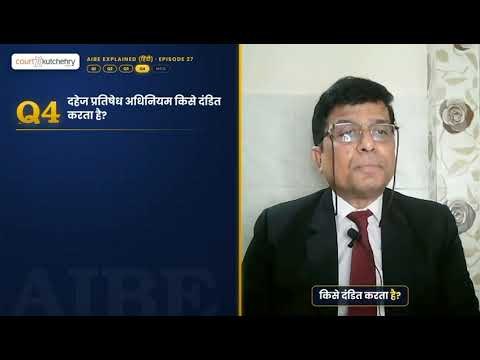
Q4. Dowry Prohibition Act, 1961
- Section 2 defines dowry; dower or mahr under Muslim personal law is excluded.
- Section 3: giving or taking dowry, punishable with a minimum of 5 years.
- Section 4: demanding dowry.
Related offences now sit in the new codes: dowry death is BNS Section 80 (old IPC 304B), with the presumption in BSA Section 118 (old Evidence Act 113B), and cruelty is BNS Sections 85 and 86 (old IPC 498A). In Arnesh Kumar v. State of Bihar, (2014) 07 SC CK 0068, the Supreme Court held that the police must not arrest automatically in such cases and must record reasons for the need to arrest.
Remember this line: DV Act reliefs are Sections 18 to 22, in the order protection, residence, money, custody, compensation.
Key Legal Terms: Hindi ↔ English
| Hindi | English |
|---|---|
| किशोर न्याय बोर्ड | Juvenile Justice Board |
| विधि से संघर्षरत बालक | Child in conflict with law |
| जघन्य अपराध | Heinous offence |
| प्रारंभिक आकलन | Preliminary assessment |
| आयु निर्धारण | Determination of age |
| विशेष गृह | Special home |
| लिंग-निरपेक्ष | Gender-neutral |
| उपधारणा | Presumption |
| संरक्षण आदेश | Protection order |
| निवास आदेश | Residence order |
| धनीय अनुतोष | Monetary relief |
| दहेज मृत्यु | Dowry death |
Key Takeaways
- JJ Act: child below 18; Board under Section 4; preliminary assessment for 16–18 in heinous offences (Section 15); no death or life without release (Section 21).
- POCSO is gender-neutral; offences in Sections 3, 5, 7, 9, 11 and 13; presumptions in Sections 29 and 30; 30 days and one year under Section 35.
- Sexual intent, not skin-to-skin contact, decides sexual assault (Attorney General v. Satish).
- DV Act reliefs: Sections 18 to 22; “adult male” struck down (Hiral Harsora); in-laws’ house can be a shared household (Satish Chander Ahuja).
- Dowry: minimum 5 years for giving or taking (Section 3); dowry death is BNS 80, cruelty BNS 85 and 86.
Frequently Asked Questions
Is this episode in Hindi?
Yes. The video is in Hindi and this article is in English. The English version of Episode 27 is linked above.
Can a child of 16 be tried as an adult?
Only for a heinous offence, and only after a preliminary assessment by the Juvenile Justice Board under Section 15. Even then, Section 21 bars a death sentence or life imprisonment without the possibility of release.
Is POCSO only for girls?
No. POCSO is gender-neutral and protects every person below 18.
Can a woman be a respondent under the DV Act?
Yes. After Hiral P. Harsora (2016), the words “adult male” no longer appear in the definition of respondent.
Is mahr dowry?
No. Section 2 of the Dowry Prohibition Act excludes dower or mahr under Muslim personal law.
Where can I watch the video?
Watch the 12-minute Hindi episode here: https://youtu.be/wlJWElmt0jc.
Conclusion
These four Acts are favourites in the AIBE because each has a small set of section numbers that carry most of the questions: Sections 4, 15, 21 and 94 of the JJ Act; the paired offences and Sections 29, 30 and 35 of POCSO; Sections 18 to 22 of the DV Act; and Sections 2, 3 and 4 of the Dowry Prohibition Act.
Learn them with the five judgments above, and use the term table to move easily between the Hindi and English forms.
▶ Watch the video: विशेष आपराधिक कानून भाग 1: किशोर न्याय, POCSO, घरेलू हिंसा और दहेज प्रतिषेध | AIBE (हिंदी) Ep 27
▶ Watch in English: Special Criminal Laws Part 1: Juvenile Justice Act, POCSO, Domestic Violence Act Ep 27
📖 Read the full article: Juvenile Justice Act, POCSO, Domestic Violence Act and Dowry Prohibition Act for AIBE: Key Sections and Cases Explained (Ep 27)
Research Judgments Like These on CourtKutchehry
Every judgment cited in this article, and lakhs more, can be searched and read on CourtKutchehry. Searching and reading judgments is free. A membership adds unlimited summaries, all related judgments, original court PDF downloads, bookmarks, notes and the CourtKutchehry AI assistant.
| Membership | Price | Works out to | AI credits |
|---|---|---|---|
| Monthly (1 month) | ₹599 | ₹599 / month | 1,000 / month |
| Quarterly (3 months) · Save 16% | ₹1,499 | ₹499.67 / month | 1,100 / month |
| Six-monthly (6 months) · Save 33% | ₹2,399 | ₹399.83 / month | 1,200 / month |
| Yearly (12 months) · Save 44% · Best value | ₹3,999 | ₹333.25 / month | 1,300 / month |
Every plan is a one-off purchase for a fixed period: nothing auto-renews and no card is kept on file. Prices are exclusive of applicable tax, which is added at checkout. Extra AI chat credits can be topped up from ₹99. A free verified account gets 5 summaries and 50 AI trial credits.
Prices are as displayed on courtkutchehry.com on 20 November 2026 and are subject to change without notice. Please check the pricing page for the current plans and offers.
For more judgments, legal opinions and case analysis, visit courtkutchehry.com
Visit CourtKutchehry →