
Watch the Video
In this 10-minute video, Episode 27 of the “AIBE Explained” series, the episode covers four special statutes protecting children and women that appear regularly in the AIBE under the criminal law heads: the Juvenile Justice (Care and Protection of Children) Act, 2015, the Protection of Children from Sexual Offences Act, 2012 (POCSO), the Protection of Women from Domestic Violence Act, 2005 and the Dowry Prohibition Act, 1961. He takes them in four questions and then solves five practice questions in the style of past papers. As in the video, this article explains only the law, and no party to any case is named where a child is involved.
Four Laws Protecting Children and Women
These four Acts share a pattern. Each creates a special forum or a special procedure, and each departs from the ordinary criminal law in some way: a different idea of punishment for children, presumptions against the accused in POCSO, a civil remedy backed by criminal enforcement for domestic violence, and a minimum sentence for dowry. The AIBE tests exactly these departures.
Q1: The Juvenile Justice Act, 2015
Who is a child?
Under the Act, a child is a person who has not completed 18 years of age. A “child in conflict with law” is one alleged or found to have committed an offence while below 18.
How is the child dealt with?
- Juvenile Justice Board (Section 4): a Metropolitan Magistrate or Judicial Magistrate of the first class (the Principal Magistrate) and two social workers, at least one of whom is a woman.
- Bail is the rule (Section 12): a child shall be released, with or without surety, unless release is likely to bring the child into association with known criminals, expose the child to moral, physical or psychological danger, or defeat the ends of justice.
- Age determination (Section 94): the Board relies first on school certificates or a birth certificate, and an ossification or other medical age test only where these are not available.
- Heinous offences by children aged 16 to 18 (Section 15): the Board makes a preliminary assessment of the child’s mental and physical capacity and ability to understand the consequences, and may then transfer the case to the Children’s Court for trial as an adult.
- Sentencing limits (Section 21): no child in conflict with law can be sentenced to death or to life imprisonment without the possibility of release.
- Special home (Section 18): where the Board finds the offence proved, it may send the child to a special home for at most three years.
Q2: What Does the POCSO Act Provide?
POCSO is gender-neutral: a child is any person below 18, and the Act protects boys and girls alike.
| Section | Offence |
|---|---|
| 3 (punished under 4) | Penetrative sexual assault |
| 5 (punished under 6) | Aggravated penetrative sexual assault |
| 7 (punished under 8) | Sexual assault |
| 9 (punished under 10) | Aggravated sexual assault |
| 11 (punished under 12) | Sexual harassment |
| 13 (punished under 14) | Using a child for pornographic purposes |
The 2019 amendment raised the minimum punishments. Penetrative sexual assault now carries at least 10 years (at least 20 years where the child is below 16), and aggravated penetrative sexual assault at least 20 years, extendable to imprisonment for the remainder of natural life, or death.
Procedure and presumptions
- Mandatory reporting (Sections 19, 21): anyone who knows or apprehends that an offence has been committed must report it to the Special Juvenile Police Unit or the local police; failure to report is itself punishable.
- Child’s identity protected (Section 23): the media cannot disclose the child’s name, address, school or any other detail that could identify the child.
- Presumption of guilt (Section 29): in a prosecution under Sections 3, 5, 7 and 9, the Special Court shall presume that the accused committed the offence unless the contrary is proved.
- Culpable mental state (Section 30): where the offence requires a culpable mental state, the court presumes it, and the accused must prove its absence beyond reasonable doubt.
- Speed (Section 35): the child’s evidence is to be recorded within 30 days of the Special Court taking cognizance, and the trial completed, as far as possible, within one year.
In Attorney General for India vs Satish, (2021) 11 SC CK 0069, a three-judge bench held that the most important ingredient of sexual assault under Section 7 is sexual intent, not “skin-to-skin” contact. A narrow reading that required direct physical contact would defeat the purpose of the Act.
Q3: Remedies Under the Domestic Violence Act, 2005
The DV Act is a civil law with criminal enforcement. The aggrieved woman applies to a Magistrate for civil reliefs, and breach of the Magistrate’s order is an offence.
Who can be a respondent?
Section 2(q) originally limited respondents to an “adult male”. In Hiral P. Harsora vs Kusum Narottamdas Harsora, (2016) 10 SC CK 0037, the Supreme Court struck down the words “adult male”. Since 2016, female relatives and others in the domestic relationship can also be respondents.
The five reliefs
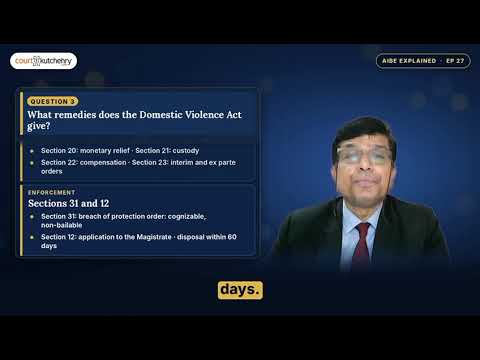
- Protection order (Section 18): prohibits acts of domestic violence, contact or communication.
- Residence order (Section 19): secures the woman’s right to live in the shared household.
- Monetary relief (Section 20): expenses, loss of earnings, medical expenses and maintenance.
- Custody order (Section 21): temporary custody of children.
- Compensation (Section 22): for injuries, including mental torture and emotional distress.
Breach of a protection order is an offence under Section 31.
The shared household
In Satish Chander Ahuja vs Sneha Ahuja, (2020) 10 SC CK 0030, a three-judge bench held that a “shared household” is the household where the woman lives or has lived in a domestic relationship, and it can include a house owned by the husband’s relatives; the husband need not own it. In Prabha Tyagi vs Kamlesh Devi, (2022) 05 SC CK 0043, the Court held that a woman in a domestic relationship can enforce her right to reside in the shared household even if she did not actually live there, and that a Domestic Incident Report is not a precondition for the Magistrate to proceed.
Q4: What Does the Dowry Prohibition Act Punish?
- Definition (Section 2): dowry is property or valuable security given or agreed to be given in connection with the marriage. Dower or mahr under Muslim personal law is excluded.
- Giving or taking dowry (Section 3): imprisonment of at least five years and a fine of at least ₹15,000 or the value of the dowry, whichever is more.
- Demanding dowry (Section 4): imprisonment of at least six months, extendable to two years, and a fine up to ₹10,000.
Under the BNS and BSA
- Dowry death: BNS Section 80 (old IPC 304B). Where a woman dies of burns or bodily injury, or otherwise than in normal circumstances, within seven years of marriage, and it is shown that soon before her death she was subjected to cruelty or harassment for dowry, the husband or relative is deemed to have caused her death. Punishment: at least seven years, extendable to life.
- Presumption: BSA Section 118 (old Evidence Act 113B). The court shall presume dowry death once these facts are shown.
- Cruelty: BNS Sections 85 and 86 (old IPC 498A).
In Arnesh Kumar vs State of Bihar, (2014) 07 SC CK 0068, the Supreme Court held that the police must not arrest automatically in cases under Section 498A or other offences punishable with up to seven years. They must record reasons under the arrest checklist (then CrPC Section 41, now BNSS Section 35), and the Magistrate must be satisfied before authorising detention.
Remember this line: JJ Act protects the child who offends; POCSO protects the child who is harmed.
Key Takeaways
- A child is below 18 under both the JJ Act and POCSO. Under the JJ Act, bail is the rule, there is no death or life without release, and a special home is for at most three years.
- POCSO is gender-neutral, reverses the burden through Sections 29 and 30, and requires evidence within 30 days and trial within one year.
- The DV Act gives five civil reliefs (Sections 18 to 22); since Hiral Harsora (2016), women can also be respondents.
- Giving or taking dowry carries at least five years; dowry death is BNS 80 with the BSA 118 presumption; cruelty is BNS 85 and 86.
- Arnesh Kumar bars automatic arrests in 498A cases.
Frequently Asked Questions
Can a child aged 16 be tried as an adult?
Only for a heinous offence, and only after the Juvenile Justice Board’s preliminary assessment under Section 15. Even then, there can be no death sentence or life imprisonment without the possibility of release.
Is POCSO only for girls?
No. POCSO is gender-neutral and protects every person below 18.
Can a woman be a respondent under the Domestic Violence Act?
Yes. After Hiral P. Harsora (2016), a respondent need not be an adult male.
Is mahr dowry?
No. Section 2 of the Dowry Prohibition Act excludes dower or mahr under Muslim personal law.
What is the new section for dowry death?
BNS Section 80, which replaces IPC Section 304B. The presumption is in BSA Section 118 (old Section 113B).
Where can I watch the full explanation?
Watch the full explanation in 10 minutes: https://youtu.be/wxTSS8gFJ8Q.
Conclusion
The four Acts in this episode are protective laws, and the AIBE asks about the protections: the composition of the Board, the presumptions in POCSO, the five DV reliefs and the minimum sentence for dowry. Learn the section numbers with their one-line meaning and these questions become straightforward.
The next episode completes the special criminal laws with the Prevention of Corruption Act, the NDPS Act, the SC and ST (Prevention of Atrocities) Act and the Arms Act.
▶ Watch the video: Special Criminal Laws Part 1: Juvenile Justice Act, POCSO, Domestic Violence Act Ep 27
📖 Read more: Delhi High Court: Wife’s Right to Residence Under Domestic Violence Act Valid Even Without Maintenance
Research Judgments Like These on CourtKutchehry
Every judgment cited in this article, and lakhs more, can be searched and read on CourtKutchehry. Searching and reading judgments is free. A membership adds unlimited summaries, all related judgments, original court PDF downloads, bookmarks, notes and the CourtKutchehry AI assistant.
| Membership | Price | Works out to | AI credits |
|---|---|---|---|
| Monthly (1 month) | ₹599 | ₹599 / month | 1,000 / month |
| Quarterly (3 months) · Save 16% | ₹1,499 | ₹499.67 / month | 1,100 / month |
| Six-monthly (6 months) · Save 33% | ₹2,399 | ₹399.83 / month | 1,200 / month |
| Yearly (12 months) · Save 44% · Best value | ₹3,999 | ₹333.25 / month | 1,300 / month |
Every plan is a one-off purchase for a fixed period: nothing auto-renews and no card is kept on file. Prices are exclusive of applicable tax, which is added at checkout. Extra AI chat credits can be topped up from ₹99. A free verified account gets 5 summaries and 50 AI trial credits.
Prices are as displayed on courtkutchehry.com on 20 November 2026 and are subject to change without notice. Please check the pricing page for the current plans and offers.
For more judgments, legal opinions and case analysis, visit courtkutchehry.com
Visit CourtKutchehry →