
COURTKUTCHEHRY EXCLUSIVE: EXTRACTS FROM BEST SELLING BOOK: WILL WRITING SIMPLIFIED
Supreme Court Clarifies Suspicious Circumstances in Wills: Indu Bala Bose v. Manindra Chandra Bose
Court rules that illness, family disputes, and witness inconsistencies do not automatically invalidate a Will.
The 1981 judgment reinforces testamentary freedom and sets clear standards for evaluating suspicious circumstances.
By Vishwas Kumar
New Delhi: April 02, 2026:
Inheritance disputes often arise when family members question the authenticity of a Will. Was the testator of sound mind? Did someone exert undue influence? Were witnesses credible? These questions frequently reach the courts, where judges must balance scepticism with fairness.
Supreme Court rulings on will validity
In Indu Bala Bose & Ors. v. Manindra Chandra Bose & Anr. (1981) [Read complete judgement here: https://www.courtkutchehry.com/judgements/670428/indu-bala-bose-and-others-vs-manindra-chandra-bose-and-anoth/] , the Supreme Court of India addressed these issues head-on. The case involved allegations of illness, concealment, and unfair bequests. The Court’s ruling clarified what counts as a “suspicious circumstance” and emphasized that not every irregularity undermines a Will.
This article explains the case in plain language, situates it within the legal framework, and explores its implications for families and society.
Detailed Explanation of the Extract
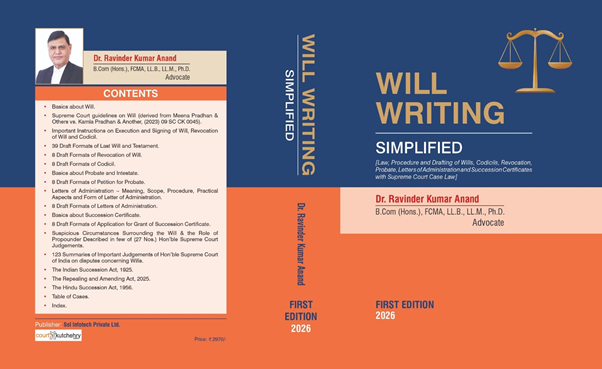
The extract from Will Writing Simplified by Dr. Ravinder Kumar Anand [📘 Buy Will Writing Simplified by Dr. Ravinder Kumar Anand online: Amazon | Flipkart ] highlights the suspicious circumstances alleged and the Court’s observations. Here is a breakdown:
- Testator’s Illness: Allegations of incapacity due to high blood pressure, diabetes, and kidney trouble were rejected. Medical evidence showed he was not in coma, could talk normally, and died suddenly eight days later. The Court held there was no proof of lack of testamentary capacity.
- Concealment of Illness: The Court found no concealment. The illness was known, treated, and the doctor was examined.
- Failure to Mention Drafting Dates: Witnesses could not recall exact dates after 13 years. The Court said these were minor lapses, not suspicious.
- Non-examination of Certain Witnesses: The Court held it was unnecessary to examine every possible witness. Evidence on record was sufficient.
- Witnesses Being Friends or Relatives: The Court said this was natural. People usually call known persons, not strangers, to witness a Will.
- Propounder’s Inconsistent Statement: The propounder claimed he learned of the Will days later, while others knew earlier. The Court found this trivial.
- Propounder’s Evidence Partly False: Even if partly incorrect, it did not affect genuineness since execution and attestation were proved by others.
- Non-production of Draft or Diary: The Court said there was no rule requiring preservation of drafts for 13 years.
- Fairness of Bequest: The Will gave half to the brother for life and half to the nephew. The Court found this fair, reflecting family arrangements amid disputes.
- Propounder Benefiting: Though he benefited, there was no evidence of undue influence.
- Onus of Proof: The Court reiterated: “Where there are suspicious circumstances, the onus is on the propounder to explain them to the satisfaction of the court before it accepts the will as genuine.”
- Definition of Suspicious Circumstance: “A circumstance is ‘suspicious’ when it is not normal or not expected in a normal situation.”
- Judicial Approach: “Rules enjoin a reasonable scepticism, not obdurate disbelief. The judge is never required to close his mind to the truth.”
- Final Finding: “No suspicious circumstance surrounds the execution of the will. The High Court rightly granted probate.”
Legal Context
- Indian Succession Act, 1925:
- Section 63 requires a Will to be signed by the testator and attested by two witnesses.
- Section 68 of the Evidence Act requires at least one attesting witness to prove execution.
- Doctrine of Suspicious Circumstances:
- The Court reaffirmed that the propounder must dispel doubts when circumstances appear unusual.
- Judicial Approach:
- Judges must apply “reasonable scepticism” but not reject Wills based on trivial inconsistencies.
Case Studies & Examples
- Hypothetical Example: Suppose a man suffering from diabetes writes a Will leaving property to his nephew. His children argue he was too ill. If medical evidence shows he was alert, the Will will likely be upheld, following Indu Bala Bose.
- Real Case Reference: In this case, despite illness and minor inconsistencies, the Court upheld the Will because execution and attestation were proved and the bequest was fair.
Historical & Comparative Context
- Evolution in India: Earlier cases like Venkatachala Iyengar stressed vigilance in suspicious Wills. This case refined the principle, clarifying that illness or family disputes do not automatically invalidate a Will.
- Comparison with England: English courts also scrutinize suspicious circumstances but emphasize fairness. Indian courts, however, highlight cultural norms, such as calling relatives to witness Wills.
Implications for Society, Families, and Courts
- For Families: The case shows that illness or family disputes do not necessarily invalidate a Will. Transparency and credible witnesses matter more.
- For Courts: The judgment emphasizes balanced scepticism — neither blind acceptance nor rigid disbelief.
- For Society: Encourages individuals to draft Wills clearly, involve trusted witnesses, and avoid secrecy.
FAQ Section
1. Does illness make a Will invalid?
No. As long as the testator is of sound mind, illness does not invalidate a Will.
2. Must all witnesses be examined?
No. Courts require sufficient evidence, not examination of every possible witness.
3. Can relatives or friends be witnesses?
Yes. It is natural to call known persons to witness a Will.
4. What if the propounder benefits from the Will?
Benefit alone does not prove undue influence. Evidence of coercion is required.
5. What is a suspicious circumstance?
Anything unusual or unexpected, such as secrecy, unfair exclusion, or contradictory testimony.
6. How should judges approach suspicious Wills?
With reasonable scepticism, not rigid disbelief.
7. What was the Court’s final finding in this case?
That no suspicious circumstance surrounded the Will, and probate was rightly granted.
Conclusion
The Indu Bala Bose v. Manindra Chandra Bose case remains a landmark in Indian succession law. It clarified that illness, minor inconsistencies, or relatives as witnesses do not automatically invalidate a Will. The ruling emphasized testamentary freedom, balanced scepticism, and fairness.
For families, the case underscores the importance of drafting Wills transparently and involving credible witnesses. For courts, it reinforces vigilance without rigidity. Ultimately, the judgment ensures that genuine Wills reflecting the testator’s intent are respected.
Book Reference
📘 Buy Will Writing Simplified by Dr. Ravinder Kumar Anand online: Amazon | Flipkart
Sentences Used from the Extract
- “Medical evidence showed the testator was not in coma, could talk normally, and died suddenly eight days later. The Court held there was no proof of lack of testamentary capacity.”
- “The Court found no concealment; the illness was known, treated, and the doctor was examined.”
- “Non-production of draft or diary was not suspicious nor mandatory.”
- “The Court said there was no necessity to examine all witnesses; evidence on record sufficiently proved execution and attestation.”
- “The Court held this was natural and normal—no one invites strangers to witness a will.”
- “The Court found this inconsistency trivial, possibly to avoid cross-examination; not a ground to doubt genuineness.”
- “Even if partly incorrect, it did not affect genuineness of execution and attestation proved by other witnesses.”
- “Will was fair and natural—half to brother for life, half to nephew; reflected family arrangement amid disputes.”
- “Though propounder received benefit, no evidence of undue influence or coercion; will was executed voluntarily.”
- “Where there are suspicious circumstances, the onus is on the propounder to explain them to the satisfaction of the court before it accepts the will as genuine.”
- “A circumstance is ‘suspicious’ when it is not normal or not expected in a normal situation.”
- “Rules enjoin a reasonable scepticism, not obdurate disbelief. The judge is never required to close his mind to the truth.”
- “No suspicious circumstance surrounds the execution of the will. The High Court rightly granted probate.”
Suggested Keywords for SEO
- Will disputes in India
- Supreme Court Will judgment
- Indu Bala Bose case
- Suspicious circumstances in Wills
- Indian Succession Act Will validity
- Testamentary freedom India
- Probate of Wills India
- Will writing simplified India