
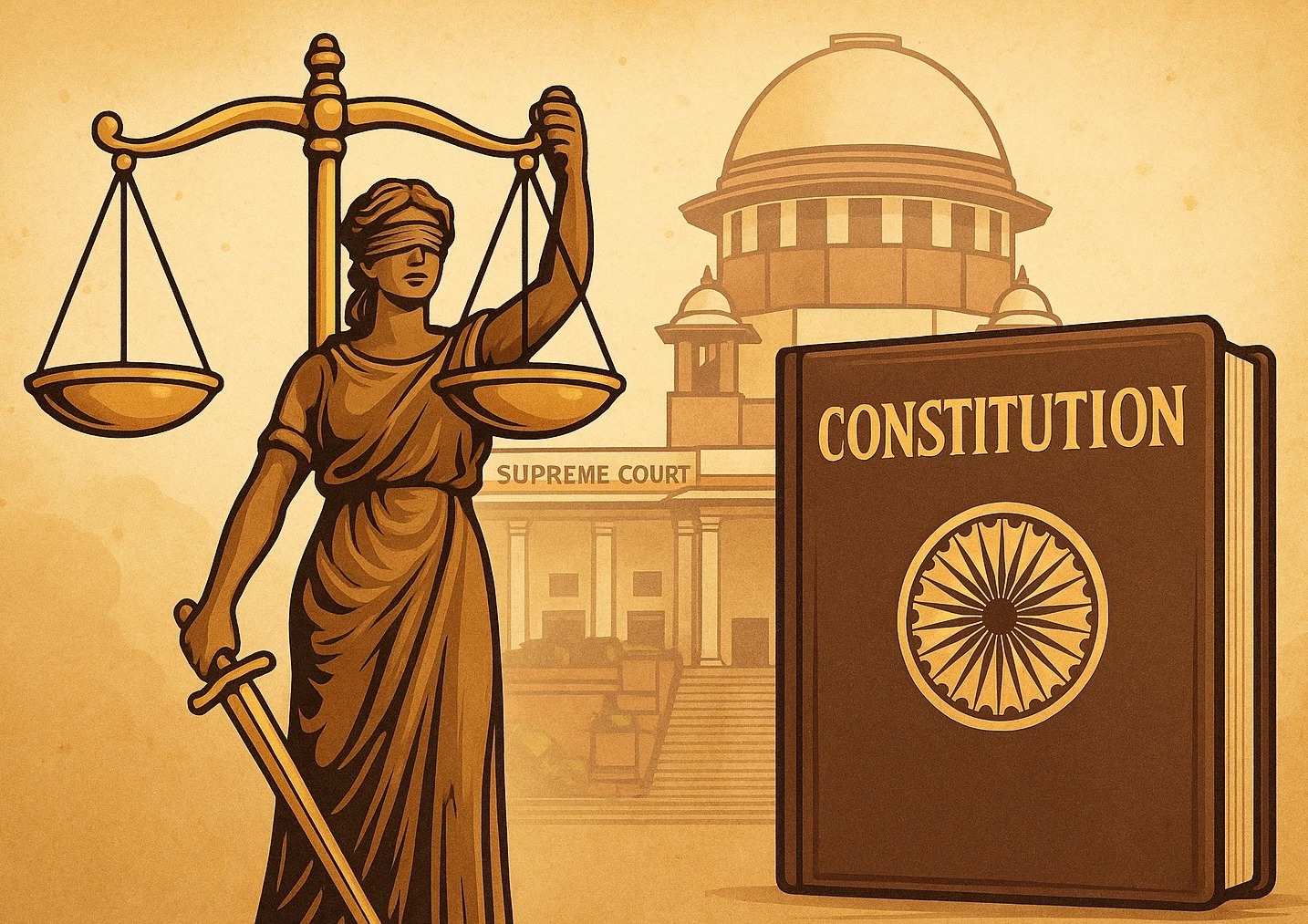
India’s Constitutional Journey: From 1950 to the Digital Age
Seventy‑six years on, India’s Constitution faces its greatest test in the era of technology.
From landmark amendments to digital rights, how the world’s longest written constitution continues to evolve.
By Vishwas Kumar
New Delhi: June 04, 2026:
On January 26, 1950, India stepped into history with a Constitution that was both ambitious and unprecedented. Drafted by the Constituent Assembly under the leadership of Dr. B.R. Ambedkar, it was designed to hold together a nation of immense diversity. At 395 Articles and 12 Schedules, it became the longest written constitution in the world, embodying ideals of sovereignty, democracy, secularism, and social justice.
The guarantee of equality before law and equal protection of laws forms the foundation of constitutional governance in India. Readers interested in understanding the scope of fundamental rights, judicial review, and the doctrine of non-arbitrariness can explore our detailed analysis on Article 14 in Constitution of India, which examines landmark Supreme Court judgments and their continuing impact on Indian constitutional law.
Over the decades, the Constitution has been amended more than 100 times, reflecting India’s evolving political, social, and economic realities. From land reforms in the 1950s to the sweeping changes of the Emergency in the 1970s, and more recently, the introduction of GST and the abrogation of Article 370, the document has remained dynamic.
Today, however, India’s Constitution faces challenges unlike any before. The digital age has brought questions of privacy, surveillance, free speech, and data protection to the forefront. Landmark Supreme Court rulings, such as the recognition of privacy as a fundamental right in 2017, show how constitutional principles are being reinterpreted for a new era.
This article traces India’s constitutional journey—its origins, landmark amendments, judicial interpretations, and the pressing challenges of governing in a digital democracy.
Section 1: Origins of the Indian Constitution (500 words)
The drafting of the Indian Constitution was a monumental exercise. The Constituent Assembly, formed in 1946, debated for nearly three years before finalizing the document. Dr. B.R. Ambedkar, as Chairman of the Drafting Committee, played a pivotal role in shaping its provisions.
The Constitution drew inspiration from multiple sources: the British parliamentary system, the US Bill of Rights, the Irish Directive Principles of State Policy, and the Canadian federal structure. Yet, it was uniquely Indian, designed to balance unity with diversity.
Key features included universal adult franchise, fundamental rights, directive principles, and a federal system with a strong center. The framers envisioned a document that could adapt to India’s vast linguistic, cultural, and religious diversity.
Early challenges included integrating princely states, managing linguistic demands, and balancing economic planning with democratic freedoms. The Constitution provided the framework for India’s transformation from a colonial economy to a modern democracy.
Section 2: Landmark Amendments
The Constitution’s flexibility is evident in its amendments. The First Amendment (1951) introduced restrictions on free speech and enabled land reforms, reflecting the tension between individual rights and social justice.
The 42nd Amendment (1976), passed during the Emergency, is often called the “mini‑Constitution.” It expanded state power, curtailed judicial review, and added the words “socialist” and “secular” to the Preamble.
The 73rd and 74th Amendments (1992) decentralized governance, empowering Panchayati Raj institutions and municipalities. These reforms brought democracy closer to the grassroots.
Recent amendments include the GST Amendment (2016), which created a unified tax regime, and the abrogation of Article 370 (2019), which revoked Jammu & Kashmir’s special status.
Globally, India’s amendment process is more flexible than the US, where constitutional changes are rare, and more structured than the UK, which lacks a single written constitution.
Section 3: Supreme Court & Constitutional Interpretation
The Supreme Court has been the guardian of the Constitution, interpreting its provisions to meet contemporary challenges.
The Kesavananda Bharati case (1973) established the basic structure doctrine, ruling that Parliament cannot alter the Constitution’s core principles. This landmark judgment preserved democracy during turbulent times.
The Maneka Gandhi case (1978) expanded Article 21, interpreting the right to life and liberty to include due process. This broadened the scope of fundamental rights.
The Puttaswamy case (2017) recognized privacy as a fundamental right, a milestone in adapting constitutional values to the digital age.
Through judicial review, the Supreme Court has balanced state power with individual freedoms, ensuring the Constitution remains a living document.
Section 4: Constitution in the Digital Age
The digital revolution has created new constitutional challenges. Issues of data protection, surveillance, and online free speech dominate debates.
India’s Digital Personal Data Protection Act (2023) seeks to regulate data collection and usage, drawing comparisons with the EU’s GDPR. While GDPR is considered more stringent, India’s law reflects its unique socio‑economic context.
Social media regulation raises questions about censorship and free speech under Article 19(1)(a). Courts must balance national security with individual liberty.
AI and big data introduce further complexities. Bias in algorithms, privacy concerns, and accountability mechanisms must be addressed within constitutional frameworks.
Section 5: Global Relevance
India’s Constitution has influenced many post‑colonial democracies. Its emphasis on rights, federalism, and social justice provides a model for nations grappling with diversity.
Global investors and policymakers closely monitor India’s constitutional landscape. Legal certainty and rights protection are critical for economic confidence.
Comparisons with South Africa, Canada, and the EU highlight India’s unique blend of flexibility and detail. Its ability to adapt through amendments and judicial interpretation makes it globally relevant.
Section 6: Future Outlook
As India enters the digital age, constitutional morality becomes crucial. The challenge is to uphold values of liberty, equality, and justice while embracing technological change.
Judicial reforms, including AI‑assisted case management, will be essential to ensure speedy trials and access to justice. Policymakers must craft ethical frameworks for AI and data governance.
India has the potential to lead global debates on digital rights. Its scale, diversity, and democratic framework position it as a laboratory for constitutional innovation in the 21st century.
Conclusion
The story of India’s Constitution is, in many ways, the story of India itself—dynamic, resilient, and constantly evolving. Drafted in the aftermath of independence, it was envisioned as a framework that could hold together a nation of extraordinary diversity. Over the past seven decades, it has not only survived but thrived, adapting to political upheavals, social transformations, and economic reforms. From the early amendments that sought to balance individual freedoms with collective progress, to the sweeping changes of the Emergency era, and the decentralization brought by the Panchayati Raj reforms, the Constitution has remained a living document, responsive to the needs of its people.
Yet, the challenges of the digital age present a new frontier. Issues of privacy, surveillance, and data protection are no longer theoretical—they affect millions of citizens daily. The Supreme Court’s recognition of privacy as a fundamental right in 2017 was a landmark moment, signaling that constitutional values must extend into cyberspace. Similarly, the Digital Personal Data Protection Act of 2023 reflects India’s attempt to legislate for a world where information is power. These developments underscore the Constitution’s ability to remain relevant in an era defined by technology, globalization, and rapid social change.
Globally, India’s constitutional journey is watched with keen interest. As one of the most detailed and flexible constitutions in the world, it offers lessons for other democracies grappling with diversity, inequality, and technological disruption. Investors, policymakers, and scholars alike recognize that constitutional stability is not just a matter of governance—it is a cornerstone of economic confidence and social trust. India’s ability to balance liberty with security, and rights with responsibilities, will shape its global standing in the decades ahead.
Looking forward, the Constitution must continue to embody what Dr. Ambedkar called “constitutional morality”—a commitment to justice, liberty, equality, and fraternity beyond mere legal text. Judicial reforms, particularly the integration of technology into case management, will be essential to uphold the promise of speedy justice. At the same time, ethical frameworks for AI, data governance, and digital rights must be developed to ensure that innovation does not erode fundamental freedoms.
In conclusion, India’s Constitution is more than a legal document—it is a living testament to the country’s democratic spirit. As India navigates the complexities of the digital age, the Constitution will remain both anchor and compass, guiding the nation toward a future where tradition and technology coexist, and where the ideals of justice, liberty, and equality continue to shine brightly.
FAQs:
Constitution Basics
1. When was the Indian Constitution adopted?
It was adopted on January 26, 1950, marking India’s transition to a sovereign democratic republic.
2. Who is known as the Father of the Indian Constitution?
Dr. B.R. Ambedkar, Chairman of the Drafting Committee, is widely regarded as its chief architect.
3. How many Articles are in the Constitution?
Originally 395 Articles, but after amendments, it now has over 450.
4. What makes India’s Constitution unique?
It is the longest written constitution in the world, blending global influences with India’s diversity.
5. How often has the Constitution been amended?
It has been amended more than 100 times to reflect changing needs.
Landmark Amendments
6. What was the First Amendment about?
It introduced restrictions on free speech and enabled land reforms.
7. What is the 42nd Amendment called?
Known as the “mini‑Constitution,” it expanded state power during the Emergency.
8. What did the 73rd Amendment introduce?
It empowered Panchayati Raj institutions, strengthening grassroots democracy.
9. What did the 74th Amendment introduce?
It gave constitutional status to urban local bodies like municipalities.
10. What was the GST Amendment?
The 2016 amendment introduced Goods and Services Tax, unifying India’s tax system.
Supreme Court Cases
11. What is the Kesavananda Bharati case?
It established the basic structure doctrine, limiting Parliament’s power to amend.
12. What is the Maneka Gandhi case?
It expanded Article 21, ensuring due process as part of the right to life.
13. What is the Puttaswamy case?
In 2017, the Supreme Court declared privacy a fundamental right.
14. What is the basic structure doctrine?
It holds that core constitutional principles cannot be altered by amendments.
15. How does the Supreme Court protect rights?
Through judicial review, it ensures laws and amendments comply with constitutional values.
Digital Age Challenges
16. What is India’s Data Protection Act?
The Digital Personal Data Protection Act, 2023, regulates how personal data is collected and used.
17. How does it compare to GDPR?
It shares principles with GDPR but is tailored to India’s socio‑economic context.
18. How does the Constitution protect online free speech?
Article 19(1)(a) guarantees freedom of speech, including digital expression.
19. What are challenges of surveillance?
Balancing national security with privacy rights is a major constitutional concern.
20. How does AI affect constitutional rights?
AI raises issues of bias, privacy, and accountability that must align with constitutional safeguards.
Global Context
21. How does India’s Constitution compare to the US?
India’s is more detailed and flexible, while the US Constitution is shorter and rarely amended.
22. How does it compare to the UK?
The UK has no single written constitution, unlike India’s codified document.
23. How does it compare to South Africa?
Both emphasize rights and equality, but India’s is more extensive in detail.
24. Why is India’s Constitution globally relevant?
It serves as a model for post‑colonial democracies balancing diversity and governance.
25. Do global investors care about India’s Constitution?
Yes, because constitutional stability ensures legal certainty and business confidence.
Rights & Duties
26. What are Fundamental Rights?
They are basic freedoms guaranteed to citizens, like equality and free speech.
27. What are Directive Principles?
They are guidelines for state policy, aiming at social and economic justice.
28. What are Fundamental Duties?
Added in 1976, they outline citizens’ responsibilities, such as respecting the Constitution.
29. How does the Constitution protect minorities?
Articles 29 and 30 safeguard cultural and educational rights of minorities.
30. How does it protect women?
Equality provisions and judicial rulings uphold women’s rights in law and society.
Future Outlook
31. Will India’s Constitution change in the digital age?
Yes, through amendments and judicial interpretation to address new challenges.
32. Can AI be regulated under the Constitution?
AI can be governed under privacy, equality, and due process provisions.
33. What is constitutional morality?
It means upholding values of justice, liberty, and equality beyond the text.
34. How can judicial reforms strengthen the Constitution?
By ensuring speedy trials and access to justice, reforms uphold constitutional promises.
35. Could India lead global debates on digital rights?
Yes, given its scale, democracy, and evolving legal framework.
Miscellaneous
36. What is the role of the President in the Constitution?
The President is head of state, with powers largely ceremonial but constitutionally significant.
37. What is the role of Parliament?
Parliament makes laws and can amend the Constitution within limits.
38. What is the role of the judiciary?
The judiciary acts as guardian of the Constitution, ensuring checks and balances.
39. How does federalism work in India?
Powers are divided between the Union and States, with a strong central authority.
40. Why is the Constitution called a living document?
Because it evolves through amendments and judicial rulings to meet new challenges.