
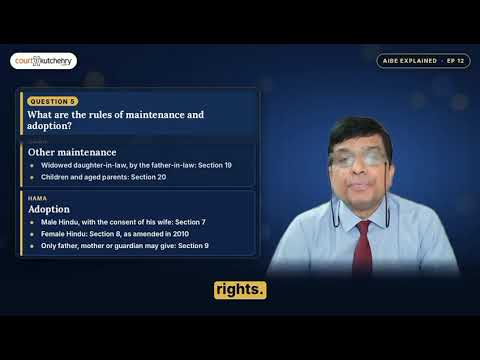
Watch the Video
In this 11-minute video, Episode 12 of the CourtKutchehry series “AIBE Explained” and Part 1 of Family Law, the episode covers Hindu law in seven questions, across the Hindu Marriage Act, the Hindu Succession Act, the Hindu Minority and Guardianship Act and the Hindu Adoptions and Maintenance Act, and then solves five practice questions. This article explains each point in writing.
Eight Marks from Family Law
Family Law carries 8 marks in the AIBE, and in most papers five or six of those questions come from the four Hindu law statutes of 1955 and 1956: the Hindu Marriage Act, 1955 (HMA), the Hindu Succession Act, 1956 (HSA), the Hindu Minority and Guardianship Act, 1956 (HMGA) and the Hindu Adoptions and Maintenance Act, 1956 (HAMA). The episode covers them in seven questions and then solves five practice questions.
Q1. Who Is a Hindu for These Acts?
Under Section 2 of the HMA (and the matching sections of the other Acts), the Acts apply to:
- a Hindu by religion in any of its forms, including a Virashaiva, a Lingayat or a follower of the Brahmo, Prarthana or Arya Samaj;
- a Buddhist, Jaina or Sikh by religion; and
- any other person who is not a Muslim, Christian, Parsi or Jew by religion, unless it is proved that he would not have been governed by Hindu law.
Under Section 2(2), it does not apply to Scheduled Tribes unless the Central Government so notifies.
Q2. Conditions of a Valid Hindu Marriage
Section 5 lays down the conditions:
- Monogamy: neither party has a spouse living.
- Capacity: neither party is incapable of valid consent due to unsoundness of mind, or suffering from mental disorder of a kind that makes them unfit for marriage.
- Age: the bridegroom has completed 21 years and the bride 18 years.
- The parties are not within the degrees of prohibited relationship,
- and are not sapindas of each other, unless custom or usage permits.
Under Section 7, a marriage may be solemnised according to the customary rites of either party; where the rites include saptapadi, the marriage is complete and binding when the seventh step is taken. Under Section 8, registration is for the purpose of proof; failure to register does not affect the validity of the marriage.
Q3. Void and Voidable Marriages
- Void marriage (Section 11): in breach of monogamy, prohibited degrees or sapinda relationship. It is a nullity from the start.
- Voidable marriage (Section 12): non-consummation owing to impotence, the capacity conditions, consent obtained by force or fraud, or the wife pregnant by another man at the time of marriage. It is valid until annulled.
- Bigamy (Section 17): a second marriage while a spouse is living is void and punishable, now read with the bigamy provision of the BNS.
- Section 18: punishment for contravening certain conditions of Section 5, including the age condition.
A classic trap: a marriage violating the age condition is neither void nor voidable under the HMA; it is only punishable under Section 18.
Remember this line: under-age marriage under the HMA is punishable, not void.
Q4. Matrimonial Remedies
| Remedy | Section |
|---|---|
| Restitution of conjugal rights | 9 |
| Judicial separation | 10 |
| Divorce; wife’s additional grounds | 13; 13(2) |
| Divorce by mutual consent | 13B |
| No petition within one year of marriage, ordinarily | 14 |
| Maintenance pendente lite and expenses | 24 |
| Permanent alimony | 25 |
| Custody of children | 26 |
For mutual consent divorce, the parties must have lived apart for a year; the second motion comes between 6 and 18 months after the first petition.
Three cases are essential here:
- Saroj Rani v. Sudarshan Kumar Chadha, (1984) 08 SC CK 0037: the Supreme Court upheld the constitutional validity of Section 9, restitution of conjugal rights.
- Amardeep Singh v. Harveen Kaur, (2017) 09 SC CK 0030: the six-month waiting period under Section 13B(2) is directory, not mandatory, and the court may waive it in a fit case.
- Shilpa Sailesh v. Varun Sreenivasan, (2023) 05 SC CK 0001: a Constitution Bench held that the Supreme Court may, under Article 142, dissolve a marriage on the ground of irretrievable breakdown, and may dispense with the six-month period.
Q5. Maintenance and Adoption under HAMA
Maintenance
- Section 18: a Hindu wife is entitled to be maintained by her husband during her lifetime, and may live separately on grounds such as desertion or cruelty.
- Section 19: a widowed daughter-in-law may claim maintenance from her father-in-law, in the circumstances the section lays down.
- Section 20: children and aged or infirm parents.
Adoption
- Section 11: where a male adopts a female, or a female adopts a male, there must be an age difference of at least 21 years.
- Section 15: a valid adoption cannot be cancelled by the adoptive parents, nor can the adopted child renounce it and return to the birth family.
Q6. Succession under the Hindu Succession Act
- Section 8: the property of a male Hindu dying intestate goes first to the Class I heirs, who take simultaneously. The mother is a Class I heir; the father is a Class II heir.
- Section 6: after the 2005 amendment, a daughter is a coparcener by birth, with the same rights and liabilities as a son.
- Section 14: property possessed by a female Hindu is held by her as full owner; a limited estate becomes absolute.
- Section 15: succession to a female Hindu dying intestate.
- Section 30: a Hindu may dispose of property, including a coparcenary interest, by will.
In Vineeta Sharma v. Rakesh Sharma, a three-judge Bench held that the daughter’s right under amended Section 6 arises by birth, and it does not matter whether her father was alive on the date of the 2005 amendment.
Q7. Natural Guardian of a Hindu Minor
Under HMGA Section 6, the natural guardian of a Hindu minor boy or unmarried girl is the father, and after him, the mother. The custody of a child below five years shall ordinarily be with the mother.
In Githa Hariharan v. Reserve Bank of India, (1999) 02 SC CK 0013, the Supreme Court read “after” to mean “in the absence of”, so that the mother can act as natural guardian even during the father’s lifetime where he is absent or uninterested.
- Section 8: a natural guardian cannot sell, mortgage or gift the minor’s immovable property without the permission of the court.
- Section 13: the welfare of the minor is the paramount consideration in appointing a guardian.
AIBE Practice Questions
The video ends with five practice questions. Try these:
- When is a Hindu marriage complete where the rites include saptapadi? Answer: on the seventh step, Section 7 HMA.
- Which section of the HMA provides for divorce by mutual consent? Answer: Section 13B.
- Is the father a Class I heir of a male Hindu? Answer: No, he is a Class II heir.
Key Takeaways
- Age of marriage: 21 and 18 (Section 5); marriage complete on the seventh step (Section 7); registration only proves it (Section 8).
- Void: Section 11; voidable: Section 12; under-age marriage is punishable, not void (Section 18).
- Remedies: Sections 9, 10, 13, 13B, 14, 24, 25, 26; the 13B waiting period may be waived (Amardeep Singh, Shilpa Sailesh).
- HAMA: wife’s maintenance Section 18, adoption age gap Section 11, adoption cannot be cancelled Section 15.
- HSA: mother Class I, father Class II (Section 8); daughter a coparcener by birth (Section 6, Vineeta Sharma); HMGA natural guardian Section 6 (Githa Hariharan).
Frequently Asked Questions
Is an unregistered Hindu marriage valid?
Yes. Under Section 8 of the HMA, registration only proves the marriage; failure to register does not affect validity.
Can the six-month period for mutual consent divorce be waived?
Yes. Amardeep Singh v. Harveen Kaur held that it is directory and may be waived in a fit case, and Shilpa Sailesh v. Varun Sreenivasan held that the Supreme Court may dispense with it under Article 142.
Is a daughter a coparcener even if her father died before 2005?
Yes. Vineeta Sharma v. Rakesh Sharma held that the right arises by birth and does not depend on the father being alive on the date of the amendment.
Can a valid adoption be cancelled?
No. Under Section 15 of HAMA, neither the adoptive parents nor the child can cancel it.
With whom does custody of a child below five ordinarily remain?
With the mother, under the proviso to Section 6 of the HMGA.
Where can I watch the full explanation?
Watch the full explanation in 11 minutes: https://youtu.be/74MSG3ThFVU.
Conclusion
Hindu law is the most reliable source of Family Law marks. The questions turn on a few numbers: the conditions in Section 5, the seventh step in Section 7, the remedies from Section 9 to Section 26, the HAMA sections on maintenance and adoption, the Class I heirs and daughters’ coparcenary rights under the HSA, and the natural guardian under the HMGA.
The next episode completes Family Law with Muslim law, the Special Marriage Act, the Guardians and Wards Act and the Indian Succession Act.
▶ Watch the video: Hindu Law for AIBE: Marriage, Divorce, Maintenance, Adoption, | Family Law Part 1 | Ep 12
📖 Read more: Tribal Couple, Hindu Rites: Rajasthan High Court Grants Mutual-Consent Divorce Under the Hindu Marriage Act
Research Judgments Like These on CourtKutchehry
Every judgment cited in this article, and lakhs more, can be searched and read on CourtKutchehry. Searching and reading judgments is free. A membership adds unlimited summaries, all related judgments, original court PDF downloads, bookmarks, notes and the CourtKutchehry AI assistant.
| Membership | Price | Works out to | AI credits |
|---|---|---|---|
| Monthly (1 month) | ₹599 | ₹599 / month | 1,000 / month |
| Quarterly (3 months) · Save 16% | ₹1,499 | ₹499.67 / month | 1,100 / month |
| Six-monthly (6 months) · Save 33% | ₹2,399 | ₹399.83 / month | 1,200 / month |
| Yearly (12 months) · Save 44% · Best value | ₹3,999 | ₹333.25 / month | 1,300 / month |
Every plan is a one-off purchase for a fixed period: nothing auto-renews and no card is kept on file. Prices are exclusive of applicable tax, which is added at checkout. Extra AI chat credits can be topped up from ₹99. A free verified account gets 5 summaries and 50 AI trial credits.
Prices are as displayed on courtkutchehry.com on 20 November 2026 and are subject to change without notice. Please check the pricing page for the current plans and offers.
For more judgments, legal opinions and case analysis, visit courtkutchehry.com
Visit CourtKutchehry →